
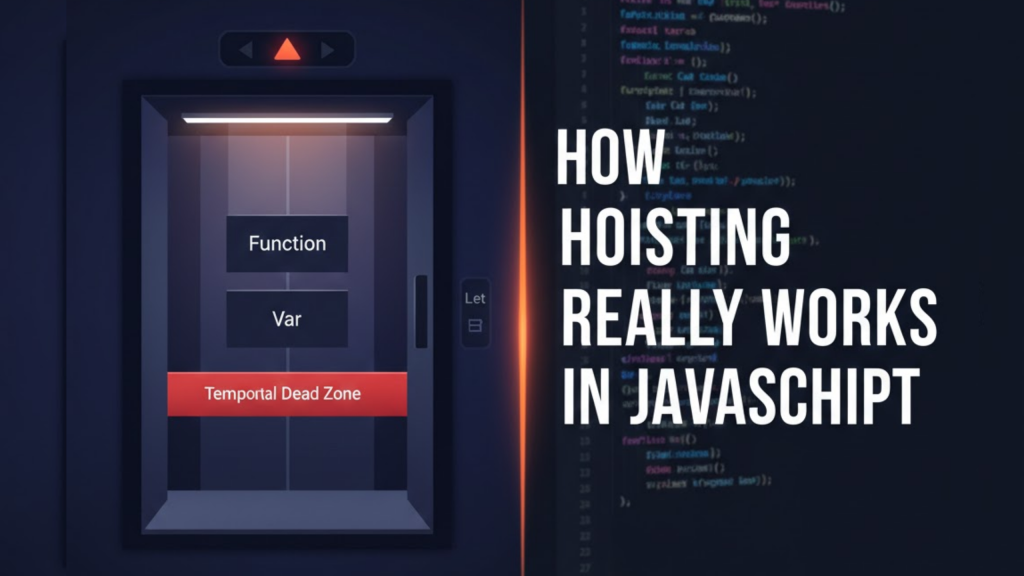
If you have ever used a variable or called a function before you actually defined it in your code, you have witnessed a phenomenon called hoisting. In 2026, understanding How Hoisting Really Works in JavaScript is the key to mastering the “behind the scenes” mechanics of the engine. While it looks like your code is moving around, the truth is actually much more logical.
At WeBlogTrips, we believe in technical accuracy. Consequently, we created this guide to explain How Hoisting Really Works in JavaScript so you can write predictable, bug-free applications.
Visual Breakdown: How Hoisting Really Works in JavaScript
| Feature | Hoisted? | Initialized Value | Result of Early Access |
| Function Declaration | Yes | The full function | Works perfectly |
| var Variable | Yes | undefined | Returns undefined |
| let / const | Yes (Technically) | Uninitialized | ReferenceError |
| Class | Yes (Technically) | Uninitialized | ReferenceError |
1. The Creation Phase: How Hoisting Really Works in JavaScript Internally
To understand How Hoisting Really Works in JavaScript, you must know that the engine reads your code twice. During the “Creation Phase,” the engine scans your script and sets aside memory for all your variables and functions.
It does not actually “move” your code to the top of the file. Instead, it simply stores the declarations in memory. This phase is exactly How Hoisting Really Works in JavaScript: the engine prepares the “blueprint” before it starts executing the first line of code.
2. Hoisting with var vs let and const
The biggest point of confusion regarding How Hoisting Really Works in JavaScript is the difference between variable types. When you use var, the engine initializes it as undefined. This is why you can log a var before its definition without the app crashing.
However, let and const are handled differently. While they are technically hoisted, they stay in a “Temporal Dead Zone” (TDZ). If you try to access them before the engine reaches their declaration, the browser throws a ReferenceError. This protective behavior is a vital part of How Hoisting Really Works in JavaScript in modern versions.
3. Function Hoisting: The “Superpower”
When discussing How Hoisting Really Works in JavaScript, function declarations are the true winners. Because the engine stores the entire function body during the creation phase, you can call a function at the very top of your script even if it is defined at the very bottom.
Be careful, though: Function Expressions (functions assigned to a variable) follow variable hoisting rules. If you assign a function to a const, you cannot call it early. This distinction is a frequent “gotcha” when learning How Hoisting Really Works in JavaScript.
Frequently Asked Questions (FAQ)
1. Is hoisting considered a bad practice?
Hoisting is a natural part of the language, not a bug. However, relying on it too much can make your code hard to read. Most developers prefer to define their variables and functions at the top of their scope to avoid the confusion of How Hoisting Really Works in JavaScript.
2. Does “use strict” affect hoisting?
Yes. Using Strict Mode doesn’t stop hoisting, but it prevents some of the silent errors that happen with var. This helps you catch bugs related to How Hoisting Really Works in JavaScript much faster.
3. Why does my code trigger an Apple Security Warning?
If hoisting issues cause a critical security variable to be undefined when your script runs, you might trigger an Apple Security Warning on your iPhone. Always initialize your security settings immediately to ensure the logic of How Hoisting Really Works in JavaScript doesn’t leave your app vulnerable.
Final Verdict: How Hoisting Really Works in JavaScript
To recap the core of How Hoisting Really Works in JavaScript:
- Functions are fully hoisted and usable anywhere in their scope.
- var is hoisted as
undefined, which often causes logic bugs. - let and const are hoisted but remain in the Temporal Dead Zone until declared.
By understanding these phases, you gain full control over your code’s lifecycle and avoid the most common “undefined” errors in development.
More From Weblogtrips
- Shallow Copy vs Deep Copy in JavaScript: 2026 Comparison
- Common JavaScript Memory Leaks: Why holding onto old references can crash your app.
- let vs var vs const Explained with Real Examples: Why declaration type changes hoisting behavior.
- Why Your Website Is Slow and How to Fix It: See how event bloat contributes to slow sites.
- Why JavaScript Is Single-Threaded: How the engine manages its two-phase execution.
- Promise vs async/await: What Actually Happens?: How orders move through the kitchen.
- JavaScript Closures Explained Like You’re 5: How memory is preserved during async suspension.
- Why Your Website Is Slow and How to Fix It: CDNs are the #1 fix for global slowness.
- REST API vs GraphQL Explained for Beginners: APIs are where most CORS errors live.
- Best Website Hosting 2026: Find hosts with integrated CDN features.
- HTML vs HTML5: What’s the Real Difference?: The foundation that holds your CSS.
- Frontend vs Backend vs Full Stack 2026 Guide: Why React mastery is essential for frontend roles.
External Links
- MDN: Hoisting: The official technical glossary for hoisting.
- W3Schools: JavaScript Hoisting: Simple code examples for quick reference.
- JavaScript.info: Variable Scope & Closure: A deep dive into the environment records.