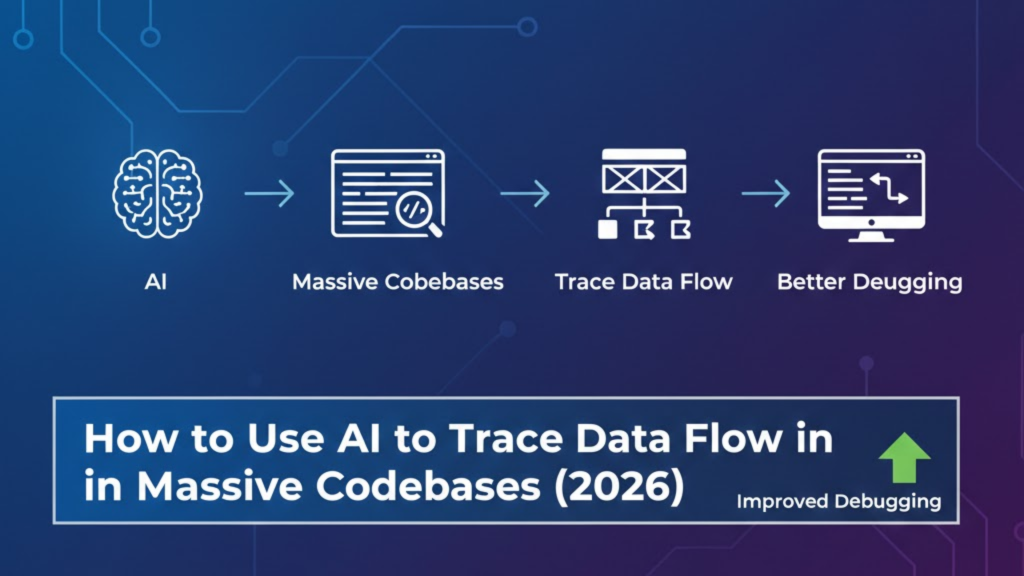
How do you map a million-line codebase without losing your mind? In 2026, manual code auditing is a thing of the past. Using an AI-powered data flow analysis strategy allows you to trace sensitive information—from a user’s input in the frontend to its final rest in a microservice database, in seconds. By implementing Agentic Tracing, developers are reducing context-gathering time from three-hour archaeology sessions to 20-minute focused reviews.
If you are still using “Find All References” to track a variable across 50 files, you are operating in the stone age. It is time to let AI orchestrate your digital archaeology.
Comparison: Manual Tracing vs. AI-Agentic Tracing
| Feature | Manual Search (⌘-Shift-F) | AI-Agentic Tracing (2026) |
| Speed | Hours (Mental mapping) | Minutes (Auto-generated graphs) |
| Context | Single-file focus | Repo-wide understanding |
| Impact Analysis | Guesswork | Predictive Regression Alerts |
| Legacy Code | Requires domain experts | Self-documenting agents |
| Security | Reactive (Find bugs later) | Proactive (Data flow modeling) |
3 Steps to Trace Data Flow with AI Agents
To map a massive codebase, you don’t just “ask a chatbot.” Instead, you must build a Multi-Agent Orchestration workflow.
1. Feed the Semantic Index
Modern 2026 IDEs like Cursor or Google Antigravity don’t just “read” your files; they index them semantically.
- The Strategy: Use a tool that maintains a persistent “Project Knowledge Graph.”
- The Result: The AI doesn’t just look for the string
userId; it understands thatuserIdin the Auth service is the same entity asowner_idin the Database layer.
2. Run an “Impact Analysis” Prompt
Instead of manual tracing, use Reasoning-capable models (like Claude 4.5 or Gemini 2.0) to perform a “Dry Run” of a change.
- The Prompt: “I want to change the ‘UserEmail’ type from string to a custom EmailObject. Trace every serialization path across all microservices and flag where this JSON schema might break”.
- The Result: The agent scans downstream services, API contracts, and DTOs, giving you a list of every file that needs an update.
3. Generate a Visual Data Lineage
In 2026, the best tools convert text-based code into Interactive Flowcharts.
- The Tool: Use agents like Windsurf’s Cascade or Codeium to generate a Mermaid.js diagram of your data’s lifecycle.
- The Benefit: Seeing the “vibe” of the data flow helps you spot architectural bottlenecks or security “sinks” where data is being logged insecurely.
Frequently Asked Questions (FAQ)
1. Is AI tracing safe for proprietary code?
Yes. In 2026, many enterprise AI tools (like Tabnine or Augment Code) offer on-premises deployment or “Zero-Data Retention” policies. Therefore, your proprietary data flow stays within your firewall.
2. Can AI handle “Spaghetti Code” with no documentation?
Actually, this is where AI shines. AI agents are specifically trained to recognize patterns in messy, legacy codebases. They can “hallucinate” the missing documentation by inferring intent from how the data is used.
3. What is the “Microservices Moment” in AI?
This refers to a 2026 trend where we move from one big “God Agent” to multiple specialized agents (e.g., a “Security Agent” and a “Refactor Agent”) that work together to map complex, distributed systems.
4. How does AI help with data privacy (GDPR)?
AI-powered tracing can automatically flag “PII” (Personally Identifiable Information) as it moves through your system. If a user’s email is suddenly passed to an unencrypted logging service, the AI flags the compliance risk immediately.
5. Does this replace manual code reviews?
No. While AI handles the 90% boilerplate of tracing, humans are still needed to verify the “edge cases” and make final architectural decisions. You move from being a “tracer” to an “orchestrator”.
6. Why do I see an Apple Security Warning on my IDE?
If your AI coding agent (like Goose or Aider) attempts to execute terminal commands or modify system-level files without explicit permission, it may trigger an Apple Security Warning on your iPhone or Mac. Always audit “Write” permissions.
7. What are the best models for large context windows?
In 2026, Gemini 2.0 Pro and Claude 4.6 are the leaders, supporting contexts of over 10 million tokens. This allows you to feed an entire monorepo into the AI’s “short-term memory” for instant analysis.
8. Can AI generate unit tests for the data flow?
Absolutely. Once the AI understands the data path, it can automatically generate integration tests that mock the entire flow, ensuring that future changes don’t break the contract between services.
Final Verdict: Digital Archaeology for the Modern Dev
Using AI to trace data flow in massive codebases is the only way to maintain velocity in 2026. By automating the mental “grunt work” of dependency mapping, you free your brain to focus on building the next big thing.
Ready to automate more? Learn how to build your own engine in our guide on Using LLM APIs to Automate Your Content Generation or master the latest UI patterns in Prompt Engineering for Web Developers.
External Links
- Augment Code: The Guide to Large Codebases – Exploring repository-wide understanding.
- Cortex: AI Developer Tool Buyer’s Guide 2026 – Choosing the right AI stack for your enterprise.
- Black Duck: AI Security Trends 2026 – How AI-driven vulnerability scanning protects your data.
- Securiti: AI Data Mapping & Governance – Mastering data lineage for compliance.
Next Step: You’ve mapped your data flow. Ready to secure those entry points? Let’s move to “The Developer’s Guide to AI Security and Prompt Injection in 2026”. Shall we proceed?