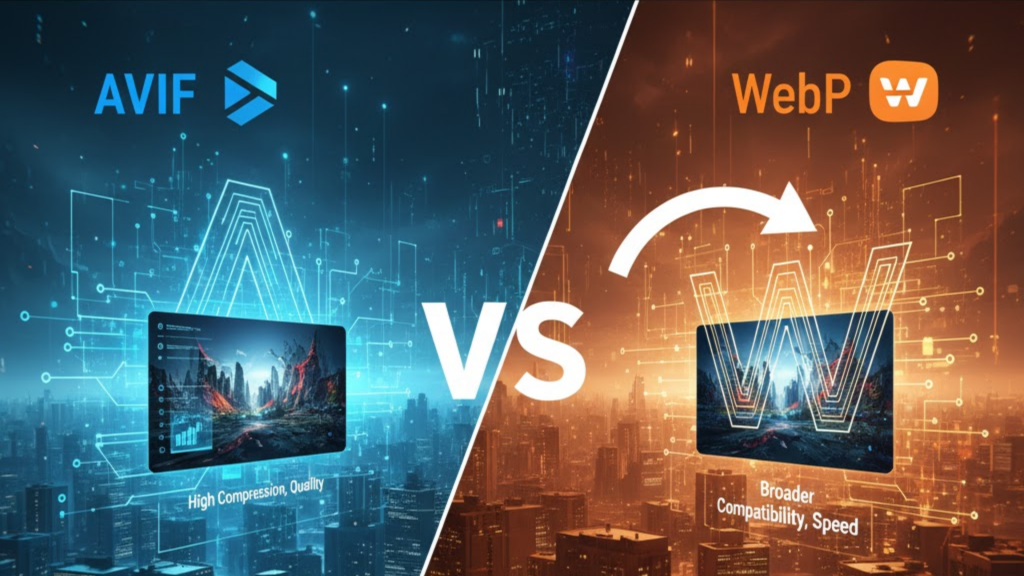
What is the best image format for 2026? The definitive choice is AVIF for high-quality photographs and WebP for general UI and legacy compatibility. In 2026, AVIF has become the “Compression King,” offering file sizes up to 20% to 30% smaller than WebP and 50% smaller than JPEG at equivalent quality. However, WebP remains the “Reliable Standard” because it boasts 99% browser support and faster decoding speeds on low-power mobile devices.
By implementing a multi-format strategy, you can deliver the highest possible quality to modern users while maintaining a “safety net” for older hardware.
Technical Showdown: AVIF vs. WebP (2026)
In 2026, the industry has shifted toward HDR (High Dynamic Range) and wide color gamuts. AVIF handles this modern demand natively, whereas WebP is increasingly showing its age in professional photography contexts.
| Feature | WebP (The Baseline) | AVIF (The Performance Choice) |
| Compression Tech | VP8 (Video-based) | AV1 (Next-Gen Video-based) |
| File Size (vs JPEG) | 25% – 35% Smaller | 45% – 60% Smaller |
| Color Depth | 8-bit only | 10-bit & 12-bit (HDR support) |
| Decoding Speed | Very Fast | Slower (CPU Intensive) |
| Browser Support | ~99% (Universal) | ~95% (Excellent) |
| Best Use Case | Logos, Icons, UI | Hero banners, Large photos |
3 Reasons Why AVIF Dominates SEO in 2026
To hit your growth targets, your site must satisfy Google’s 2026 Core Web Vitals, specifically Largest Contentful Paint (LCP).
1. Superior “Hero” Performance
AVIF excels at compressing large “Hero” images. Because AVIF images are significantly smaller than WebP, they download faster over mobile 5G connections. This directly improves your LCP score, which Google uses as a primary ranking factor.+1
2. Crawl Budget Efficiency
Smaller files mean less bandwidth consumption for search engine bots. In 2026, Google explicitly rewards fast-loading sites by crawling more of their pages. By reducing your image payload with AVIF, you effectively increase your crawl budget, ensuring your new content is indexed faster.
3. Visual Search & Google Lens
Google Lens queries are growing at 30% annually. High-fidelity AVIF images retain more detail in shadows and highlights without adding weight. This clarity helps AI models identify your products more accurately, placing you at the top of visual search results.+1
Frequently Asked Questions (FAQ)
1. Does AVIF replace WebP entirely?
No. WebP is still superior for lossless images (like logos) and simpler graphics. In 2026, the best practice is to serve AVIF to modern browsers and use WebP as a fallback.+1
2. Is AVIF supported on social media?
Support is mixed. While Facebook and Pinterest support AVIF in 2026, platforms like LinkedIn and X (formerly Twitter) still prefer WebP or JPEG. Always use a CDN that can auto-convert based on the destination.
3. Does AVIF support transparency and animation?
Yes. Like WebP, AVIF supports both alpha-channel transparency and animation. In fact, AVIF animations (AVIS) are much smaller and higher quality than animated GIFs or WebPs.
4. Why do I see an Apple Security Warning during image upload?
If your image optimization plugin attempts to run local processing on your Mac or iPhone without proper sandboxing, you may trigger an Apple Security Warning on your iPhone.
5. What is the downside of AVIF?
The main downside is encoding time. Generating an AVIF file takes more CPU power than a WebP. If you are a high-volume site (e.g., a news outlet), you may need a dedicated image server or CDN to handle the load.+1
6. Can I use AVIF in WordPress 2026?
Yes. WordPress has native AVIF support. You can simply upload your images, and the media library will handle them. However, for the best performance, use a plugin like ShortPixel to manage fallbacks.
7. What about JPEG XL?
JPEG XL is a powerful competitor to AVIF, but as of early 2026, browser support remains inconsistent. Stick with AVIF for web delivery and use JPEG XL for archival or high-end photography niches.
8. How do I implement the fallback?
Use the HTML <picture> tag:
HTML
<picture>
  <source srcset="image.avif" type="image/avif">
  <source srcset="image.webp" type="image/webp">
  <img src="image.jpg" alt="Description">
</picture>
This ensures the browser always picks the best format it can handle.
Final Verdict: The Tiered Strategy
In 2026, the winning image strategy is: AVIF for speed, WebP for safety, and JPEG for history. By optimizing your format selection, you reduce bounce rates and ensure your content shines in the competitive visual search landscape.
Ready to optimize your site? Learn how to integrate these formats into your Automated Content Generation Pipeline or explore the Top Dev Skills Needed to Shine in 2026.
Authority Resources
- ShortPixel: AVIF vs WebP – 2026 Comparison – Technical benchmarks on compression and quality.
- Cloudinary: Choosing the Right Format for 2026 – Strategic guide for media-heavy applications.
- Digital Applied: Image SEO 2026 Trends – How format selection impacts Google Images and Lens.
- MDN Web Docs: Image File Type and Format Guide – Official developer standard for modern browsers.