What is WebXR in 2026?
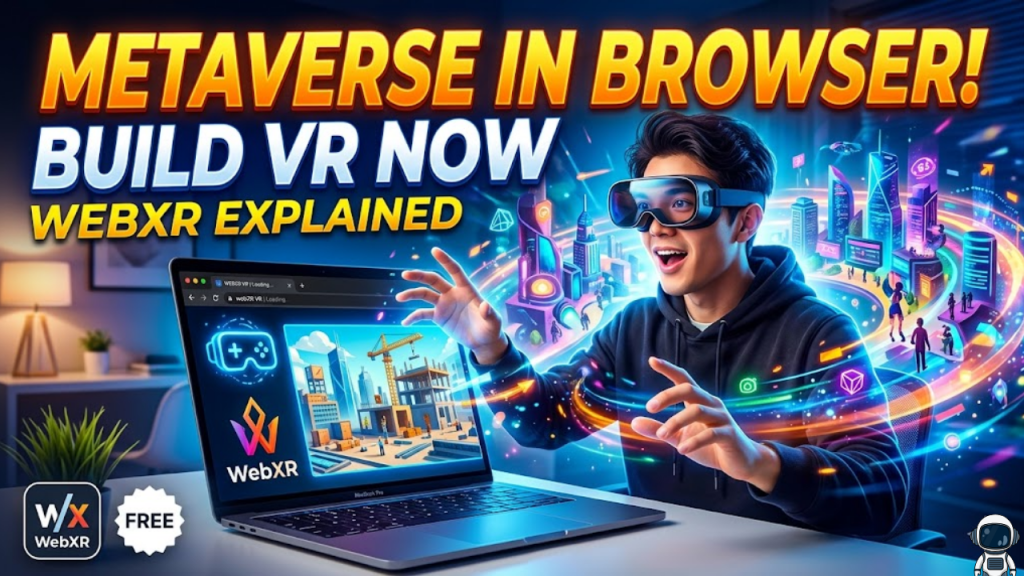
WebXR is the open standard API that allows web browsers to deliver immersive Virtual Reality (VR) and Augmented Reality (AR) content without requiring any downloads. In 2026, it has become the “OS of the Metaverse.” Unlike native apps that are locked to specific stores, WebXR experiences are simply URLs. Consequently, they democratize the spatial web, allowing anyone with a headset or a smartphone to enter a shared 3D world instantly.
By leveraging WebXR, you aren’t just building a website; you are architecting a “Spatial Destination” that lives on the open web.
3 Pillars of a High-Performance WebXR Scene
In 2026, building for the browser requires a strict focus on latency and asset management to maintain immersion.
1. The Sub-20ms Latency Rule
In VR, if the delay between a user’s head movement and the visual update exceeds 20 milliseconds, it causes “Sim Sickness.”
- The 2026 Strategy: Use WebGPU for rendering whenever possible. It offloads complex shaders to the GPU much more efficiently than WebGL, ensuring your frame rates stay at a rock-solid 90Hz or 120Hz even in complex environments.
2. Multi-Modal Input (Gaze, Pinch, and Hands)
2026 hardware has moved beyond plastic controllers.
- The Implementation: Your code must support the WebXR Hand Input Module. On devices like the Apple Vision Pro, users interact via “Gaze and Pinch” (Transient Pointers), while Quest 3 users might use full hand tracking. Therefore, you must build “input-agnostic” interfaces that work regardless of the hardware.
3. Spatial UI and “UIKitML”
Traditional 2D menus do not work in 3D space.
- The Implementation: Use Spatial UI frameworks (like UIKit for Three.js) to create interfaces that exist as physical objects in the world. In 2026, we use “Z-index” for depth rather than just layering, allowing menus to float at a comfortable reading distance for the user.
The Tech Stack: Three.js and the Immersive Web SDK
Building the Metaverse is now more approachable thanks to high-level abstractions.
- Three.js: The industry standard for 3D web logic. It handles the “Scene Graph,” lighting, and cameras.
- Immersive Web SDK (IWSDK): A 2026 favorite that provides pre-built systems for Locomotion (teleporting), Grab Interactions, and Spatial Audio. This allows you to focus on the “Vibe” and “Story” instead of reinventing the physics of 3D space.
Frequently Asked Questions (FAQ)
1. Do I need a VR headset to develop for the Metaverse?
No. In 2026, developers use the Immersive Web Emulator (a browser extension). It allows you to simulate headsets and controllers directly on your 2D monitor, though you should always perform a final “Vibe Check” on real hardware before launching.
2. Is WebXR as powerful as Unity or Unreal?
Not for “AAA” gaming. However, for 90% of business use cases, like Virtual Showrooms, Education, and Meetings, WebXR is superior because it has zero friction and lower development costs.
3. How do I enable WebXR on Apple Vision Pro?
While visionOS 2+ has it enabled by default, some experimental features still require you to toggle the WebXR Device API and Hand Input Module in the Safari “Advanced” settings menu.
4. Why do I see an Apple Security Warning on my VR site?
Browsers require a Secure Context (HTTPS) to access XR sensors. If you try to test on a local network without SSL, you may trigger an Apple Security Warning on your iPhone or headset.
5. What is “Passthrough” in WebXR?
Passthrough (or immersive-ar mode) allows the user to see the real world while your 3D objects are overlaid on top. This “Mixed Reality” mode is the fastest-growing segment of the immersive web in 2026.
6. Can I build a multiplayer Metaverse on the web?
Yes. By pairing WebXR with WebSockets or WebRTC, you can create shared spaces where users appear as 3D avatars and can talk to each other via spatial audio.
7. Does WebXR work on Android?
Yes. Chrome on Android supports WebXR with full “Depth Sensing” and “Hit Testing,” allowing you to place virtual objects on real-world floors and tables using just a phone camera.
8. What is “foveated rendering”?
It is a 2026 performance trick where the browser only renders the area the user is looking at in high resolution. This saves up to 40% of GPU power, allowing for much more detailed environments in WebXR.
Final Verdict: The Web is No Longer Flat
In 2026, the browser is the gateway to the Metaverse. By mastering WebXR and Three.js, you move beyond the “2D screen” and begin building the Spatial Web. For businesses, this means higher engagement and zero friction; for you, it means a seat at the table of the next computing revolution.
Ready to build your first world? Explore our guide on Using WebGL and Three.js for 3D Showcases or learn how to optimize your performance in The Impact of WebAssembly (Wasm) on Browser Performance.
Authority Resources
- Meta Horizon: Immersive Web SDK Overview – The 2026 standard for high-performance WebXR development.
- Unity Blog: 5 Immersive Tech Trends for 2026 – Understanding the shift toward virtual-first engineering.
- Three.js Resources: Best VR Headsets for Developers – A guide to hardware compatibility and feature support.
- W3C: WebXR Device API Specification – The official technical standard for the immersive web.