What is AI-Driven Threat Detection in 2026?
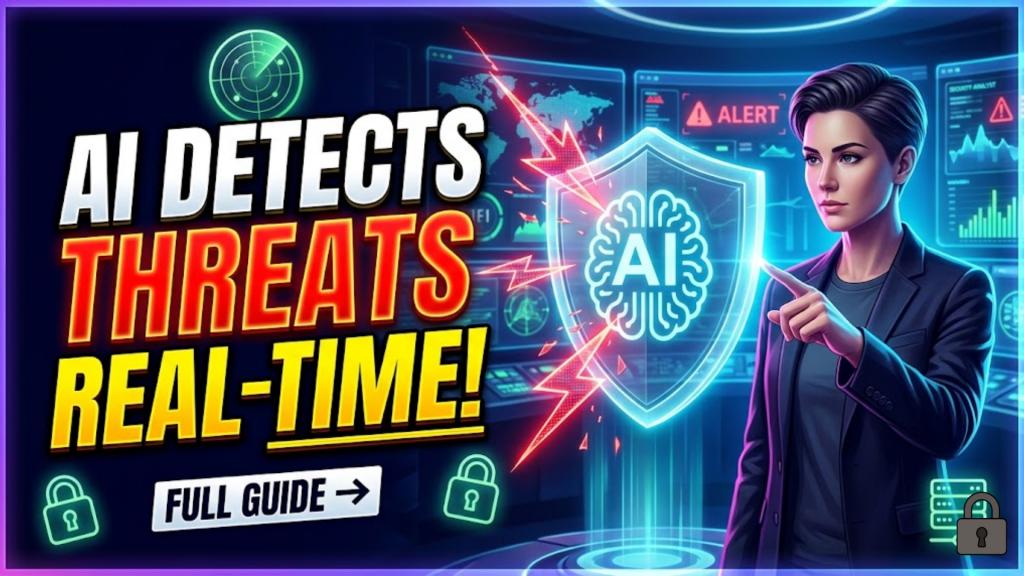
It is a shift from “Signature-Based” (looking for known viruses) to “Behavior-Based” (looking for weird activity). In 2026, AI agents continuously scan your network, endpoints, and cloud logs. They don’t wait for a human to see an alert; instead, they use Agentic AI to autonomously “hunt” for anomalies, like a user logging in from a new device while simultaneously exfiltrating 5GB of data, and neutralize the threat before it can spread.
In 2026, the goal isn’t just to build a better wall; it is to ensure your system can out-think and out-act the attacker in real time.
The 2026 Breakthrough: Agentic AI vs. Traditional Rules
In 2026, traditional Security Information and Event Management (SIEM) systems are being replaced by Agentic SOCs. These systems don’t just alert; they act.
| Feature | Traditional SIEM (Manual) | AI-Driven Automation (2026) |
| Detection Method | Static Signatures/Rules | Self-Learning Behavioral Models |
| Response Time | Minutes to Hours (Human) | Milliseconds to Seconds (Autonomous) |
| Zero-Day Defense | Fails (No signature yet) | Succeeds (Detects “weird” intent) |
| Alert Fatigue | High (Thousands of false positives) | Low (AI correlates & triages alerts) |
| Scalability | Limited by human staff | Infinite (Handles 31+ Tbps baselines) |
3 Pillars of AI Automation for Web Apps
To implement real-time detection in your 2026 projects, you must focus on these three automated layers:
1. Adaptive WAF (Web Application Firewall)
Traditional WAFs use “Regex” to block simple SQL injections. In 2026, AI-driven WAFs (like Cloudflare’s 2026 Threat Shield) analyze the intent of the request. They can detect Indirect Prompt Injection in your AI features or polymorphic malware that rewrites its own code to bypass static filters.
2. Autonomous Incident Response (SOAR)
When a threat is detected, the AI executes an automated “Playbook.”
- Containment: If a user’s session token is stolen (a major 2026 trend), the AI instantly invalidates that token and triggers a mandatory biometric re-auth across all devices.
- Quarantine: If a server begins making unusual outbound connections, the AI places that container in a “Sandbox” for immediate analysis by a senior engineer.
3. Predictive Threat Forecasting
Instead of just looking at what is happening, 2026 systems use Forecasting Agents. These agents monitor the Dark Web and global telemetry to predict which of your specific APIs are likely to be targeted next based on emerging exploit trends in your industry.
Frequently Asked Questions (FAQ)
1. Can AI replace my security team?
No. In 2026, the role has shifted from “Triage Analyst” to “AI Orchestrator.” AI handles the high-volume Tier-1 alerts, but you still need humans to handle the “Deep Logic” attacks and make final ethical decisions on system-wide shutdowns.
2. What are the best tools for beginners in 2026?
Aikido Security is a 2026 favorite for web developers because it integrates natively with GitHub and automatically prioritizes real risks. For enterprise-level autonomous defense, Darktrace and CrowdStrike Falcon remain the gold standards.
3. Is AI security expensive?
While enterprise tools are costly, many “DevSecOps” platforms now offer “AI-Native” tiers for smaller teams. These tools often pay for themselves by preventing a single breach, which costs an average of $4.8 million in 2026.
4. Why do I see an Apple Security Warning on my monitoring dashboard?
If your monitoring agent attempts to record high-resolution telemetry or intercepts encrypted system traffic without a verified certificate, you may trigger an Apple Security Warning on your iPhone or Mac.
5. What is “Polymorphic Malware”?
This is 2026 malware that uses AI to rewrite its own code every time it moves to a new machine. It has no fixed “signature,” making it invisible to traditional antivirus. Only Behavioral AI can catch it.
6. Does AI automation cause “False Positives”?
It can. The biggest risk in 2026 is “Over-Automation”, where an AI accidentally disconnects a mission-critical system because it misinterpreted a heavy but legitimate data load. You must use “Shadow Mode” to test your AI before giving it full autonomy.
7. What is the “EU AI Act” impact?
In 2026, “High-Risk” AI security systems must provide Explainability. You must be able to prove why the AI decided to block a specific user, or you could face massive regulatory fines.
8. How do I start with AI threat detection?
Start with Identity and Endpoint monitoring. These have the highest “Signal-to-Noise” ratio. Once you’ve tuned these, expand your AI’s scope to your Cloud Network and SaaS integrations.
Final Verdict: Fight AI with AI
In 2026, cybersecurity is an AI arms race. Attackers are already using agents to automate their reconnaissance and exploitation. To survive, your defense must be just as autonomous. By implementing Real-Time AI Detection, you ensure your systems are protected 24/7, even when no human is watching the screen.
Ready to harden your site? Explore our guide on Zero-Trust Architecture for Web Developers or learn how to secure your login flows in Why Passkeys are Replacing Passwords in 2026.
Authority Resources
- Cloudflare: 2026 Threat Report – Insights into the rise of agentic AI attackers and hyper-volumetric strikes.
- Black Duck: AI Security Trends 2026 – Expert predictions on the disruption of traditional vulnerability management.
- Cyble: Top 5 Breakthroughs in AI Threat Intelligence 2026 – How defenders are winning with agentic AI engines.
- Checkmarx: Best AI Cybersecurity Solutions 2026 – A deep dive into the top 9 AI tools for modern AppSec teams.