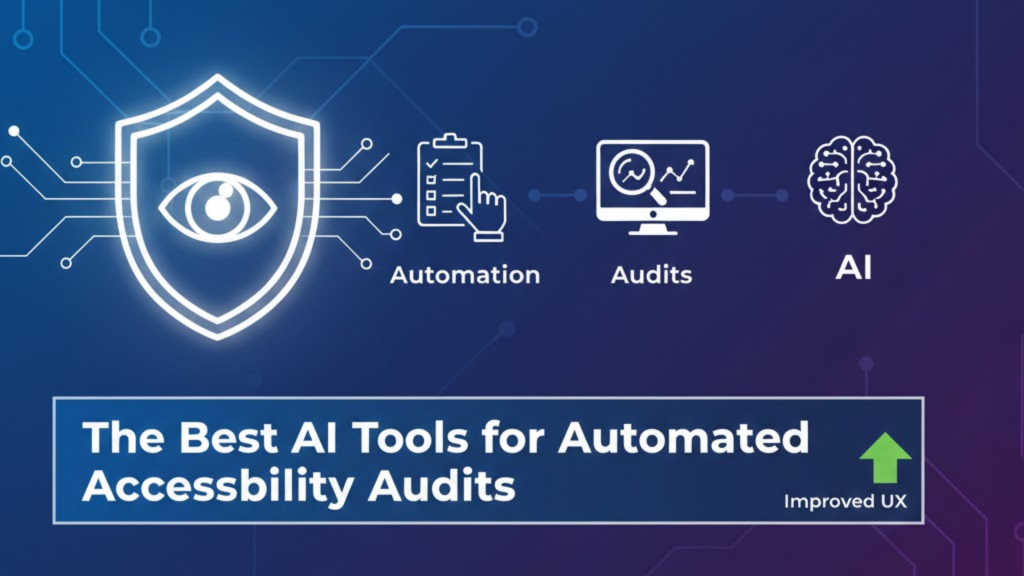
What exactly is an automated accessibility audit? An automated accessibility audit is a strategic software scan that uses AI and machine learning to detect violations of the Web Content Accessibility Guidelines (WCAG 2.2 and 3.0). In 2026, these tools have evolved into agentic assistants. They no longer just find issues like low color contrast or missing alt text; instead, they provide real-time code fixes and remediation roadmaps. Implementing these tools can reduce manual audit time by up to 20 hours per project, allowing your team to focus on complex user experience tasks.
Comparison: Top AI Accessibility Tools for 2026
The market for accessibility software has split into two main categories: tools that “Shift Left” into the design phase and those built for production monitoring. Choosing the right one depends on your specific development stage.
| Tool | Category | Best For | Key AI Feature |
| Axe DevTools | Developer SDK | Enterprise CI/CD | AI-powered Intelligent Guided Tests |
| UserWay | Managed Platform | Rapid Compliance | Autonomous “Fix-at-Source” agents |
| Uxia | Pre-Development | Design Validation | Scans Figma/Sketch frames before coding |
| Lighthouse | Browser Built-in | Quick Page Audits | Automated WCAG 2.2 scoring |
| Siteimprove | Unified Platform | Marketing Teams | Combined SEO and Accessibility insights |
How to build an AI-driven accessibility workflow?
An automated accessibility audit is not a one-time event. On the contrary, it is a continuous system. You should integrate these steps into your AI-First development pipeline to ensure your site stays compliant as it grows.
1. Audit the design before coding
You should not wait for the code to be written before checking for errors. Tools like Uxia or Stark use AI to analyze your Figma mockups. Because they can flag color contrast failures and typography issues early, you save hours of rework later in the cycle.
2. Automate the “low-hanging fruit”
Most accessibility lawsuits target simple, binary issues. For this reason, you should use Axe DevTools or Microsoft Accessibility Insights in your CI/CD pipeline. These tools can automatically block any code that includes:
- Images without
altattributes. - Forms without associated
<label>tags. - Buttons with insufficient color contrast.
3. Use AI remediation agents for instant fixes
When an audit fails, modern 2026 tools provide a “Detailed Technical Answer” agent. Instead of reading boring documentation, your developers receive a specific code snippet tailored to their actual React or Vue component. Consequently, they can fix the bug and push the update in minutes.
Does an automated accessibility audit help or hurt SEO?
In 2026, the answer is a resounding yes, it helps. In fact, accessibility and SEO are two sides of the same coin. Consider these three key benefits:
- Higher Ranking Signal: Research shows that websites with stronger accessibility scores consistently outperform others. This is because search engines view inclusive design as a hallmark of high-quality content.
- Better Semantic Structure: AI tools ensure your HTML is meaningful by using proper heading hierarchies (H1 through H6). This helps search engine crawlers index your content more accurately.
- Improved User Metrics: Accessible sites often load faster and have lower bounce rates. Since these are primary ranking signals, your accessibility work directly boosts your search visibility.
Frequently Asked Questions (FAQ)
1. Can AI tools ensure 100% WCAG compliance?
No. In 2026, even the best AI tools only catch about 30% to 50% of issues. Complex interactions like “keyboard traps” or the “logical reading order” still require human expert review.
2. Is it safe to use AI overlays for legal compliance?
Overlays are risky. While they provide quick “visual” fixes, they often fail to fix the underlying code. For this reason, many companies still face legal action despite using them.
3. What is the difference between WCAG 2.2 and 3.0?
WCAG 2.2 is the current legal standard in 2026. However, WCAG 3.0 is a next-generation “score-based” model (Bronze, Silver, Gold) that is expected to be finalized by 2028.
4. What is the best free accessibility tool for 2026?
Google Lighthouse and Microsoft Accessibility Insights remain the top free choices. They provide robust automated scans directly in your browser.
5. How does AI improve alt text generation?
Modern AI models use computer vision to “see” an image and generate context-aware alt text. For example, it can describe the specific action and emotion in a photo rather than just labeling objects.
6. Why do I see an Apple Security Warning on my site?
If your accessibility scanner injects unverified third-party scripts, it may trigger an Apple Security Warning on your iPhone. Always verify the scripts your tools use.
7. Can non-coders perform these accessibility audits?
Yes. Platforms like Siteimprove and UserWay provide visual dashboards and plain-English reports. Thus, marketing teams can monitor compliance without touching code.
8. How often should I run an automated accessibility audit?
Ideally, you should run these audits weekly. Since content and code change constantly, regular scans are the only way to prevent “accessibility drift”.
Final Verdict: The Hybrid Human-AI Model
An automated accessibility audit is the most efficient way to maintain a baseline of compliance in 2026. However, you must pair your AI tools with manual testing by real users to truly avoid lawsuits and provide a great experience.
Ready to build a more inclusive site? Explore our guide on Using LLM APIs to Automate Your Content or learn how to Scaffold Web Apps from Figma to see how AI is revolutionizing the development lifecycle.
External Links
- Accessible.org: New AI Advancements in 2026 – Insight into hybrid automation and manual review.
- Deque Systems: Axe DevTools Extension – Enterprise standards for automated testing.
- WebAIM: 2026 Predictions for Web Accessibility – Future shifts in native HTML and AI tools.
- Uxia: AI-Powered WCAG Checker – Shifting accessibility left into the design phase.