What is the Borderless Paradox?
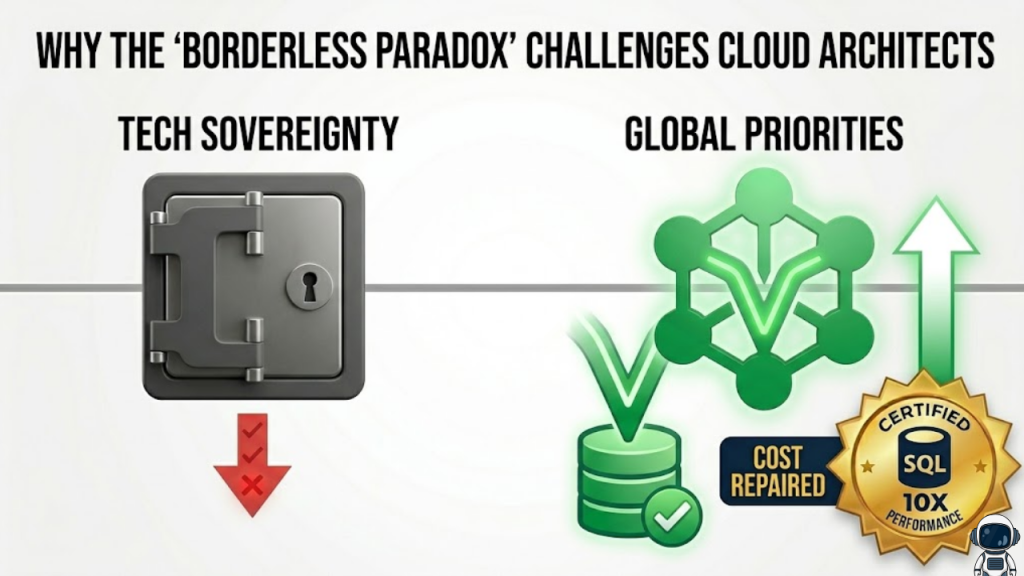
The Borderless Paradox is the 2026 architectural conflict where technology requires borderless collaboration to function (e.g., global AI training and distributed clouds), yet governments demand strict digital borders (e.g., data sovereignty and national firewalls). In 2026, tech sovereignty has moved from a policy concept to a strategic priority. You are now tasked with a seemingly impossible goal: designing systems that remain globally connected for performance but locally isolated for legal compliance.
This paradox forces architects to abandon the “Global Region” mindset of the 2010s and adopt a “Sovereign-by-Design” approach.
The Three Pillars of the Paradox (2026)
In 2026, the paradox manifests in three specific architectural friction points:
1. Interdependence vs. Independence
AI and Quantum systems thrive on shared data, code, and global hardware. However, nations now fear that “lending their keys” to foreign cloud giants risks economic sabotage or espionage. Consequently, you must build systems that are “Resiliently Interdependent”—using global tools but maintaining the “kill switch” to run entirely on local infrastructure if a geopolitical rift occurs.
2. Kinetic Threats to Intangible Assets
The “Cloud” is no longer an intangible entity. In 2026, AI data centers are high-value strategic targets. This shift has recalibrated cloud facilities from commercial real estate to National Infrastructure. As an architect, you must now consider “Physical Resilience” and “Bunkerization” alongside your traditional failover scripts.
3. Compliance vs. Innovation Speed
Regulatory forces (like the EU Data Act and Saudi Arabia’s National Firewalls) create a “Compliance Burden.” To stay competitive, you need the elasticity of the public cloud; however, to stay compliant, you need the isolation of private infrastructure. This leads to the Sovereignty Paradox: the more you innovate with global AI, the higher your risk of a residency breach.
2026 Architectural Solutions: Squaring the Circle
To solve the Borderless Paradox, cloud architects are shifting toward three emerging 2026 patterns:
- The Sovereign Data Estate: This involves physically locating data processing within national borders while using Kubernetes as a “Universal Substrate” to maintain interoperability with global hyperscalers.
- Decoupled Compute and Storage: Instead of using “Black Box” SaaS (like older versions of Snowflake), 2026 architects use decoupled architectures (e.g., Spark on K8s + S3/MinIO). This allows you to “unplug” your compute from a foreign provider while keeping your data under local jurisdiction.
- Air-Gapped AI Inference: Organizations are increasingly training models on the global cloud but deploying Agentic RAG and inference engines in local, air-gapped environments that do not require an internet connection to function.
Frequently Asked Questions (FAQ)
1. Can’t I just use a local data center to fix this?
No. In 2026, “location” is only half the battle. If your local data center is managed by a US-based company, the US CLOUD Act might still compel them to provide your data to a foreign government, regardless of the server’s physical address.
2. Does the Borderless Paradox increase cloud costs?
Yes, significantly. Moving from “Node-based” public cloud to a “Sovereign Estate” often requires a high initial investment. However, it can reduce Total Cost of Ownership (TCO) by 60% in the long run by eliminating consumption-based SaaS markups.
3. What is “Model Sovereignty”?
This is the 2026 ability to run, tune, and govern AI models entirely within national borders. It ensures that your most sensitive business logic isn’t being “stored” or “learned from” by a foreign AI provider.
4. Why do I see an Apple Security Warning on my sovereign cloud app?
If your sovereign architecture uses self-signed certificates or unverified local tunnels to maintain its “air-gapped” status, you may trigger an Apple Security Warning on your iPhone during mobile testing.
5. Is Multi-Cloud a solution to the paradox?
Multi-cloud is a tool, not a solution. While it reduces “direct” dependence, it increases “indirect” dependence. If your auth provider is on Google and your database is on AWS, you are still vulnerable to the laws and outages of both.
6. What is “Resilient Interdependence”?
It is the 2026 strategy of balancing open collaboration with strategic self-reliance. You use the best global technology but embed “sovereignty principles” into the architecture so you can survive if global connections are cut.
7. Does the Borderless Paradox affect small businesses?
Yes. If you use any SaaS tool (like Slack or Zoom), you are part of a global value chain. In 2026, even small firms must map their “indirect dependencies” to ensure they aren’t liable for data residency breaches.
8. What is “Cloud 3.0”?
Cloud 3.0 is the 2026 era where Hybrid, Private, and Sovereign architectures are the default. It moves away from “one-size-fits-all” public cloud toward tailored environments that prioritize criticality and latency.
Final Verdict: From Migration to Orchestration
In 2026, the role of the Cloud Architect has shifted from “Migrating to the Cloud” to “Orchestrating Sovereignty.” By understanding the Borderless Paradox, you build systems that leverage global innovation without sacrificing national security or legal compliance.
Ready to build a sovereign stack? Explore our guide on Zero-Trust Architecture for Web Developers or learn about the latest infrastructure standards in Edge Functions vs. Serverless: Where Should Your Code Live?.
Authority Resources
- Capgemini: Top 5 Tech Trends to Watch in 2026 – The definitive source on the rise of the Borderless Paradox.
- Modern Diplomacy: The Paradox of Digital Sovereignty – Analysis of the collision between nation-states and internet architecture.
- CircleID: The Kinetic Frontier of AI Infrastructure – Why physical security is now a cloud architectural constraint.
- Medium: Cloud Architecture Design Mistakes in 2026 – A practical look at managing indirect cloud dependence and FinOps.