What is a JavaScript bundler?
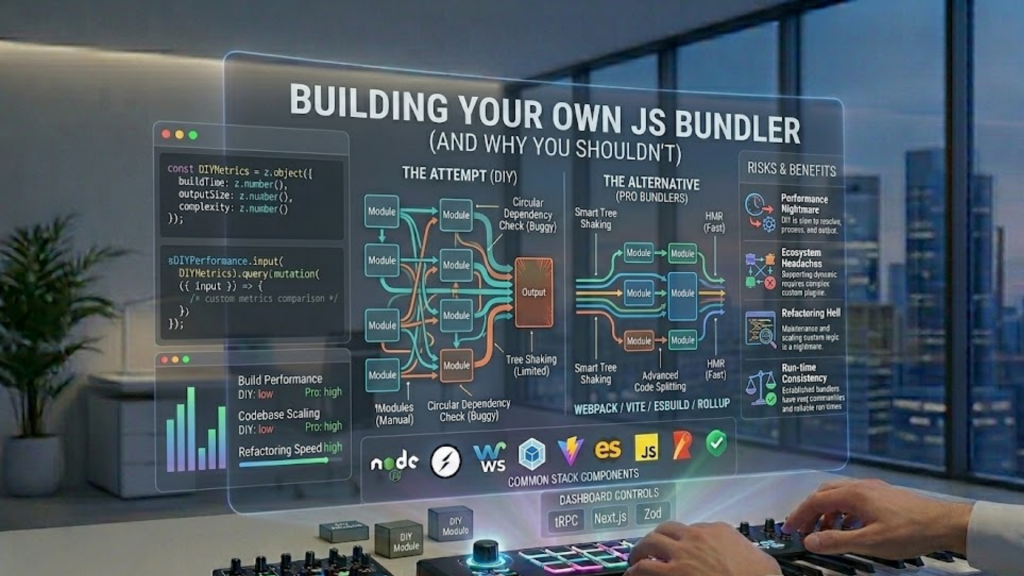
A bundler is a tool that takes a collection of separate files and dependencies and merges them into a single, optimized file (or a few small files) that a browser can understand. In 2026, while tools like Vite and Turbopack dominate the market, the core logic remains the same: a bundler resolves a “Dependency Graph” to ensure your code runs in the correct order.
Building one from scratch is the ultimate “Rite of Passage” for senior developers to truly understand how the modern web is stitched together.
Step-by-Step: How to Build a Basic Bundler
To build a functional (though primitive) bundler in 2026, you follow a four-stage architectural process.
1. Dependency Mapping (The Crawler)
Your bundler starts at an “Entry Point” (usually index.js). It reads the file and looks for import or require statements.
- The Task: For every import found, the bundler must find the file on the disk, read it, and repeat the process for that file’s imports until it has a complete map of every file needed.
2. Code Transformation (The Transpiler)
Browsers in 2026 are fast, but they still don’t support every experimental feature.
- The Task: Use a parser like Babel or SWC to turn the code into an Abstract Syntax Tree (AST). This allows you to rewrite the code (e.g., changing
importto a custom__webpack_require__function) so it can run in a single scope.
3. Topological Sorting (The Organizer)
You can’t run a file that depends on a variable from another file until that first file has finished loading.
- The Task: You must sort your list of files so that dependencies always come before the code that uses them. This is often done using a “Depth-First Search” algorithm.
4. The “Big Wrap” (The Generator)
Finally, you wrap all the files in a single self-executing function (IIFE).
- The Task: You provide a small “Runtime” script at the top of the file that manages the loading and caching of these modules so they don’t leak into the global window scope.
Why You Shouldn’t Build Your Own in 2026
While building a bundler is an incredible learning exercise, using your own in production is almost always a mistake for three reasons:
- Performance Moats: Modern bundlers like Rolldown (the new Rust-based heart of Vite) use multi-threaded processing and incremental caching that a hand-written JS bundler simply cannot match.
- The Plugin Ecosystem: You would have to manually write integrations for PostCSS, Tailwind, TypeScript, and Image Optimization. Standard tools have thousands of community-tested plugins ready to go.
- Tree Shaking: Efficiently removing “dead code” (functions you import but never use) is incredibly difficult to get right. Professional bundlers save you megabytes of bandwidth through advanced static analysis.
Frequently Asked Questions (FAQ)
1. Is Vite a bundler?
In 2026, Vite is an Orchestrator. It uses Esbuild for lightning-fast development and Rolldown (the Rust successor to Rollup) for production bundling.
2. What is an Abstract Syntax Tree (AST)?
An AST is a tree representation of your code’s structure. Bundlers use it to “read” your code without executing it, allowing them to rename variables or remove unused imports safely.
3. Do we still need bundlers with native ESM support?
Yes. While browsers support import/export natively now, loading 500 separate files over a network is still significantly slower than loading one optimized bundle due to HTTP overhead.
4. Why do I see an Apple Security Warning on my build tool?
If your custom bundler attempts to execute unverified binaries or scripts from a non-secure local directory, you may trigger an Apple Security Warning on your iPhone or Mac.
5. What is “Module Federation”?
It’s a technique where multiple separate builds (from different teams) can share code at runtime. It’s the standard for 2026 micro-frontend architectures.
6. Which bundler is the fastest in 2026?
Turbopack and Bun’s native bundler currently hold the speed records, often bundling massive projects in under 50ms.
7. What is HMR (Hot Module Replacement)?
HMR allows the bundler to “patch” only the changed file into the running browser tab without a full page refresh. Building this yourself is notoriously difficult.
8. Should I learn Rust to build build-tools?
In 2026, yes. Most high-performance tooling is shifting to Rust (or Zig) to take advantage of low-level memory management and speed.
Final Verdict: Learn the “How,” Use the “Best”
Build a bundler over a weekend to understand Dependency Injection and ASTs. It will make you a better debugger and a more informed architect. But for your professional projects, stick to the battle-tested speed of Vite or Turbopack.
Ready to optimize your build? Explore our guide on Next.js 16 vs. Nuxt 4 to see how these frameworks handle bundling, or learn how to speed up your rendering in Beyond SSR: Streaming HTML in React 19.
Authority Resources
- Medium: Build Your Own Webpack – A conceptual walkthrough of the bundling lifecycle.
- Daily.dev: Best JavaScript Bundlers for 2026 – A comparison of the current industry-standard tools.
- Babel: Understanding Abstract Syntax Trees – Technical documentation on how parsers “see” your code.
- Vite: Why a Bundler is Still Necessary – Exploring the performance gap between native ESM and bundled assets.