
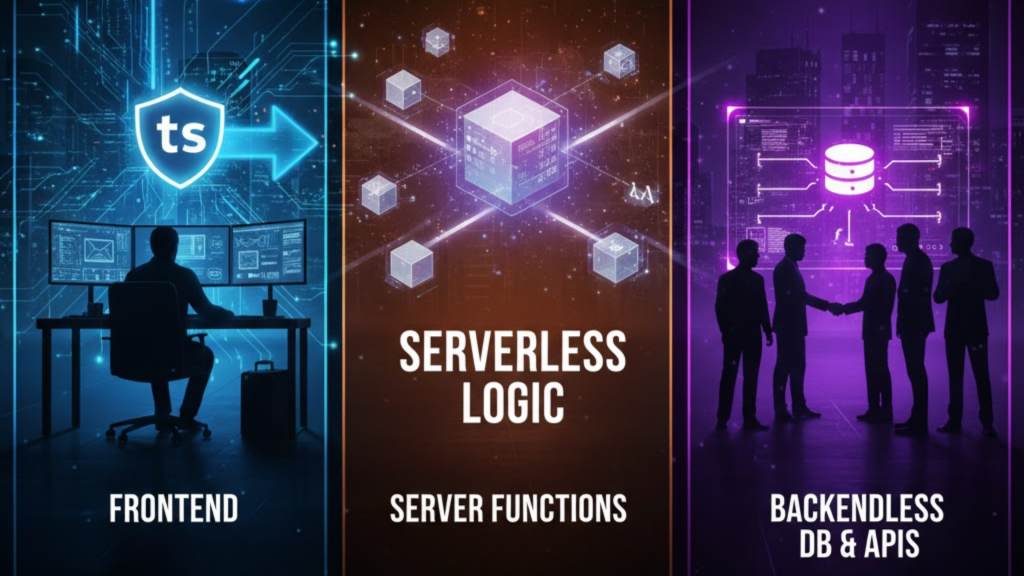
What exactly is a “Backendless” app? In 2026, “Backendless” doesn’t mean your app has no backend; rather, it means you no longer write, maintain, or deploy a separate backend server. Instead, you use Server Functions—asynchronous, server-only functions that you call directly from your frontend components like regular TypeScript functions. This “Zero-API” approach eliminates the need for REST or GraphQL boilerplate, allowing your data to flow seamlessly from your database to your UI.
By collapsing the wall between frontend and backend, you can build and ship features in hours instead of days.
The Power of TypeScript Server Functions in 2026
In 2026, the primary advantage of this architecture is Automatic Type Safety. Because your server logic lives in the same project as your UI, TypeScript ensures that if you change a database schema, your frontend breaks immediately in your editor—not at runtime in production.
| Feature | Traditional Backend (Express/Nest) | Server Functions (Next/Nuxt) |
| API Boilerplate | High (Routes, Controllers, DTOs) | Zero (Direct function calls) |
| Type Safety | Manual (Zod/Swagger sync) | Automatic (End-to-end TS) |
| Deployment | Separate (Server + Frontend) | Unified (Single Deploy) |
| Scaling | Manual/Auto-scaling groups | Infinite (Per-function scaling) |
| Cold Starts | Varies (Usually 200ms+) | Minimal (Optimized runtimes) |
How to Architect a Backendless TypeScript App
To build a “Backendless” app that scales to millions of users, you must follow the Server-First design pattern.
1. The “use server” Directive
In 2026, a single string—'use server'—at the top of your file tells the compiler: “Everything in this file stays on the server.” You can now import your database client (like Prisma or Drizzle) directly into these functions. Because this code never reaches the browser, your secrets and database credentials remain 100% secure.
2. Progressive Enhancement by Default
One major benefit of Server Functions is that they are compatible with standard HTML forms. This means your app can still work (or “gracefully degrade”) even if the user has a slow connection or disabled JavaScript. The browser can submit the form directly to your server function, which handles the logic and redirects the user.
3. Unified Error Handling
Instead of catching a 500 Internal Server Error and trying to parse a JSON response, you simply return a TypeScript object from your server function.
- Success:
return { success: true, data: user } - Error:
return { success: false, error: 'Email already exists' }This makes your frontend logic clean, readable, and perfectly typed.
Security Best Practices for 2026
Building “Backendless” doesn’t mean skipping security. In fact, because the attack surface is different, you must be more vigilant with Authorization.
- Input Validation: Even with TypeScript, you must validate data at the server boundary using libraries like Zod or Valibot to prevent malicious injections.
- Session Verification: Always check the user’s session inside every server function. Never trust a “User ID” passed from the client as a simple argument.
- Rate Limiting: Use middleware to prevent bots from spamming your server functions, especially for high-cost operations like AI generation or email sending.
Frequently Asked Questions (FAQ)
1. Do Server Functions replace API routes entirely?
For internal app logic (like forms, buttons, and data fetching), yes. However, you still need traditional API routes if you want to allow third-party apps or mobile clients to talk to your backend.
2. Is this the same as “Serverless”?
Yes, most Server Functions are deployed to Serverless Runtimes (like AWS Lambda or Vercel Functions). The difference is in the developer experience—you write them as functions, not as standalone server scripts.
3. Can I use Server Functions with any database?
Yes. Whether you use a SQL database (PostgreSQL/MySQL) or a NoSQL one (MongoDB/Firebase), you can call your database driver directly inside the function.
4. Why do I see an Apple Security Warning on my app?
If your server function attempts to set a cookie or access a protected resource without the proper Secure and SameSite attributes, you may trigger an Apple Security Warning on your iPhone.
5. What happens if a Server Function takes too long?
Most platforms have a timeout (usually 10–30 seconds). For heavy tasks like video processing, you should use a Server Function to trigger a Background Job instead of doing the work in the request.
6. Are Server Functions fast enough for real-time apps?
For most apps, yes. However, for high-frequency real-time needs (like a multiplayer game), you still need WebSockets or Server-Sent Events (SSE), which require a persistent server.
7. Does this architecture lock me into a specific host?
While Vercel and Netlify pioneered this, in 2026, you can deploy “Backendless” apps to any cloud provider using tools like OpenNext or SST, which convert your functions into standard AWS Lambda resources.
Final Verdict: Simplify Your Stack
The “Backendless” revolution is about reducing cognitive overhead. By using Server Functions and TypeScript, you stop fighting with API layers and start focusing on the only thing that matters: the user experience.
Ready to build your first backendless app? Check out our Next.js 16 vs. Nuxt 4 Showdown to see which framework handles server functions best, or learn how to optimize your code in How the React Compiler Eliminates useMemo.
Authority Resources
- MakerKit: Next.js Server Actions Complete Guide 2026 – A deep technical dive into the standard for server functions.
- Encore: Best TypeScript Backend Frameworks 2026 – A comparison of frameworks that automate backend infrastructure.
- Fermyon: The Serverless Guide to Functions and Apps – Understanding the shift from software servers to request handlers.
- eLeoRex: Why TypeScript Powers Scalable Apps in 2026 – The importance of type safety in modern full-stack systems.