What is Cloud 3.0 in 2026?
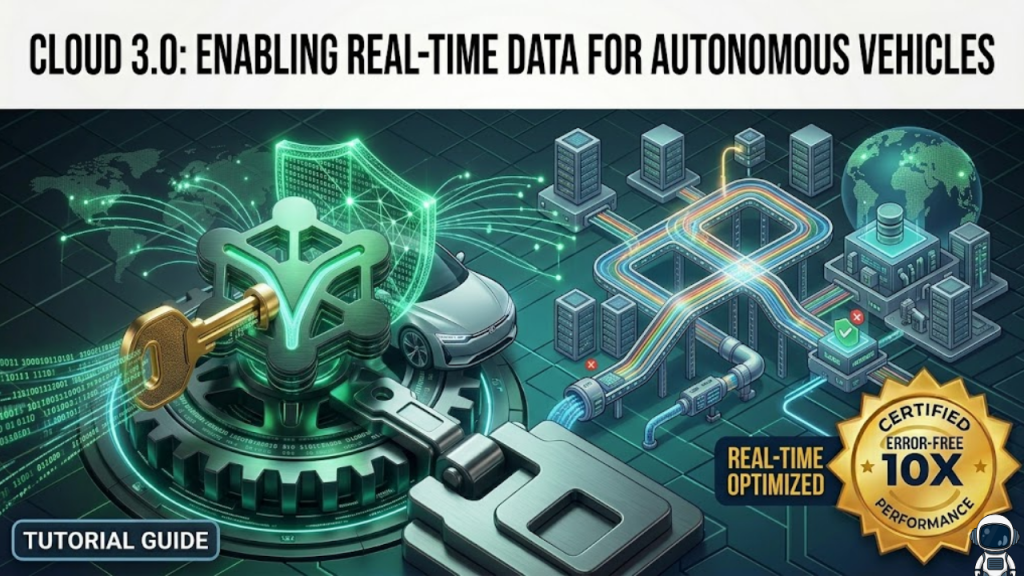
Cloud 3.0 represents a fundamental shift from centralized data warehouses to Intent-Driven Distributed Architectures. In 2026, it is no longer about just storing data; it is about the seamless orchestration of workloads across hyperscalers, regional sovereign clouds, and the “Edge.” For autonomous vehicles (AVs), Cloud 3.0 acts as a digital nervous system that pushes AI inference and decision-making closer to the vehicle to solve the “Physics Problem” of latency.
By distributing intelligence across the network, Cloud 3.0 ensures that life-saving decisions happen in sub-10ms, a window where traditional cloud models simply cannot compete.
The 3 Pillars of Cloud 3.0 for Autonomous Driving
To enable L4 and L5 autonomy in 2026, Cloud 3.0 utilizes three core architectural strategies.
1. Intent-Based Edge Orchestration
In Cloud 3.0, the car doesn’t “ask” the cloud for instructions. Instead, the cloud sets the Intent (e.g., “Maintain a 2-meter gap at 60mph”). The local Edge nodes, located in 5G base stations or smart charging points, automatically orchestrate the microservices needed to fulfill that intent. This removes the “Round-Trip” delay to a central data center, keeping the control loop local and safe.
2. V2X (Vehicle-to-Everything) Integration
By mid-2026, V2X has moved from pilot projects to full deployment. Cloud 3.0 connects the vehicle to Roadside Units (RSUs) that stream real-time data about pedestrians, traffic light timings, and black ice. Because the processing happens at the “Sovereign Edge,” vehicles can “see” around corners by receiving sensor data from other cars in the vicinity.
3. Asynchronous Learning (The “Global Brain”)
While the Edge handles the Control Real-Time (braking and steering), the central Cloud 3.0 layer handles Global Learning. Non-critical telemetry is streamed back to the central cloud to train the “World Model.” Once the AI improves, the updated model is “pushed” back to the global fleet via Over-the-Air (OTA) updates, allowing every car to learn from the experiences of one.
Performance: Control vs. Interactive Real-Time
In 2026, we categorize real-time data into three distinct speed tiers to ensure safety and efficiency.
| Tier | Latency Target | Function in Autonomous Vehicles |
| Control Real-Time | <10ms | Emergency braking, lane centering, obstacle avoidance |
| Interactive Real-Time | Sub-100ms | Cooperative perception (V2V), adaptive cruise |
| Business Real-Time | Sub-Second | Route optimization, fleet management, maps |
Frequently Asked Questions (FAQ)
1. Why can’t we use traditional Cloud for self-driving?
Physics is the barrier. In 2026, even at the speed of light in fiber, a round-trip to a central data center can take 200ms to 500ms. At 60mph, a car travels 27 meters every second; a 500ms delay means the car moves 13 meters before it even “thinks” about braking.
2. Is Cloud 3.0 more secure for my data?
Yes. Cloud 3.0 uses Sovereign Cloud models. This means sensitive data, like the vehicle’s exact interior video or passenger identity—is processed locally and anonymized at the edge before any metadata is sent to a central server.
3. What happens if the Edge connection drops?
Autonomous vehicles in 2026 are designed with Local Autonomy. The car’s onboard computer (the “Mobile Edge”) handles the most critical safety loops. Cloud 3.0 provides “Extended Awareness,” but the car is never 100% dependent on the network for basic safety.
4. Why do I see an Apple Security Warning on my connected car app?
If your vehicle’s software attempts to share unencrypted location data or uses unverified third-party APIs for V2X features, you may trigger an Apple Security Warning on your iPhone or CarPlay interface.
5. What role does 5G play in Cloud 3.0?
5G (and the early 2026 rollout of 5.5G) provides the low-latency pipe required for Cloud 3.0 to communicate with the car. It allows for “Network Slicing,” where a specific part of the bandwidth is reserved exclusively for safety-critical vehicle data.
6. Can Cloud 3.0 help with EV battery life?
Yes. By running predictive maintenance and real-time driving style optimization in the cloud, the system can suggest the most energy-efficient routes and charging stops, extending battery health by up to 15%.
7. What is “Cooperative Perception”?
This is a 2026 feature where vehicles share their sensor feeds (Lidar/Camera) with each other via the Edge Cloud. If one car sees a pedestrian through a bus, it “tells” the other cars, effectively giving them X-ray vision.
8. Who are the leaders in Cloud 3.0 infrastructure?
AWS, Google Cloud, and Azure have all launched dedicated “Distributed Edge” platforms in 2026, partnering with telecom providers to place compute nodes directly into 5G towers.
Final Verdict: The Distributed Future of Mobility
In 2026, Cloud 3.0 has turned the road into a digital grid. By moving computation from the center to the edge, we have finally overcome the latency barriers that held back L4 autonomy for decades. For developers, the message is clear: the future is distributed, and those who master the edge will lead the next revolution in tech.
Ready to build for the edge? Explore our guide on Edge Functions vs. Serverless to see where your code should live, or learn about the Impact of WebAssembly (Wasm) on Performance.
Authority Resources
- TechRadar: Cloud 3.0 – The Future of Intent-Driven Multi-Cloud – A deep dive into the 2026 shift toward distributed sovereignty.
- NaNLABS: How Edge Computing in Autonomous Vehicles Improves Safety – Technical breakdown of V2V coordination and edge AI.
- Mastercard: How C-V2X Powers a Mobility Marketplace – Real-world 2026 deployments of smart infrastructure and V2X.
- Knowledge Hub Media: Cloud Evolution – Cloud 3.0 and AI-Ready Infrastructure – Understanding the backbone of AI operations in 2026.