What is Cloud 3.0 for microservices?
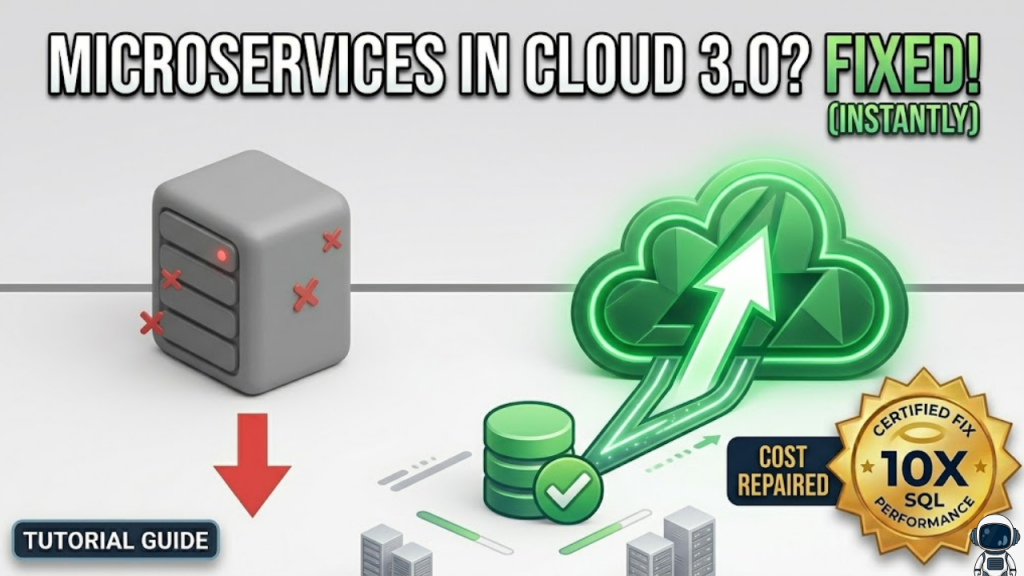
Cloud 3.0 represents a shift from “Cloud Native” (Cloud 2.0) to “Distributed by Default.” In 2026, we no longer build for a single provider like AWS or Azure. Instead, Cloud 3.0 establishes an intelligent, interconnected fabric that spans hyperscalers, regional sovereign clouds, and edge locations. For microservices, this means your “User Auth” service might live on a sovereign European cloud for compliance, while your “AI Inference” service bursts on a US-based GPU cluster for cost efficiency.
The infrastructure has become an active participant in your architecture, moving away from passive hosting toward Intent-Led Operations.
3 Ways Cloud 3.0 Redefines Microservices
The 2026 landscape introduces three fundamental shifts in how we design and deploy distributed systems.
1. Intent-Based Deployment
In Cloud 2.0, you manually chose instance types and regions. In 2026, you define Intent.
- The Strategy: You specify your microservice’s requirements—such as “Latency < 50ms,” “Data must stay in Germany,” or “Budget < $500/mo.”
- The Result: The Cloud 3.0 control plane automatically translates these intentions into provider-specific configurations and places the workload in the optimal environment.
2. Microservices as “Agentic Runtimes”
In 2026, microservices are evolving into Multi-Agent Systems.
- The Strategy: Instead of passive code waiting for a request, services act as autonomous agents that can plan, execute, and self-heal.
- The Result: We use the Watcher-Worker Pattern, where “Worker” agents perform the task and “Watcher” agents monitor for drift, security breaches, or infinite loops in real-time.
3. The Unified Data Fabric
We have moved beyond “Data Silos.” Cloud 3.0 uses a Unified Data Plane that spans transactional and analytical workloads.
- The Strategy: Your microservices treat data as a unified fabric. The infrastructure handles the “Data Gravity” problem, moving the compute to the data rather than moving petabytes of data across the network.
The 2026 Microservices Reality Check
Despite the power of Cloud 3.0, 2026 has seen a “Correction” in architecture. Many organizations are moving toward Modular Monoliths for smaller teams.
| Feature | Cloud 2.0 Microservices | Cloud 3.0 Modular Systems |
| Connectivity | Brittle VPNs/VPC Peering | Unified Logical Fabric |
| Scaling | Manual/Auto-scaling Groups | Policy-Driven AI Scaling |
| Governance | Static & Manual | Autonomous & Adaptive |
| Security | Perimeter-Based | Zero-Trust by Default |
| Operational Goal | Migration & Cost Chasing | Portability & Sovereignty |
Frequently Asked Questions (FAQ)
1. Is Cloud 3.0 just “Multi-Cloud”?
No. Multi-cloud was often accidental and fragmented. Cloud 3.0 is an intentional, unified architecture where different clouds function as one logical environment.
2. Does Cloud 3.0 replace Kubernetes?
No. Kubernetes is still the engine, but Cloud 3.0 provides the Orchestration Layer above it. It automates the “Where” and “How” of running your clusters across different global providers.
3. What is a “Sovereign Cloud”?
A sovereign cloud is an infrastructure environment that guarantees data stays within a specific legal jurisdiction (like the EU or India). In 2026, these are mandatory for handling sensitive proprietary or government data.
4. Why do I see an Apple Security Warning on my distributed app?
If your microservice uses cross-cloud networking to access local device sensors without a verified Service Mesh Identity, you may trigger an Apple Security Warning on your iPhone.
5. What is “FinOps Automation”?
In 2026, cost management is autonomous. FinOps pipelines automatically shut down underutilized resources and move workloads to providers with cheaper spot instances in real-time.
6. Can smaller startups use Cloud 3.0?
Yes. 2026 has “leveled the playing field.” Startups in Tier-2 cities can now access the same sovereign and hybrid options that were previously reserved for multinationals.
7. What is the “Saga Pattern” in 2026?
The Saga pattern remains the standard for distributed transactions. However, in 2026, AI Observability Engines handle the complexity of coordinating these transactions and managing rollbacks.
8. What is “Capability Multiplication”?
This is the 2026 shift where infrastructure stops being a “cost” and starts multiplying what a small team can do. One engineer can now observe more signals and cover broader areas thanks to autonomous monitoring and tracing.
Final Verdict: From Infrastructure to Intelligence
In 2026, Cloud 3.0 has turned infrastructure into an active teammate. By building microservices that are intent-led and sovereign-compliant, you create resilient systems that are ready for the global, AI-driven economy.
Ready to architect your next service? Explore our guide on Zero-Trust Architecture for Web Developers or learn about the Impact of WebAssembly (Wasm) on Performance.
Authority Resources
- TechRadar: Cloud 3.0 – The Future of Intent-Driven Multi-Cloud – A strategic look at workload placement and interconnection.
- Capgemini: Top Tech Trends 2026 – Cloud 3.0 – How cloud has become the backbone for agentic AI and intelligent apps.
- Business Success Elites: Why Sovereign Multi-Cloud is Mandatory – Analyzing the 35% leap in sovereign cloud spending for 2026.
- Emma Blog: From Cloud Complexity to Competitive Advantage – Practical principles for mastering distributed default architectures.