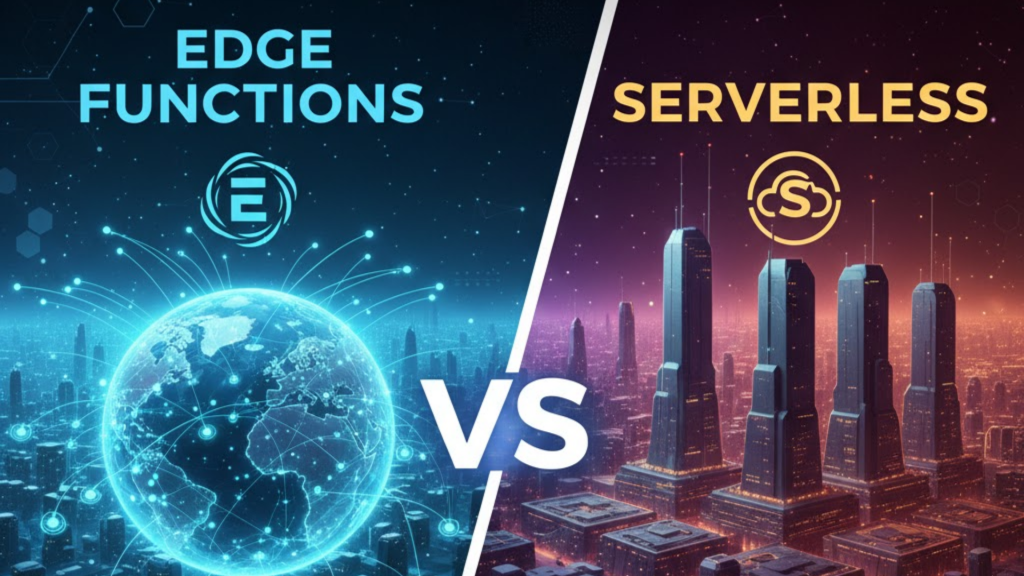
What is the difference between Edge Functions and Serverless?
In 2026, the distinction is clear: Edge Functions run on globally distributed nodes (CDNs) within miles of your user, offering sub-5ms cold starts for lightweight logic. Serverless Functions (like AWS Lambda) run in centralized data centers, providing massive compute power and deep database integrations for heavy backend tasks.+1
Think of it this way: Edge is the “Front Desk” that handles check-ins instantly, while Serverless is the “Kitchen” that cooks the complex meals.
Comparison: The 2026 Performance Benchmarks
In 2026, Edge runtimes (like V8 Isolates) have effectively eliminated the “Cold Start” problem for small tasks, while traditional Serverless remains the king of raw power.
| Feature | Edge Functions | Serverless Functions |
| Location | Closest CDN node (Global) | Regional Data Center |
| Cold Start | <5ms (Nearly Instant) | 50ms – 500ms |
| Compute Limit | Lightweight (50ms execution) | Heavy (Minutes of execution) |
| Database Access | HTTP APIs only (Limited) | Direct VPC/SQL Access |
| Cost (10M reqs) | **~$5 (Cloudflare/Vercel)** | ~$17 (AWS/Azure) |
When to use Edge Functions?
Use the Edge when Latency is your #1 Enemy. In 2026, the Edge is the default for anything that happens before the user sees the page.
- Authentication & Gatekeeping: Verify JWT tokens and user permissions at the edge so unauthorized requests never even hit your main server.
- A/B Testing & Personalization: Instantly swap headlines or images based on the user’s location or device type without a “flicker”.
- Bot Mitigation: Block malicious scrapers at the perimeter before they consume your expensive backend resources.
- Dynamic Redirects: Handle 301/302 redirects globally to ensure users reach the right content in milliseconds.
When to use Serverless Functions?
Use Serverless when Logic is Heavy and Context is Deep. If your code needs to “think” or “talk” to a big database, it belongs in the region where that data lives.
- Complex Data Processing: Image manipulation, video transcoding, or generating massive PDF reports.
- Direct Database Operations: If you need a persistent connection to an SQL database (PostgreSQL/MySQL) or a private VPC, Serverless is your only choice.
- Long-Running Tasks: Any process that takes more than a few seconds: like an AI inference or a batch data sync – will timeout on the Edge.
- Heavy Libraries: If your code requires large Node.js dependencies (like
PuppeteerorSharp), the lightweight Edge runtimes will reject it.
The 2026 Winning Strategy: The Hybrid Model
The most successful 2026 architectures use a Relay Race approach:
- The Edge handles the “Sprint”: It intercepts the request, checks the user’s cookie, and serves a cached page shell.
- Serverless handles the “Marathon”: It fetches the specific user data from the database and streams it into the page shell.
This hybrid pattern gives you the best of both worlds: the speed of the edge and the power of the cloud.
Frequently Asked Questions (FAQ)
1. Are Edge Functions cheaper than Serverless?
Yes, significantly. At scale (10 million requests), Edge platforms like Cloudflare Workers can be up to 70% cheaper than traditional AWS Lambda setups because they use lightweight “Isolates” instead of full virtual machines.
2. Can I use Python on the Edge?
In 2026, most Edge runtimes are strictly JavaScript, TypeScript, and WebAssembly (WASM). If you need Python or Go for a backend service, you should stay with traditional Serverless.
3. What is a “V8 Isolate”?
It is the technology behind Edge Functions. Instead of booting an entire Operating System (like Serverless), it runs your code inside an existing browser process. This is why Edge cold starts are virtually zero.
4. Does the Edge have access to a File System?
No. Edge functions are stateless and have no access to local disks. If you need to read or write files, you must use a cloud storage API like AWS S3 or a Serverless function.
5. Why do I see an Apple Security Warning on my local Edge dev?
If your local development environment attempts to simulate an Edge network by intercepting system-level SSL traffic, you may trigger an Apple Security Warning on your iPhone. Always use secure headers.
6. Is “Middleware” the same as an Edge Function?
In 2026 frameworks like Next.js 16, Middleware is an Edge Function. It is a piece of code that runs before every request to handle routing and auth at the edge.+1
7. What happens if an Edge Function fails?
Most platforms have a “fail-open” or “fail-closed” setting. You can configure it to either bypass the error and hit the origin server or show a custom 500 error page at the edge.
8. Who is the leader in Edge computing in 2026?
Cloudflare Workers and Vercel Edge remain the industry leaders, though AWS has significantly narrowed the gap with their ultra-fast Lambda@Edge updates.
Final Verdict: Choose Edge for UX, Serverless for Power
To summarize the 2026 landscape:
- Choose Edge for ultra-low latency, lightweight, and globally distributed logic.
- Choose Serverless for backend-heavy, database-integrated, or long-running workloads.
By splitting your logic correctly, you build apps that feel instant to the user and stay cost-effective for the business.
Ready to deploy? Check out our guide on Next.js 16 vs. Nuxt 4 to see how these frameworks handle edge deployment, or learn the Top Dev Skills Needed to Shine in 2026.
Authority Resources
- Vercel: Edge Functions vs. Serverless Functions – Official architectural breakdown of the two runtimes.
- Cloudflare: What is Edge Computing? – Deep dive into the distributed network model.
- Byteiota: Edge vs. Serverless 2026 Benchmarks – Real-world performance data comparing major providers.
- AWS: Choosing Between Lambda and Lambda@Edge – Decision framework for the Amazon ecosystem.