What is Functional Programming in JavaScript?
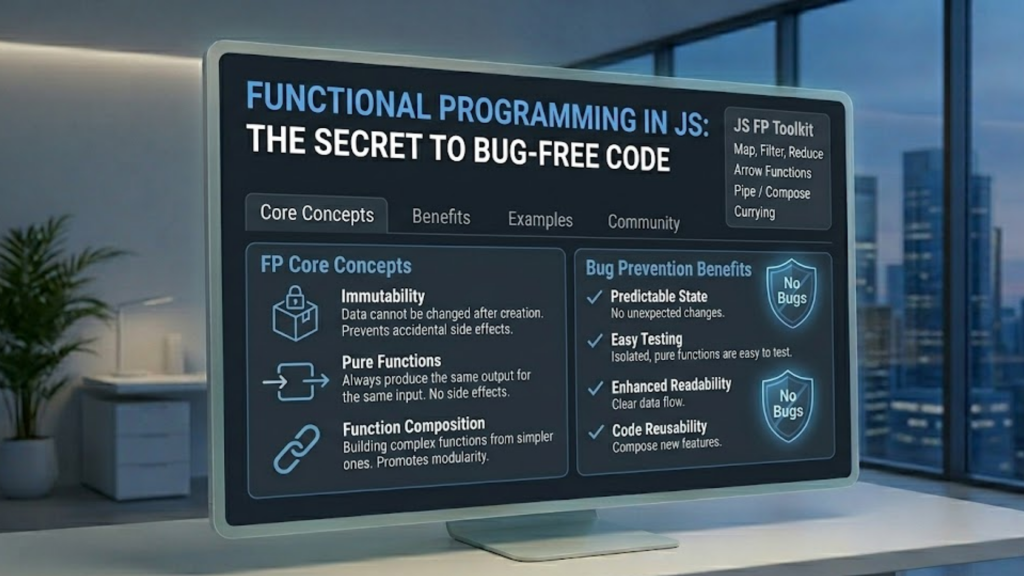
Functional Programming (FP) is a declarative coding paradigm where you build software by composing Pure Functions, avoiding shared state, and treating data as Immutable. In 2026, FP has become the “Gold Standard” for large scale applications because it eliminates the hidden side effects that cause 80% of software bugs. Instead of telling the computer “how” to change a variable, you describe “what” the data should become through transformations.
The 3 Pillars of Bug-Free Functional Code
To write reliable code in 2026, you must replace imperative “loops and mutations” with these three fundamental principles.
1. Pure Functions (Determinism)
A function is “pure” if it always returns the same output for the same input and has no side effects (like changing a global variable or logging to the console).
- Why it stops bugs: Because pure functions are self contained, they are “Predictable.” If a function works once, it works forever, regardless of what is happening in the rest of your app.
2. Immutability (The “No-Touch” Rule)
In 2026, we never “update” an object. Instead, we create a new copy with the changes.
- Why it stops bugs: Most bugs come from a variable being changed in one place and breaking code in another. With immutability, data remains constant throughout its lifecycle, making “Time Travel Debugging” possible in tools like Redux or Pinia.
3. Higher-Order Functions (Abstraction)
JavaScript treats functions as “First-Class Citizens,” meaning they can be passed around like variables.
- The Strategy: Use built-in methods like
.map(),.filter(), and.reduce(). These allow you to perform complex data operations without writing manualforloops, which are common breeding grounds for “off-by-one” errors.
Comparative Breakdown: Imperative vs. Functional
In 2026, the industry is moving away from the “Manual Step-by-Step” (Imperative) approach toward the “Result-Focused” (Functional) approach.
| Feature | Imperative Style | Functional Style (2026) |
| Logic Focus | “How” to do it (Steps) | “What” to do (Results) |
| Data State | Mutable (Changes in place) | Immutable (New copies) |
| Predictability | Low (Side effects) | High (Deterministic) |
| Testing | Hard (Requires mocking) | Trivial (Just input/output) |
| Concurrency | Risky (Race conditions) | Safe (No shared state) |
Frequently Asked Questions (FAQ)
1. Is Functional Programming slower than OOP?
In 2026, the performance difference is negligible for 99% of web apps. While creating new objects uses slightly more memory, the React Compiler and modern V8 engines optimize these patterns so well that the “safety” gains far outweigh any minor speed loss.
2. Do I have to use a library like Ramda or Lodash/fp?
No. Modern JavaScript (ES2026) has enough built-in power (Spread operator, toSorted, toReversed) to write fully functional code without external dependencies.
3. Can I mix FP with Object-Oriented Programming?
Yes. This is called Multi-Paradigm programming. Many 2026 developers use OOP for the broad “structure” of the app and FP for the internal “business logic” and data processing.
4. Why do I see an Apple Security Warning on my FP project?
If your functional code uses high-level “Proxies” or “Reflect” APIs to enforce immutability in an insecure local environment, you may trigger an Apple Security Warning on your iPhone or Mac.
5. What is “Currying”?
Currying is the process of turning a function that takes multiple arguments into a sequence of functions that each take a single argument. This allows for better “Function Composition”.
6. Does FP help with AI integration?
Yes. Because FP is deterministic, it is much easier for AI Coding Assistants to suggest improvements and write unit tests for your code. “Pure” code is “Clean” code for AI.
7. What are Monads?
In 2026, think of Monads as “Wrappers” that handle side effects (like errors or null values) in a functional way. The Maybe and Either monads are the most common tools for “Safe” error handling.
8. Is FP hard to learn?
It requires a “Mindset Shift.” If you are used to changing variables in loops, you have to “unlearn” that. However, once you master it, you will find it much easier to reason about large, complex codebases.
Final Verdict: Predictability is Your Superpower
In 2026, the best developers don’t just write code that “works”; they write code that cannot fail. By embracing Functional Programming, you eliminate the chaos of shared state and side effects, making your applications more robust, testable, and future-proof.
Ready to write cleaner code? Explore our guide on How the React Compiler Eliminates useMemo or learn about the Top Dev Skills Needed to Shine in 2026.
Authority Resources
- True Sparrow: Functional Programming for Bug-Free Code – A guide to using ES6+ features for software reliability.
- 618Media: Benefits of Immutable Data in JS – Why treating data as constant leads to more predictable apps.
- Syncfusion: Pure and Impure Functions Complete Guide – Understanding side effects and deterministic logic in 2026.
- Medium: Handling Immutable Data Structures – Best practices for state management in complex UIs.