What is a Sovereign Cloud in 2026?
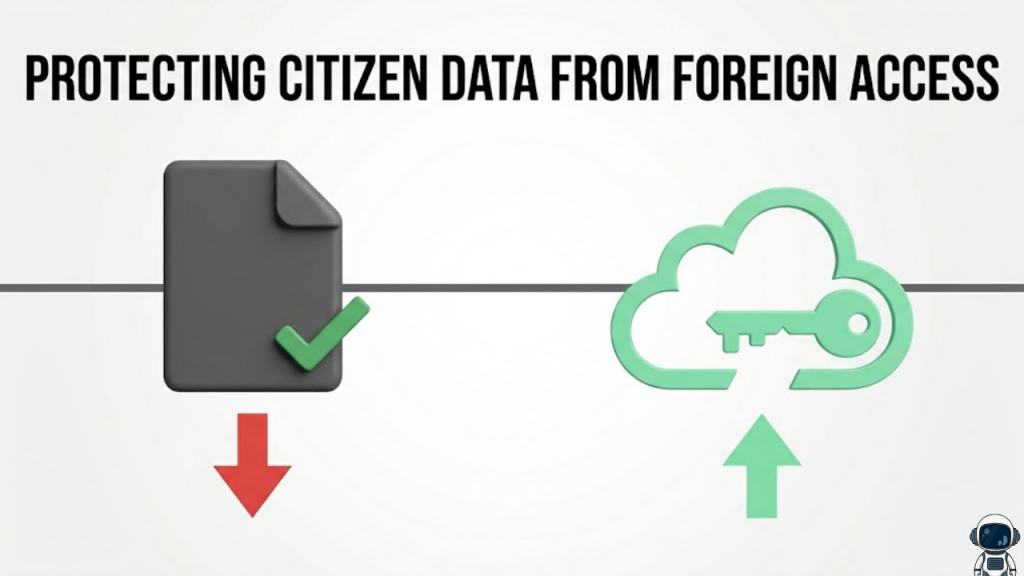
A sovereign cloud is a cloud environment specifically designed to ensure that all data, infrastructure, and operations remain within the legal jurisdiction of a specific country or region. In 2026, this is the primary defense against the US CLOUD Act and other foreign laws that attempt to claim “extraterritorial reach.” Unlike a standard public cloud, which might store your data in one country but remain subject to the laws of its parent company’s home nation, a sovereign cloud ensures that only local laws and local courts have authority over the data.
By decoupling technology from foreign legal influence, sovereign clouds provide a “Digital Fortress” for a nation’s most sensitive citizen records.
3 Pillars of Sovereign Data Protection
In 2026, protecting data from foreign access requires a combination of legal, operational, and technical “walls”.
1. Jurisdictional Sovereignty (The Legal Wall)
The most critical protection is that the cloud provider must be a domestic entity.
- The Strategy: In 2026, using a US-owned hyperscaler (even if the servers are in Europe) is often considered a “Sovereignty Trap.” This is because foreign laws can compel those companies to provide data regardless of where it is stored. A sovereign cloud uses providers that are headquartered and owned within the local jurisdiction, meaning they are legally immune to foreign warrants.
2. Operational Autonomy (The Human Wall)
Data isn’t just protected by code; it is protected by the people who manage it.
- The Strategy: Sovereign clouds are operated exclusively by trusted domestic personnel who often hold national security clearances. This prevents “Foreign Admin Access,” where an engineer at a global headquarters might otherwise have the power to view or export sensitive citizen datasets.
3. Technical Sovereignty (The Encryption Wall)
In 2026, “Zero-Knowledge” architectures make unauthorized access technically impossible, not just legally prohibited.
- The Strategy: Sovereign clouds utilize External Key Management (EKM). This ensures that the encryption keys are held by the government or a local third party, never by the cloud provider itself. Even if a foreign entity seized the physical servers, the data would remain an unreadable, encrypted “digital brick”.
2026 Mechanisms: Beyond Data Residency
While “Data Residency” just means your bits are on a local server, “Data Sovereignty” ensures you have total control over those bits.
- Confidential Computing: In 2026, sovereign clouds use hardware-based TEEs (Trusted Execution Environments). These protect data even while it is in use (in memory), ensuring that even the cloud’s own system administrators cannot “peek” at the data while it is being processed.
- Air-Gapped Options: For the most critical datasets, like military or national identity records, sovereign clouds offer “Disconnected” modes. These environments are physically or logically separated from the global internet, making remote foreign cyber-attacks or data extractions virtually impossible.
- Erasure Coding & Fragmentation: Some 2026 decentralized sovereign clouds fragment data across multiple local nodes. No single data center holds a complete file, meaning a foreign actor would need to compromise dozens of high-security sites simultaneously to reconstruct a single document.
Frequently Asked Questions (FAQ)
1. Can the US CLOUD Act still reach a Sovereign Cloud?
No. Because a true sovereign cloud in 2026 is owned and operated by a non-US entity, US law has no jurisdiction over it. The provider is not “subject to” US warrants, which is the primary reason for the mass migration of European government data to national partners like T-Systems or Orange.
2. Is Sovereign Cloud more expensive?
Generally, yes. Because it lacks the massive economies of scale of global hyperscalers and requires specialized local staff and infrastructure, sovereign clouds can cost 20% to 40% more. However, for governments, this is seen as a necessary cost for national security.
3. Does it stop innovation?
In 2026, no. Many global hyperscalers (like Microsoft and AWS) now offer “Sovereign Partner” models. They provide the high-end AI and analytics software, but a local partner owns the infrastructure and data, allowing for “Sovereign Innovation”.
4. Why do I see an Apple Security Warning on my government portal?
If your sovereign cloud portal uses unverified third-party analytics or scripts that attempt to track users across borders, you may trigger an Apple Security Warning on your iPhone.
5. What is the “Sovereignty Score”?
A 2026 industry benchmark that assesses a cloud service’s exposure to foreign laws. A high score means the service is technically and legally isolated from any extraterritorial influence.
6. What sectors use this most?
Government, Defense, Healthcare, and Finance are the primary users. Any sector where a data breach or foreign access could lead to a loss of citizen trust or national stability is now “Sovereign-First”.
Final Verdict: Building Trust in a Borderless World
In 2026, the Sovereign Cloud has become the only way for nations to retain their “Digital Borders.” By combining local ownership, domestic operations, and advanced encryption, these clouds ensure that citizen data belongs to the citizens, and the laws that protect them, regardless of geopolitical pressure.
Ready to secure your data? Explore our guide on Zero-Trust Architecture for Web Developers or learn about modern authentication in Why Passkeys are Replacing Passwords in 2026
Authority Resources
- BCG: Sovereign Clouds Are Reshaping National Data Security – A strategic look at the infrastructure and operational pillars of sovereignty.
- Sangfor: What Is Sovereign Cloud and Why It Matters – A high-level guide to jurisdiction and domestic compliance.
- T-Systems: What is a Sovereign Cloud? – A look at the benefits for public services, healthcare, and finance.
- Impossible Cloud: Data Sovereignty Guide for 2026 – Technical insights into decentralized storage and the “Sovereignty Trap”.