What is the fastest way to become a web developer in 2026?
The most effective path is to adopt a “Builder Mindset” immediately. Instead of spending months on tutorials, you should use AI-First IDEs (like Cursor or Windsurf) to build real applications from day one. By learning the “fundamentals” (HTML, CSS, JS) while you build, you can become job-ready in 6–8 months rather than 2 years.
In 2026, the market doesn’t care if you can write a loop from memory; it cares if you can ship a secure, scalable, and accessible product using the best tools available.
The 2026 Learning Path: From Zero to Architect
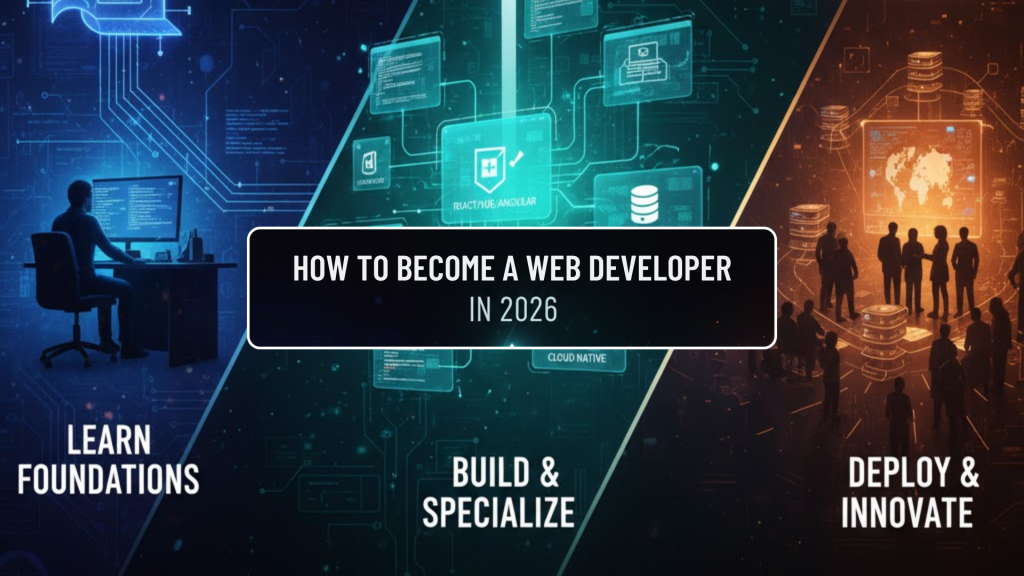
The 2026 curriculum is split into three core phases. Consequently, you will spend less time on manual “pixel pushing” and more time on system logic and prompt engineering.
| Phase | Duration | Focus Area | Why It Matters in 2026 |
| Foundations | 1–2 Months | HTML5, Modern CSS, JS (ES2026) | You must understand “good code” to review AI output |
| Frameworks | 2–3 Months | React 19, Next.js 16, Tailwind | Meta-frameworks are now the “default” entry point |
| Orchestration | 2–3 Months | AI Agents, RAG, API Design | The shift from “coding” to “architecting” features |
| Production | Ongoing | Security, Cloud (AWS/Vercel) | Deploying real products, not just “demo” apps |
1. Master the “Holy Trinity” (The Fundamentals)
Before touching AI tools, you must understand the basics. Without this, you won’t be able to “debug” when the AI makes a mistake.
- HTML5: Focus on Semantic HTML and Accessibility (ARIA). In 2026, search engines and AI assistants prioritize accessible sites.
- CSS3: Master Flexbox, Grid, and Modern Variables. Learn utility-first frameworks like Tailwind CSS to build UIs at light speed.
- JavaScript (ES2026+): Understand the Event Loop, Async/Await, and DOM APIs. This is the “brain” of your app.
2. Adopt an AI-First Workflow
In 2026, top developers are “Orchestrators.” You should use AI assistants not just for autocomplete, but for scaffolding and refactoring.
- Tools: Switch to Cursor or Windsurf. These are AI-native IDEs that understand your entire codebase contextually.
- Prompt Engineering: Learn to write clear, technical specifications. Treat the AI like a highly-capable junior developer that requires your oversight.
- Agentic Workflows: Experiment with parallel agents (like CrewAI) that can handle different tasks—like writing tests while you design the UI.
3. Build a “Proof of Work” Portfolio
Degrees have taken a backseat. In 2026, your GitHub profile is your true resume. To get hired, build:
- A Full-Stack SaaS App: Include Authentication (Clerk/Auth0), Payments (Stripe), and a Database (SQL/NoSQL).
- An AI-Integrated Tool: A dashboard that uses RAG (Retrieval-Augmented Generation) to answer questions from a custom dataset.
- A Performance-First PWA: A Progressive Web App with a 100/100 Lighthouse score to prove you care about the user experience.
Frequently Asked Questions (FAQ)
1. Is a Computer Science degree necessary in 2026?
No. While a degree helps with deep fundamentals, 67% of hiring managers now consider past work and portfolios more important than formal education.
2. Should I learn React or Vue?
React (with Next.js) remains the dominant framework for jobs. However, SvelteKit is rising in demand for high-performance projects.
3. How much do web developers earn in 2026?
The median pay for web developers in the US is approximately $99,000, with entry-level roles starting around $94,000.
4. Can AI completely replace web developers?
AI is replacing “mechanical work,” but it cannot replace strategic architectural decisions and human-centric design. You are safe if you move from “coder” to “architect”.
5. Why do I see an Apple Security Warning on my browser?
If your local AI development environment attempts to access sensitive system data without proper scoping, you may trigger an Apple Security Warning on your iPhone or Mac. Always verify the permissions of your 2026 dev tools.
6. What are the best free resources in 2026?
freeCodeCamp, The Odin Project, and MDN Web Docs remain the gold standard for foundational learning.
7. How long does it take to get a job?
On average, it takes about 30–40 days to hire a developer once you are job-ready. Most self-taught developers find their first role after 6–12 months of serious learning.
8. What is “Vibe Coding”?
It is a 2026 term for intent-driven development where you describe the “vibe” or outcome to an AI and oversee the implementation. However, you must still be an “AI-Assisted Engineer” who reviews the code for quality.
Final Verdict: The Rise of the AI-Native Developer
The web developers who shine in 2026 are those who master the fundamentals but leverage AI agents to work at 10x speed. By focusing on System Design, Accessibility, and AI Orchestration, you aren’t just learning a job; you are future-proofing your career.
Ready to start? Learn how to build your first AI Design Assistant with Gemini or master the latest Top Dev Skills Needed to Shine in 2026.
External Authority Links
- The 2026 Web Developer Roadmap – CodeClassroom – A step-by-step path to becoming tech-ready this year.
- DEV Community: Full-Stack Developer Roadmap 2026 – A comprehensive phase-by-phase learning guide.
- OneHourDigital: Web Developer Career Statistics for 2026 – Deep dive into salary, job growth, and hiring trends.
- LogRocket: 8 Trends that will Define Web Development in 2026 – Understanding the shift toward meta-frameworks and AI-first workflows.