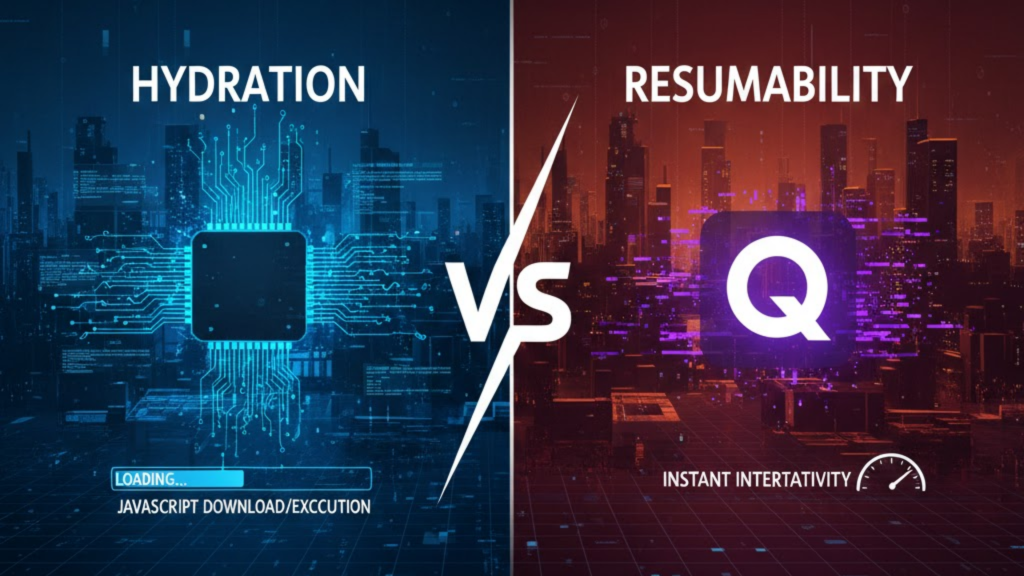
What is the difference between hydration and resumability? In 2026, Hydration is viewed as a “performance tax.” It is the process where a browser downloads the entire component tree and re-executes all the JavaScript to attach event listeners before a page becomes interactive. Resumability, pioneered by the Qwik framework, skips this step entirely. It serializes the application state on the server and “resumes” it on the client without re-executing a single line of code at startup.+2
This shift allows Qwik sites to achieve a Time to Interactive (TTI) of under 50ms, even on slow mobile connections, effectively eliminating the “uncanny valley” where a page looks loaded but doesn’t react to clicks.
The Technical Showdown: Why Hydration is Failing in 2026
Traditional frameworks like React and Vue are “replayable.” To wake up the page, the browser must do the work of the server all over again.
| Feature | Traditional Hydration (React 19/Vue 4) | Qwik Resumability |
| Startup Cost | Proportional to page complexity | Constant (Near-zero) |
| JS Bundle | Downloaded & Executed upfront | Loaded only on interaction |
| Event Listeners | Attached during hydration | Serialized in HTML |
| Main Thread | Blocked during “bootup” | Free & Responsive |
| Core Web Vitals | High TTI & INP | Instant TTI (Best-in-Class) |
How Resumability Achieves “Zero-JS” Startup
Qwik’s dominance in 2026 comes from its Optimizer, which uses the iconic $ suffix in your code to split every component and event handler into its own tiny, lazy-loadable file.
1. Serialized State
Instead of the client rebuilding the app’s state, Qwik embeds the state directly into the HTML as a JSON-like string. When the browser loads the page, it instantly knows exactly what the application “looks like” without running any logic.+1
2. Global Event Delegation
Qwik doesn’t attach listeners to individual buttons. Instead, it uses a tiny global listener that “captures” clicks and only then downloads the specific piece of JavaScript needed to handle that click. This is called JavaScript on Demand.
3. Fine-Grained Lazy Loading
In 2026, Qwik is known as the “disappearing framework.” If a user never scrolls to the footer or clicks the “Settings” menu, the code for those components is never downloaded.
SEO and Core Web Vitals Impact
In 2026, Google’s ranking algorithm focuses heavily on Interaction to Next Paint (INP). Because Qwik doesn’t block the main thread with a heavy hydration step, it consistently passes the 75th percentile of user interaction tests. For competitive niches like e-commerce, this technical lead often acts as the “tie-breaker” that moves a site from position eight to position three on the SERP.
Frequently Asked Questions (FAQ)
1. Is Qwik better than Next.js for performance?
For landing pages, e-commerce, and content sites, yes. Qwik’s TTI is near-instant, whereas Next.js (even with Streaming and RSC) still incurs a hydration cost for interactive components.
2. What is the “Uncanny Valley” in web dev?
It is the period between when a page is visible (FCP) and when it is interactive (TTI). In traditional frameworks, this gap can be 2–5 seconds on slow devices; in Qwik, it is 0 seconds.
3. Can I use React components in Qwik?
Yes, using Qwik-React, you can wrap React components and run them inside Qwik. However, those specific components will still use hydration, so you should use this sparingly.
4. Why do I see an Apple Security Warning on my Qwik site?
If your Qwik app’s service worker (used for prefetching) or third-party scripts attempt to access system files without permission, you may trigger an Apple Security Warning on your iPhone.
5. Is resumability harder to learn than hydration?
It requires a different mental model regarding serializability. You must ensure that everything you pass into components (props, state) can be serialized into a string.
6. Does Qwik work with Edge Functions?
Yes. Qwik is “native” to the Edge. It can pre-render a personalized page on a global CDN node and resume it instantly on the user’s device.+1
7. How does Qwik handle large bundle sizes?
It doesn’t “handle” them—it avoids them. By splitting every interaction into its own file, the initial bundle size is often under 1KB, regardless of how large the app is.
8. What is the iconic $ suffix in Qwik?
The $ is a signal to the Qwik Optimizer. It marks a “lazy-loading boundary,” telling the framework: “Split the code here and only download it when needed”.
Final Verdict: Why Resumability is the Future
The Hydration vs. Resumability debate is over for those who prioritize real-world speed. By eliminating the “performance tax” of re-execution, Qwik delivers the fastest possible experience to users on every device.
Ready to build? Learn how to optimize your framework choice in our guide on Next.js 16 vs. Nuxt 4 or discover the Top Dev Skills Needed to Shine in 2026.
Authority Resources
- Builder.io: Resumability vs. Hydration – The definitive technical comparison by the creator of Qwik.
- Qwik.dev: Resumable Concepts – Official documentation on pausing and resuming execution.
- Medium: How Qwik Redefines High-Performance Apps – Insight into granular code execution and SEO.
- Index.dev: SvelteKit vs Remix vs Qwik 2026 – Benchmark data on bundle sizes and TTI.