
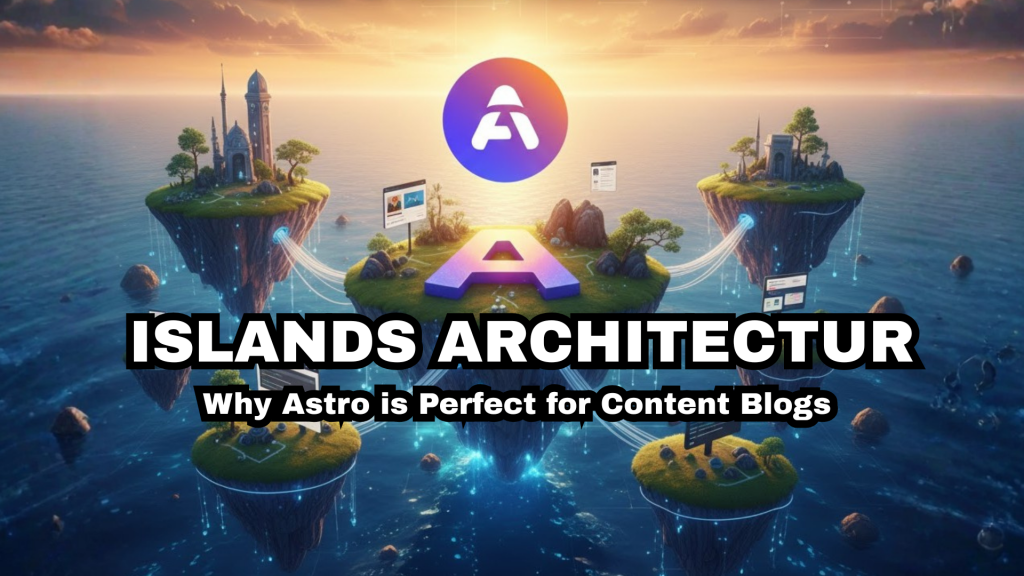
What is Islands Architecture?
Islands Architecture is a modern web development pattern where the majority of a webpage is delivered as fast, static HTML, while small, isolated, interactive regions (the “islands”) are hydrated with JavaScript only when necessary. In 2026, this approach has become the industry standard for content blogs. It allows you to deliver massive, media-heavy articles that load instantly while still supporting interactive features like comment sections, live polls, or newsletter sign-ups.
Astro is the framework that pioneered this shift. Consequently, it is the most effective tool for bloggers who want to achieve perfect Lighthouse scores without sacrificing the dynamic features readers expect.
The Performance Gap: Traditional SPA vs. Astro Islands
Traditional frameworks like Next.js or Nuxt often ship a “JavaScript Tax” to your readers. Even if your blog post is 95% text, the browser has to download and execute a massive bundle of code before the page becomes interactive.
| Feature | Traditional SPA (React/Vue) | Astro (Islands Architecture) |
| Default State | Heavy JavaScript Bundle | Zero JavaScript by Default |
| Hydration | Full Page Re-hydration | Selective/Surgical Hydration |
| Initial Load | “JavaScript Tax” delays TTI | Instant First Meaningful Paint |
| Core Web Vitals | Often struggles with INP/LCP | Best-in-Class Performance |
| Scalability | Complexity grows with interactivity | Islands stay isolated & fast |
3 Reasons Why Astro is the King of Content in 2026
To hit your growth targets, your site must be fast, adaptable, and easy to maintain. Astro excels in these three specific areas:
1. Zero JavaScript by Default
Astro automatically strips away all non-essential JavaScript. If you write a standard blog post with just text and images, Astro sends exactly zero bytes of JavaScript to the browser. As a result, your Largest Contentful Paint (LCP) occurs almost immediately, providing a massive boost to your SEO rankings.
2. Selective Hydration with “Client Directives”
In 2026, you don’t have to choose between speed and interactivity. Astro allows you to define exactly when a component should become interactive.
client:load: Hydrates critical items like the mobile menu immediately.client:visible: Only loads the JavaScript for a comment section once the user scrolls down to it. This ensures you don’t pay for code the user never sees.
3. Framework Agnostic Freedom
Astro doesn’t lock you into one ecosystem. You can build your header in React, your sidebar in Vue, and your footer in Svelte, all on the same page. This modularity is perfect for content blogs that need to integrate diverse third-party widgets without rebuilding the entire tech stack.
Impact on Core Web Vitals and SEO
Google’s 2026 search algorithm prioritizes Interaction to Next Paint (INP) and Visual Stability (CLS).
Because Astro Islands load in parallel and execute in isolation, they prevent the main thread from locking up. Specifically, this means your readers can click a button or scroll through a gallery while the rest of the page remains rock-solid and responsive. This technical advantage often translates to higher search rankings compared to bloated, client-heavy competitors.
Frequently Asked Questions (FAQ)
1. Is Astro better than Next.js for a blog?
For content-driven sites like blogs or documentation, Astro typically outperforms Next.js because it ships significantly less JavaScript. While Next.js is powerful for complex applications, it is often “overkill” for a blog where speed is the primary ranking factor.
2. What are “Server Islands” in 2026?
Astro Server Islands allow you to cache the static parts of your page aggressively while rendering dynamic parts (like a “Welcome, [User]” banner) separately. This provides the speed of a static site with the personalization of a dynamic one.
3. Can I use Markdown with Astro?
Yes. Astro has built-in support for Markdown and MDX, allowing you to write your content in a clean, developer-friendly format that is automatically converted into high-performance HTML.
4. Why do I see an Apple Security Warning on my blog?
If you use unverified third-party widgets or insecure tracking scripts in your interactive islands, you might trigger an Apple Security Warning on your iPhone. Always audit the scripts you add to your islands.
5. Does Astro support Server-Side Rendering (SSR)?
Yes. While Astro is known for Static Site Generation (SSG), it has a mature SSR mode for sites that need real-time data or user authentication, making it a highly flexible choice for 2026.
6. Is Islands Architecture hard to learn?
No. If you know HTML, CSS, and basic JavaScript, you can master Astro. The framework is designed to be “HTML-first,” meaning the complexity only appears when you explicitly opt-in to interactive islands.
7. How does Astro handle images?
Astro has a built-in Image component that automatically optimizes, resizes, and converts your images to modern formats like WebP or AVIF, ensuring your LCP remains lightning-fast.
8. Who is using Astro in 2026?
Major tech brands like Google, NordVPN, and Trivago use Astro for their content and documentation sites because of its unmatched performance and developer experience.
Final Verdict: Why You Should Choose Astro
If you are building a content blog in 2026, Islands Architecture is your greatest competitive advantage. By choosing Astro, you deliver the fastest possible experience to your readers, improve your SEO, and reduce the complexity of your codebase.
Ready to build your first island? Check out our guide on Next.js 16 vs. Nuxt 4 to see how other frameworks are trying to keep up, or learn how to scale your site with our Automated Content Generation Pipeline.
Authority Resources
- Astro Docs: Islands Architecture Deep Dive – The official manual for understanding component isolation.
- Patterns.dev: Islands Architecture Guide – A comprehensive architectural overview of partial hydration.
- Medium: Why I Chose Astro for My 2026 Blog – A developer’s first-hand account of the DX benefits.
- BCMS: Astro Server Islands Tutorial – Step-by-step implementation for dynamic content sites.