What is an Offline-First app in 2026?
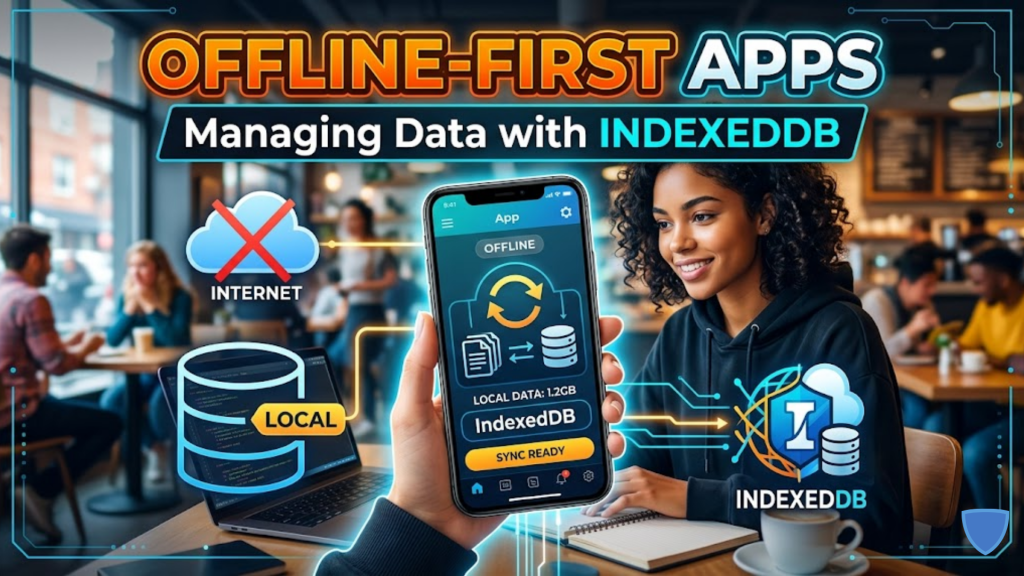
An Offline-First app is a web application that treats the local device as the primary source of truth rather than a remote server. In 2026, this architecture relies on IndexedDB, a low-level, NoSQL database built into the browser. Unlike simple storage methods, IndexedDB can store gigabytes of structured data, including files and complex objects. This allows users to continue working, editing, and creating content without an internet connection.
Once the device reconnects, a background process syncs the local changes to the cloud, making the transition between “online” and “offline” completely invisible to the user.
Why IndexedDB Wins Over LocalStorage in 2026
While LocalStorage is easy to use, it is a synchronous API that blocks the main thread, making it unsuitable for modern, high-performance apps.
| Feature | LocalStorage | IndexedDB (2026 Standard) |
| Data Types | Strings only | Objects, Blobs, Files, Arrays |
| Execution | Synchronous (Blocking) | Asynchronous (Non-blocking) |
| Storage Limit | ~5MB to 10MB | Hundreds of MBs to GBs |
| Querying | Key-only | Indexes and Transactions |
| Performance | Poor for large data | Excellent for massive datasets |
3 Pillars of a Successful Sync Engine
Managing data offline is only half the battle. You must also handle the return to connectivity.
1. The Sync Queue
Whenever a user performs an action offline, you should store that action in a “Sync Queue” within IndexedDB.
- The Strategy: Record the specific operation (e.g.,
Update_Profile) and a timestamp. When the browser detects anonlineevent, the app processes this queue in order.
2. Conflict Resolution
What happens if a user edits a document on their phone while offline and on their laptop while online?
- The Strategy: Implement a Conflict Resolution policy. In 2026, the most common methods are “Last-Write-Wins” (based on timestamps) or CRDTs (Conflict-free Replicated Data Types), which mathematically merge changes without data loss.
3. Background Sync API
In 2026, we use the Background Sync API to finish the job.
- The Strategy: If a user closes the tab before a sync finishes, the Service Worker can register a sync event. The browser will then wake up the script to complete the upload even after the user has navigated away.
Frequently Asked Questions (FAQ)
1. Is the native IndexedDB API hard to use?
Yes, it is notoriously verbose and callback-heavy. In 2026, professional developers always use wrapper libraries like Dexie.js or idb. These libraries provide a clean, Promise-based API that feels like a modern ORM.
2. Can users clear my IndexedDB data?
Yes. Browsers can clear data if the device runs low on storage. However, you can use the Persistent Storage API to request that the browser “persists” your data, making it immune to automatic eviction.
3. Does IndexedDB work in Incognito mode?
Support varies. In 2026, most browsers allow IndexedDB in private mode, but the data is wiped as soon as the session ends. Always include a fallback or a warning for users in private browsing.
4. Why do I see an Apple Security Warning on my offline app?
If your app attempts to sync large amounts of data to an unverified domain in the background, you may trigger an Apple Security Warning on your iPhone.
5. What is “Delta Sync”?
Instead of uploading the whole document again, Delta Sync only sends the specific parts that changed. This saves data and reduces the chance of sync conflicts.
6. Can I use SQL in the browser?
Yes. In 2026, many developers use SQLite via WebAssembly (Wasm). This allows you to write standard SQL queries while using IndexedDB as the underlying storage engine.
7. How do I handle database versioning?
IndexedDB has a built-in versioning system. When you change your schema, you increment the version number, which triggers an onupgradeneeded event where you can safely migrate old data to the new structure.
8. Is IndexedDB secure?
Yes, it follows the Same-Origin Policy. This means a script on site-a.com can never see the data stored by site-b.com. For sensitive information, you should still encrypt the data before storing it.
Final Verdict: Reliable Data, Anywhere
In 2026, Offline-First is the mark of a high-quality application. By mastering IndexedDB, you provide a seamless experience that respects the user’s time and data, ensuring your app remains the preferred choice in an increasingly mobile and unpredictable world.
Ready to build your offline engine? Explore our guide on Converting Your WordPress Site into a High-Performance PWA or learn how to boost speed with Critical CSS: How to Inline Styles for Instant Loading.
Authority Resources
- MDN Web Docs: Using IndexedDB – The definitive technical manual for the asynchronous API.
- LogRocket: Offline-First Frontend Apps in 2025-2026 – A look at SQLite, Wasm sync, and local-first architecture.
- GeeksforGeeks: Difference Between localStorage and IndexedDB – Choosing the right storage for performance and scale.
- Medium: Implementing Offline-First with IndexedDB and Sync – Real-world code for building resilient sync engines.