What is Streaming HTML in React 19?
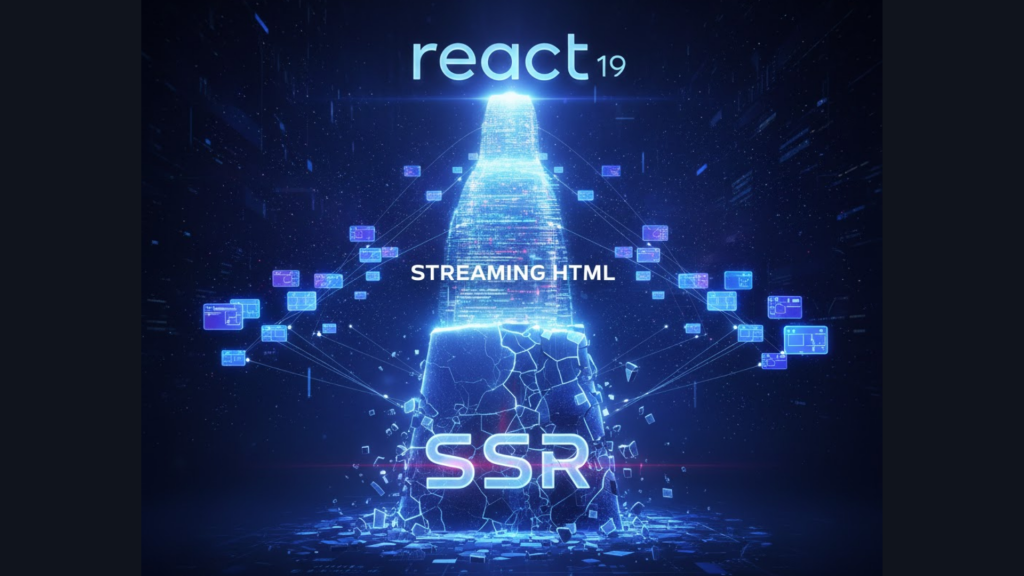
Streaming HTML is a rendering technique that allows your server to send parts of a webpage to the browser incrementally as they become ready, rather than waiting for the entire page to finish rendering. In 2026, this has replaced traditional Server-Side Rendering (SSR) as the gold standard for high-performance apps. It means your “Shell” (header, navigation) appears instantly, while heavy data-driven components “stream” in as soon as the server fetches the required data.
In the past, SSR was a “one-shot” process: you fetch all data, render the whole page, and send it. React 19 turns rendering into a continuous flow.
Why Traditional SSR Struggles in 2026
Standard SSR has a “waterfall” problem. If your page has a fast “Header” but a slow “Product Reviews” section, the user sees a blank white screen until the reviews are ready. This kills your Largest Contentful Paint (LCP) and Time to First Byte (TTFB) metrics.
| Feature | Traditional SSR | React 19 Streaming HTML |
| Data Fetching | Sequential/Blocking | Parallel/Non-blocking |
| TTFB | Delayed by slowest request | Nearly Instant (Header/Shell first) |
| User Experience | Blank screen → All at once | Progressive reveal |
| SEO Impact | Good, but slow FCP | Superior (Crawlable chunks) |
| Hydration | Full-page cliff | Selective/Surgical |
How Streaming HTML Works (The Technical Blueprint)
The secret to Streaming HTML in React 19 is the deep integration between React Server Components (RSC) and Suspense boundaries.
1. Progressive Rendering with Suspense
When you wrap a component in <Suspense>, you tell React: “Don’t wait for this to finish before sending the rest of the page.” React sends a “placeholder” (fallback) in the initial HTML stream. Once the data resolves, React pushes a small “chunk” of HTML and a script tag that swaps the placeholder for the real content, all over the same HTTP connection.
2. Selective Hydration
With React 19, the browser doesn’t have to wait for the entire page to load before making it interactive. React can start Selective Hydration on the parts that are already visible. If a user clicks a button in the “Header” while the “Reviews” are still streaming, React prioritizes hydrating that button so the app feels instant.
3. Server-Only Logic (RSC)
Because Streaming often involves Server Components, your sensitive API keys and heavy logic stay on the server. The client only receives the final, serialized HTML, reducing your bundle size significantly.
The SEO Advantage in 2026
Search engines like Google have evolved to handle streams perfectly. By sending the “Shell” and critical metadata (Title/Meta tags) first, you ensure that crawlers see your page’s identity within milliseconds. This satisfies the Interaction to Next Paint (INP) metric, which is a primary ranking factor in 2026.
Frequently Asked Questions (FAQ)
1. Does Streaming HTML require a special server?
Yes. You need a server that supports HTTP/2 or HTTP/3 and a runtime capable of handling readable streams (like Node.js, Bun, or Edge runtimes).
2. Is Streaming better than Static Site Generation (SSG)?
For static blogs, SSG is still faster. However, for dynamic apps like dashboards or e-commerce where content changes per user, Streaming HTML is superior because it provides the speed of static with the freshness of dynamic data.
3. What is “Suspense Batching” in React 19.2?
A new optimization where React groups multiple Suspense boundaries together to reduce “UI Churn” (flickering). It ensures that siblings appear at the same time if they resolve closely together.
4. Why do I see an Apple Security Warning during local streaming?
If your local development server uses self-signed certificates or insecure WebSockets to manage the stream, you may trigger an Apple Security Warning on your iPhone.
5. Can I use Streaming with any data fetching library?
Most modern libraries like TanStack Query or SWR have native support for React 19 Suspense, making it easy to plug into an existing streaming pipeline.
6. Does streaming affect my server’s CPU usage?
It can. Because the server stays “connected” and active while waiting for data chunks, it uses more concurrent resources than traditional “request-response” SSR.
7. What happens if a streamed component fails?
React 19 handles this gracefully. If an error occurs during the stream, React can render the nearest Error Boundary fallback directly into the stream, preventing the whole page from crashing.
8. Is “Partial Prerendering” (PPR) related to this?
Yes. PPR is the next level of streaming where the “Static Shell” is pre-built at compile time, and only the “Dynamic Islands” are streamed at request time.
Final Verdict: The End of the Blank Screen
Streaming HTML in React 19 marks the end of the “blank white screen” era. By breaking the render cycle into progressive chunks, you deliver a faster, more resilient, and SEO-optimized experience to your users.
Ready to implement this? Check out our guide on Next.js 16 vs. Nuxt 4 to see how top frameworks handle streaming, or learn how to optimize your UI with Prompt Engineering for Web Developers.
Authority Resources
- React Dev: New SSR Streaming APIs – Official documentation for implementation.
- Medium: Understanding React Streaming – A deep dive into perceived performance metrics.
- Vercel: How Streaming and Suspense Drive Speed – Case studies on modern page speed.
- TkDodo: React 19 and Suspense Drama – An architect’s perspective on rendering logic.