What is tech sovereignty in 2026?
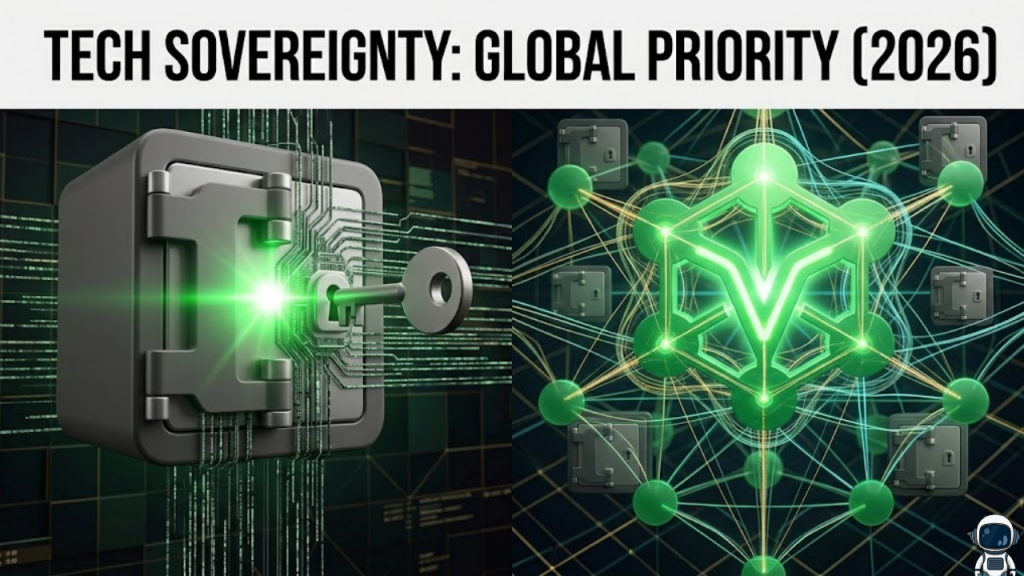
Tech sovereignty (or digital sovereignty) is an organization’s ability to maintain full control over its digital assets, infrastructure, and data. In 2026, it has moved from a niche political ambition to a mainstream business necessity. As geopolitical tensions rise and global trade becomes more transactional, businesses have realized that total dependence on a single foreign tech stack is a strategic vulnerability. Consequently, they are investing in homegrown AI, sovereign clouds, and independent cybersecurity to ensure they can operate autonomously regardless of international shifts.
Sovereignty is no longer about isolation; rather, it is about “Resilient Interdependence”, balancing global collaboration with the power to act independently when interests demand it.
3 Drivers of the 2026 Sovereignty Surge
Global businesses are prioritizing sovereignty for three main reasons: Regulatory Pressure, Operational Autonomy, and Trust as a Product.
1. The Regulatory Triple Threat
By 2026, laws like NIS2, DORA, and the EU AI Act have entered full application. These regulations mandate strict data residency and personal liability for management. Violations now carry GDPR-level fines of up to 4% of global turnover, making “Sovereignty by Design” the only way to avoid catastrophic legal risks.
2. Geopolitical Volatility and “Data Gravity”
Recent events in 2026 have shattered the illusion of a stable, rules-based global order. From trade wars to the potential seizure of digital assets, businesses now treat tech dependence as a national security risk. Furthermore, the concept of “Data Gravity” means that where you put your data today determines where your apps must live tomorrow. By placing data in sovereign zones now, firms prevent expensive future migrations.
3. Competitive Advantage through Trust
In 2026, customers and partners no longer give trust away for free; they demand it. Showing that you have full authority over your data, free from “external pressures” or foreign government subpoenas, has become a massive market differentiator. Businesses with robust sovereignty strategies win more RFPs because they can prove exactly where their data is stored and who can access it.
The 2026 Sovereignty Action Plan
To achieve sovereignty without sacrificing innovation, leading CIOs are adopting a Hybrid Strategy.
- Sovereign AI Backbones: Instead of using generic US-based LLMs for everything, firms are fine-tuning models on proprietary data within Sovereign Cloud environments. This ensures that sensitive IP never leaves the designated jurisdiction.
- Zero Data Egress Architectures: These systems allow organizations to use innovative global services (like specialized AI tools) while ensuring that the raw data remains within a sovereign “data bucket” that the provider cannot access.
- Local Talent and Skills: Sovereignty depends on people. In 2026, businesses are aggressively upskilling local teams to manage these complex architectures, reducing their reliance on foreign consulting firms.
Frequently Asked Questions (FAQ)
1. Can a business be 100% tech sovereign?
In 2026, “Full-Stack Autarky” is mostly an illusion. Most businesses pursue “Resilience” instead. They maintain enough control to switch providers or operate independently during a crisis, even if they still use global tools for non-sensitive tasks.
2. Is tech sovereignty just another word for “Protectionism”?
While some governments use it that way, for global businesses, it is about Risk Management. It’s the digital equivalent of diversifying a supply chain to ensure a single point of failure doesn’t shut down the company.
3. How does sovereignty affect AI innovation?
It can slow things down initially due to compliance checks. However, by 2026, sovereign clouds have matured, offering “Compliant-by-Default” AI pipelines that actually speed up the move from “Proof of Concept” to full production.
4. Why do I see an Apple Security Warning on my sovereign app?
If your sovereign cloud deployment uses non-standard encryption certificates or attempts to bypass system-level identifiers on an iOS device, you may trigger an Apple Security Warning on your iPhone.
5. What is the “28th Regime”?
This is a 2026 EU initiative designed to simplify cross-border business. It provides a single legal code that innovative companies can adopt to reduce the legal friction of managing different sovereign rules across Europe.
6. Does sovereignty increase IT costs?
Yes, initially. Adopting a “Highest Common Denominator” approach to compliance across 70+ countries increases complexity. However, the long-term payback is built-in agility and the avoidance of massive fines or emergency migrations.
7. What is “Cloud 3.0”?
Cloud 3.0 is the 2026 evolution of cloud computing. It focuses on multi-cloud and sovereign architectures that prioritize data sensitivity and low-latency AI inference over simple cost-saving migration.
8. Who is leading the tech sovereignty movement?
Europe remains the leader in regulation (GDPR/AI Act), but regions like Latin America and APAC (specifically Brazil and India) are fast following with their own localized data boundaries and “anchor tenant” processing rules.
Final Verdict: Autonomy is the New Currency
In 2026, Tech Sovereignty is the foundation of long-term competitiveness. By taking control of your digital infrastructure and data today, you ensure that your business remains agile, compliant, and, most importantly, independent in an increasingly volatile world.
Ready to secure your autonomy? Explore our guide on Zero-Trust Architecture for Web Developers or learn about modern data protection in Why Passkeys are Replacing Passwords in 2026.
Authority Resources
- SoftwareOne: Data Sovereignty 2026 Fundamentals – A deep dive into jurisdictional awareness and the “trust bucket”.
- Digital SME Alliance: The 2026 Tech Sovereignty Roadmap – How SMEs and public admins are building homegrown capacity.
- Capgemini: Top Tech Trends 2026 – Sovereign Cloud – Understanding Cloud 3.0 and the “paradox” of tech sovereignty.
- BCG: AI Sovereignty is an Illusion, Resilience is Real – A pragmatic look at national AI policy and domestic capacity.