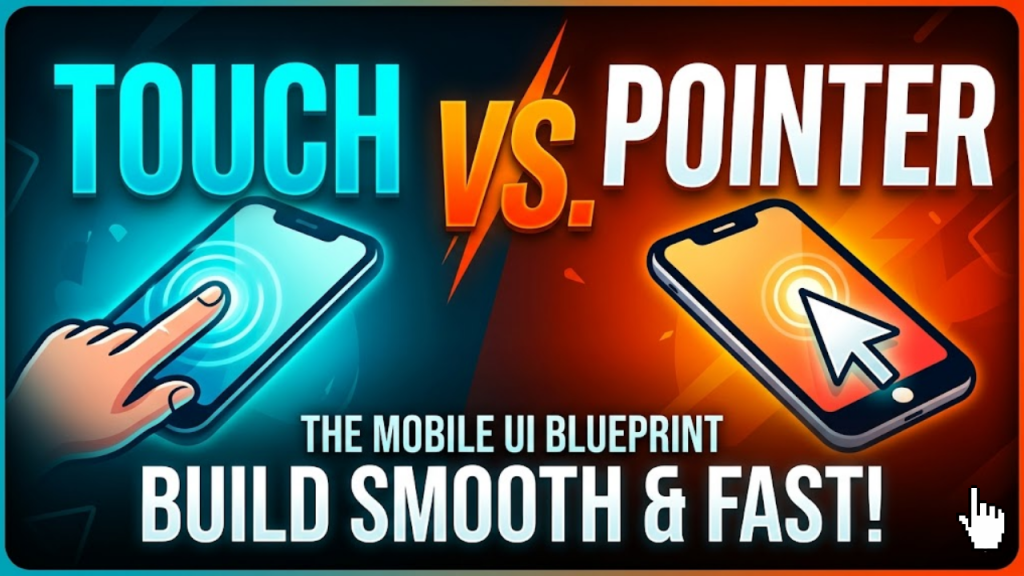
What is the difference in 2026? The debate between Touch and Pointer events centers on Code Consolidation. In 2026, Pointer Events have become the industry standard because they provide a unified, hardware-agnostic API for all input types, including fingers, mice, and styluses. Conversely, Touch Events are low-level APIs specifically for multi-touch surfaces. While Touch Events were once the only choice for mobile, Pointer Events now handle complex gestures with less overhead and better performance across modern browser engines.
Switching to a “Pointer-First” workflow allows you to build a single interaction layer that works perfectly on an iPhone, a Wacom tablet, or a standard desktop mouse.
[Image showing a unified Pointer Event flow compared to separate Mouse and Touch event paths]
Why Pointer Events Dominate in 2026
In 2026, maintaining separate touchstart and mousedown logic is considered a “Legacy Debt.” Pointer Events provide a cleaner mental model for developers.
| Feature | Touch Events (Legacy Path) | Pointer Events (2026 Standard) |
| Input Support | Multi-touch fingers only | Mouse, Pen, & Multi-touch |
| Code Efficiency | High (Requires parallel paths) | Low (One API for all inputs) |
| Pressure & Tilt | Not natively supported | Supported for Stylus/Pen |
| Event Delay | Can suffer from 300ms lag | Instant (Zero-delay default) |
| Multi-touch | Via TouchList array | Via pointerId tracking |
3 Pillars of Smooth Mobile Interaction
To build a high-performance UI in 2026, you must handle the physical nature of “Input” with precision.
1. Pointer Capture and Tracking
When a user starts a gesture, you need to “capture” the pointer so it stays locked to that element even if their finger slides off the screen.
- The Implementation: Use
el.setPointerCapture(event.pointerId)inside yourpointerdownhandler. This ensures a “drag” or “swipe” interaction remains stable until the user releases their touch, preventing the UI from “dropping” the action mid-gesture.
2. Device-Specific Optimization (pointerType)
While Pointer Events are unified, you might still want a “larger” button for a finger than for a precise stylus.
- The Strategy: Use the
event.pointerTypeproperty. It identifies if the input is a “touch”, “pen”, or “mouse”. You can use this to dynamically adjust your hit-testing boundaries or show “hover” effects only when a mouse or pen is detected.
3. Native Panning with touch-action
In 2026, the best way to improve scroll performance is to stop using JavaScript for it.
- The Implementation: Use the CSS
touch-actionproperty (e.g.,touch-action: pan-y). This tells the browser: “I’ll handle the horizontal swipe in JS, but you handle the vertical scroll.” This prevents the “Jank” that occurs when JavaScript and the browser’s native scroll try to fight for control.
Frequently Asked Questions (FAQ)
1. Are Pointer Events faster than Touch Events?
Generally, yes. By using a single event model, the browser avoids “Hit Testing” twice. Furthermore, Pointer Events eliminate the 300ms tap delay that once plagued mobile browsers, making your UI feel significantly more responsive.
2. Is browser support universal in 2026?
Yes. Every major browser, Chrome, Safari, Firefox, and Edge, now fully supports the Pointer Events W3C standard. You no longer need polyfills like Hand.js for modern mobile development.
3. How do I handle pinch-to-zoom?
While Pointer Events provide the coordinates for multiple fingers via unique pointerIds, you must still calculate the distance change between those points manually to implement custom zooming.
4. Why do I see an Apple Security Warning on my mobile UI?
If your interaction scripts attempt to “hijack” the system’s global gestures (like the iOS swipe-back) without proper user consent or secure scoping, you may trigger an Apple Security Warning on your iPhone.
5. Can I use Pointer Events for a drawing app?
Yes, and it’s the best choice. Pointer Events include pressure and tilt properties for pens and styluses, allowing you to build professional-grade drawing tools that react to how hard a user presses their screen.
6. What is isPrimary?
This property identifies the first finger that touched the screen. It is crucial for distinguishing between a “Primary Click” and a “Secondary Multi-touch Gesture” in complex 2026 dashboards.
7. Should I still use click events?
Use click for simple, non-sensitive buttons. However, for “drag-and-drop”, “long-press”, or “swipe” menus, Pointer Events are the only way to ensure a smooth, professional feel.
8. What is the “Minimum Touch Target” in 2026?
Even with great code, small buttons fail. In 2026, ensure all touch targets are at least 44×44 pixels (approx. 10-12mm) to account for the imprecision of the human fingertip.
Final Verdict: Unity Over Fragmentation
In 2026, building a smooth mobile UI is about choosing the most abstract and powerful tools available. By prioritizing Pointer Events, you build interfaces that are faster to develop, easier to maintain, and remarkably consistent across the vast landscape of modern devices.
Ready to polish your mobile interactions? Explore our guide on Converting Your WordPress Site into a PWA to see how these events feel in an app-like environment, or learn about Interaction to Next Paint (INP) to track your real-world performance.
Authority Resources
- SitePoint: Unifying Touch and Mouse with Pointer Events – A foundational look at the benefits of a single codebase.
- MDN Web APIs: Pointer Events – The official technical manual for event types and capture.
- The Modern JavaScript Tutorial: Pointer Events – A step-by-step guide to handling multi-touch and pressure.
- Mozilla Hacks: Launching Interop 2026 – How browser vendors are stabilizing Pointer Events for consistent mobile behavior.