
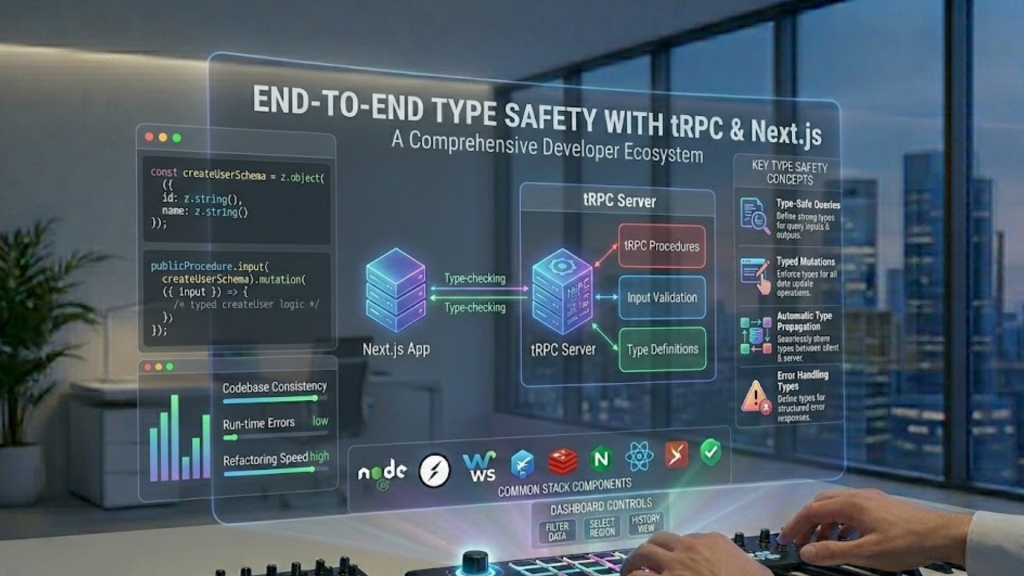
What is tRPC?
tRPC (TypeScript Remote Procedure Call) is a framework that allows you to build and consume fully type-safe APIs without schemas or code generation. In 2026, it is the preferred tool for monorepo applications. Unlike REST (where you hope the documentation is right) or GraphQL (where you must maintain a separate schema file), tRPC leverages TypeScript Inference. If you change a variable name in your backend, your frontend code will immediately show a red underline error before you even save the file.
In 2026, tRPC has moved beyond a “niche library” to become a core pillar of the T3 Stack, providing a seamless developer experience that eliminates 98% of common API bugs.
tRPC vs. Server Actions: Which to Choose?
With Next.js 16, Server Actions are the built-in default for many tasks. However, tRPC remains the superior choice for complex, data-heavy applications that require robust middle-layer features.
| Feature | Next.js Server Actions | tRPC (2026) |
| Type Safety | Built-in (Function signatures) | End-to-End (Inferred) |
| Caching | Manual / RevalidatePath | TanStack Query (Built-in) |
| Middleware | Limited (Global) | Granular (Per Procedure) |
| Validation | Manual (Zod in action) | First-Class (Zod integrated) |
| Best Use Case | Simple Forms / Revalidation | Dashboards / Complex SaaS |
3 Pillars of tRPC Architecture
To build a production-grade 2026 API, you must structure your tRPC setup around these three concepts:
1. The Unified Router (appRouter)
Instead of hundreds of flat files, organize your backend into feature-based routers (e.g., userRouter, postRouter). These are then merged into a single appRouter. You export only the type of this router, keeping your backend logic entirely hidden from the client’s browser bundle while still providing 100% autocomplete.
2. Zod-Powered Input Validation
In 2026, we never trust client data. Every tRPC procedure uses a Zod schema to define its inputs.
- The Payoff: If the frontend tries to send a string where the backend expects a number, the code won’t even compile. This prevents “Bad Request” errors from ever reaching your production logs.
3. Reusable Procedure Bases
Don’t repeat your authentication logic. Use tRPC Middlewares to create procedure bases:
publicProcedure: For anyone to call (e.g., getting a landing page).protectedProcedure: Chained with auth logic; it guaranteesctx.userexists before the main function even runs.
Frequently Asked Questions (FAQ)
1. Does tRPC work with the Next.js App Router?
Yes. In 2026, tRPC has deep integration with React Server Components (RSCs). You can use a “Server Caller” to invoke your procedures directly on the server without an extra HTTP hop, making your app significantly faster.
2. Is tRPC faster than GraphQL?
For TypeScript-to-TypeScript applications, yes. tRPC removes the overhead of parsing schemas and query strings. It is a direct function call over HTTP, making it lighter and easier to maintain for small to medium teams.
3. Can I use tRPC with a mobile app?
Yes! As long as your mobile app is written in React Native (TypeScript) and is part of the same monorepo, you get the same end-to-end type safety as your web app.
4. Why do I see an Apple Security Warning on my tRPC calls?
If your tRPC endpoints are not served over HTTPS or if your CORS headers are misconfigured to allow unverified third-party domains, you may trigger an Apple Security Warning on your iPhone.
5. What is “Superjson”?
Superjson is a transformer commonly used with tRPC to allow you to send complex data types—like Dates, Maps, and Sets—between server and client without them turning into plain strings.
6. Do I need a monorepo for tRPC?
While not strictly required, a monorepo is the most common 2026 setup. It allows the frontend to directly import the backend’s router type without any complex publishing steps.
7. How does tRPC handle file uploads?
In 2026, tRPC supports Multipart/FormData through its procedures, allowing you to handle file uploads with the same type safety as your JSON data.
8. What is the “98% Bug Reduction” statistic?
This refers to the elimination of “Type Mismatch” errors (expecting a string but getting a null) that plague REST and manually-typed APIs. In 2026, these errors are caught instantly during development.
Final Verdict: Speed through Safety
In 2026, End-to-End Type Safety is the hallmark of a professional developer. By using tRPC and Next.js, you create a developer workflow where the tools work for you, not against you. You stop writing documentation and start writing features.
Ready to secure your API? Explore our guide on Building Backendless Apps with Server Functions or learn how to optimize your UI in How the React Compiler Eliminates useMemo.
Authority Resources
- tRPC.io: Blog – Using Server Actions with tRPC – How to combine the two for the ultimate DX.
- Medium: Level Up Next.js App Router with tRPC – Deep dive into createCaller and RSC integration.
- LogRocket: The 8 Trends for Web Dev in 2026 – Why type safety is the baseline for professional projects.
- Askan Technologies: tRPC & Type Safety Revolution – Business outcomes and bug reduction statistics.