
Why focus on TypeScript 5.x?
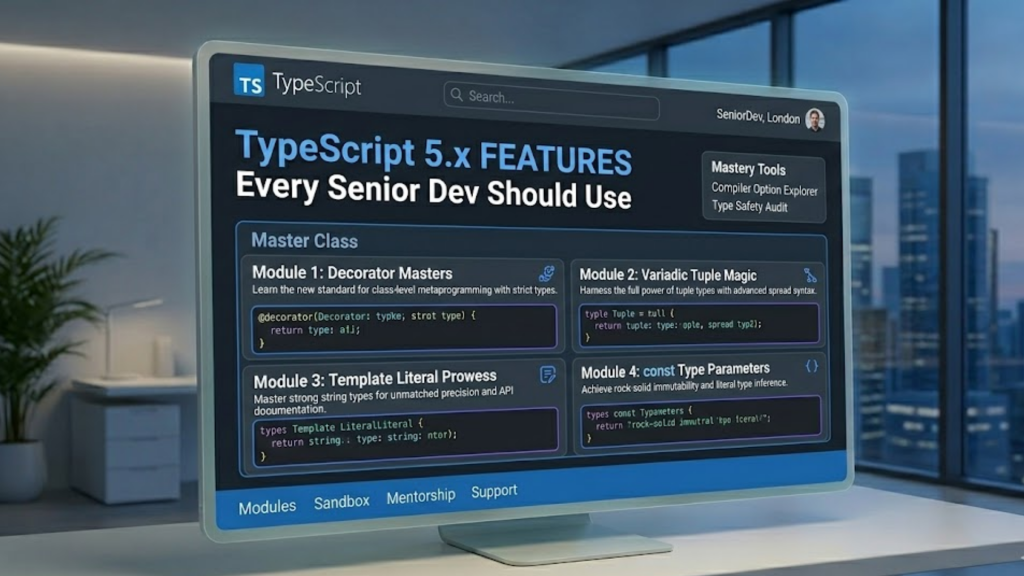
The 5.x era of TypeScript has shifted away from simply “adding types” to “Type Orchestration.” In 2026, senior developers use these features to create “Zero-Error” developer experiences for their teams. Features like Stable Decorators, Satisfies, and Explicit Resource Management allow you to write code that is not only type-safe but also incredibly performant and self-documenting.
If you are still writing types the way you did in version 4.x, you are missing out on the architectural moats that define a senior-level codebase.
1. The satisfies Operator: Inference without Dilution
One of the most powerful 5.x additions is satisfies. It solves the “Inference Dilemma”: How do you validate an object against a type without “widening” the type and losing literal information?.
- The Problem: Using
: Record<string, string>wipes out the specific names of your keys, making autocomplete impossible for specific properties. - The Solution: Use
const config = { ... } satisfies AppConfig;. This validates the object against the interface but preserves the exact literal types for your IDE and downstream logic.
2. const Type Parameters: Literal Generics
Before 5.0, getting TypeScript to infer a function’s argument as a “deeply constant” literal required the user to add as const manually. Now, you can build this into the function itself.
- How it works: By adding
constbefore a generic parameter (<const T>), you force TypeScript to infer the most specific literal types possible (e.g.,"admin"instead ofstring) without requiring the caller to do anything extra.
3. Stable ECMAScript Decorators
In 2026, we have finally moved away from “Experimental Decorators.” The stable implementation in TS 5.0+ allows you to use a Context-Based API to wrap classes and methods.
- The Senior Advantage: Use decorators for cross-cutting concerns like logging, authorization, and timing. Instead of cluttering your business logic with boilerplate, you can simply slap a
@loggedor@authenticatedtag on your methods for a clean, declarative architecture.
4. Explicit Resource Management (using)
Introduced in TS 5.2, the using keyword is a game-changer for handling “leak-prone” resources like database connections, file handles, or stream readers.
- The Implementation: Any object that implements the
Symbol.disposemethod can be declared withusing. When the variable goes out of scope, its cleanup logic is automatically executed, eliminating the need for complextry/finallyblocks.
Frequently Asked Questions (FAQ)
1. Is TypeScript 5.x faster than previous versions?
Yes. The 5.0 release was a total internal refactoring that reduced the package size by 40% and significantly improved build times for large monorepos.
2. Can I use the using keyword in 2026 browsers?
Yes. Chrome and Firefox have supported Explicit Resource Management since version 134. For older environments, you can use a polyfill for Symbol.dispose.
3. Should I migrate my “Experimental Decorators” to Stable?
Yes. The stable decorators use a context object instead of the old descriptor API, making them more future-proof and compatible with standard JavaScript.
4. Why do I see an Apple Security Warning on my TypeScript build?
If your build tools attempt to download unverified type definitions over an insecure connection or access sensitive system paths without permission, you may trigger an Apple Security Warning on your iPhone or Mac.
5. What is the “Bundler” Module Resolution?
Introduced in TS 5.0, moduleResolution: "bundler" is the new 2026 standard. it replicates the flexible rules used by modern tools like Vite and Webpack, preventing the “Relative import must include extension” errors.
6. Does satisfies replace as?
Not exactly. as is a “Type Assertion” (telling TS you know better), while satisfies is a “Type Validation” (asking TS to check if you’re right while keeping the original info). Use satisfies whenever possible to stay type-safe.
7. What are “Type Predicates” in TS 5.5?
TS 5.5 now automatically infers type predicates for many array filtering operations. You no longer have to manually write .filter((x): x is string => ...) for simple cases.
8. Is baseUrl still used in 2026?
No. TS 6.0 (which many senior devs are already moving toward) has officially deprecated baseUrl in favor of standard path mapping and native subpath imports.
Final Verdict: Building for Maintainability
In 2026, being a senior dev is about reducing friction. By mastering satisfies, using, and const parameters, you create a codebase that “guides” other developers toward the right patterns, making your architecture nearly impossible to use incorrectly.
Ready to upgrade your stack? Explore our guide on Building Backendless Apps with TypeScript or learn about the Top Dev Skills Needed to Shine in 2026.
Authority Resources
- Documentation – TypeScript 5.0 Release Notes – The foundational source for stable decorators and const type params.
- Dev.to: TypeScript 5.0 Features Every Developer Should Use – A quick-reference guide for build speed and smarter inference.
- Effective TypeScript: Blockbuster Release 5.5 – Deep dive into inferred type predicates and isolated declarations.
- V8 Dev: Explicit Resource Management – Understanding the runtime power of the ‘using’ keyword.