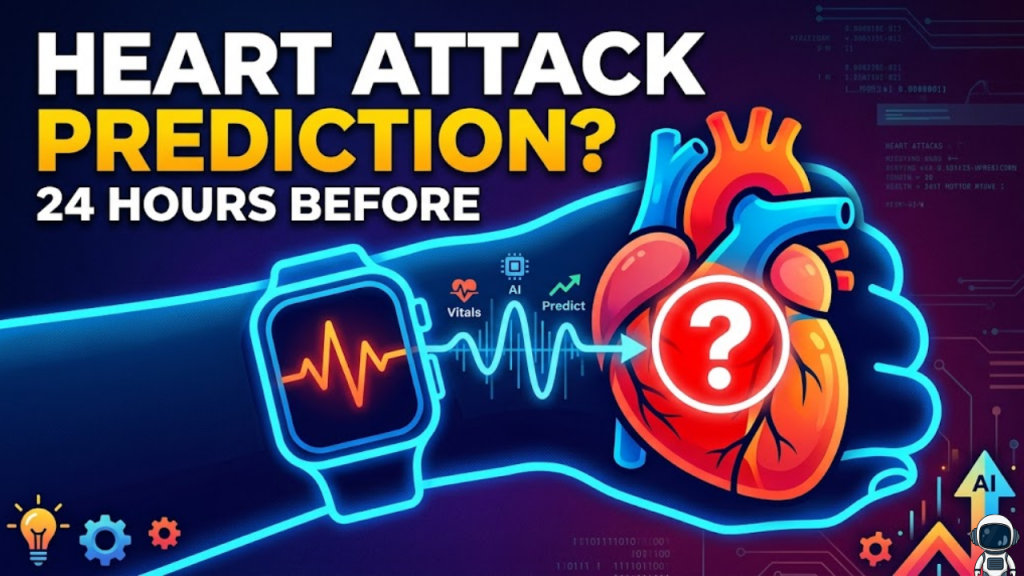
Can a wearable actually predict a heart attack? In 2026, the short answer is: almost. While standard smartwatches cannot yet give you a “24-hour warning” with 100% certainty, a new generation of wearable biosensors and AI-driven algorithms is closing the gap. Current research shows that specific biosensors can now detect “Invisible Signals”, such as micro-shifts in heart rate variability (HRV), magnetic field fluctuations, and sub-clinical arrhythmias—that often precede a major cardiac event by several hours or even a full day.
This technology is shifting the paradigm from “reactive treatment” to “anticipatory care,” potentially giving patients a critical head start to seek medical help before permanent damage occurs.
The Science of the “24-Hour Warning”
In 2026, the breakthrough isn’t just in the sensor itself, but in the AI Orchestration behind the data.
1. Magnetic Field Detection
Standard smartwatches use light (PPG) to track heart rate. However, 2026-era magnetic biosensors can now convert the heart’s actual magnetic field into voltage signals. These sensors provide a much higher fidelity of data, allowing machine learning models to identify abnormal heartbeats and subtle “deterioration signatures” that occur 24 hours before a patient feels any symptoms.
2. Multi-Modal Data Integration
AI models now achieve over 90% accuracy in risk assessment by combining data from multiple sources. A single wearable can now track:
- Heart Rate Variability (HRV): Rapid drops in HRV can signal extreme physiological stress.
- Respiratory Rate: Sudden increases often precede cardiac distress.
- ECG Synthesis: At-home, cable-free 12-lead ECGs can now be synthesized from a single wearable point, providing clinical-grade insights outside a hospital.
3. The “Symptom-to-Door” Gap
Currently, patients often wait 3 to 4 hours after feeling symptoms before seeking help. Wearable biosensors aim to eliminate this gap by providing an “Alert” the moment sub-perceptual changes are detected, effectively moving the intervention window back by several hours.
2026 Breakthrough: Predicting Heart Failure Years in Advance
While predicting an acute heart attack is the immediate goal, 2026 research has also unlocked the ability to predict Heart Failure up to five years in advance. AI tools at the University of Oxford now analyze “invisible textural changes” in the fat around the heart using routine scans. This “early warning system” allows doctors to treat inflammation years before it ever leads to a heart attack.
Frequently Asked Questions (FAQ)
1. Should I trust my Apple Watch to predict a heart attack?
In 2026, consumer smartwatches are excellent for detecting atrial fibrillation (AFib), but they are not yet FDA-cleared for heart attack prediction. You should use them as a “trend monitor” rather than a definitive diagnostic tool.
2. What is the difference between a heart attack and heart failure?
A heart attack is a “plumbing” problem where a blockage stops blood flow. Heart failure is a “pumping” problem where the heart becomes too weak to move blood efficiently. Wearables are becoming effective at detecting the early signs of both.
3. Are these sensors only for high-risk patients?
While high-risk patients benefit most, 2026 wellness trends see healthy individuals using “Preventive Patches” for continuous 24-hour monitoring to establish a “baseline” for their heart health.
4. Why do I see an Apple Security Warning on my health app?
If your medical app attempts to share unencrypted raw ECG data with a third-party server without your explicit consent, you may trigger an Apple Security Warning on your iPhone.
5. What is an “ECG Patch”?
This is a 2026 medical wearable that adheres to the chest. It provides a much more stable and accurate signal than a wrist-worn watch, making it the preferred tool for true 24-hour predictive monitoring.
6. Can AI tell me I’m having a heart attack right now?
Yes. Systems like HeartBeam are currently in pilot studies to enable at-home heart attack assessment using 3D ECG technology, aiming to significantly reduce the time it takes to get to an emergency room.
7. Does insurance cover these wearables in 2026?
Many private insurers and the NHS are beginning to cover medical-grade wearables for patients with a history of cardiovascular disease, as they reduce hospitalization rates by 18% to 25%.
8. What is the “Invisible Signal” researchers mention?
It refers to changes in the fat and magnetic fields around the heart that human doctors cannot see on standard scans but that AI can detect with high accuracy.
Final Verdict: The Era of the Early Warning
In 2026, wearable biosensors have not replaced the cardiologist, but they have given the cardiologist a “24-hour head start.” By monitoring the heart’s subtle electrical and magnetic shifts, these devices are turning the “silent” signs of a heart attack into loud, life-saving alerts.
Ready to upgrade your health tech? Explore our guide on How to Become a Web Developer in 2026 to learn how these medical APIs are built, or discover how to secure your data in Why Passkeys are Replacing Passwords in 2026.
Authority Resources
- Texas Tech: Researchers Hope to Advance Wearable Heart Monitoring – Deep dive into magnetic sensors and AI heart condition prediction.
- BHF: AI Tool Can Predict Heart Failure Five Years in Advance – The latest breakthrough in Oxford-led cardiac scanning.
- HeartBeam: Heart Attack Detection Pilot Study – Official progress on clinical-grade 3D ECG wearables.
- Dove Press: AI for Cardiovascular Risk Prediction Review – A comprehensive synthesis of AI accuracy in wearable heart monitoring.