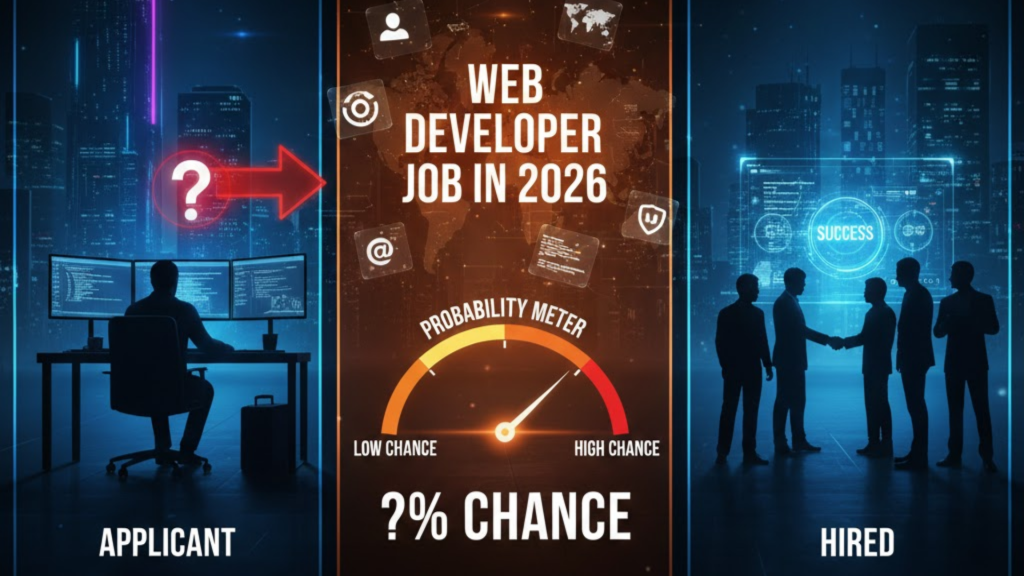
What is the actual probability of getting a web developer job in 2026?
The probability is high for those with specialized skills but significantly lower for “generalist” juniors. Specifically, while the US Bureau of Labor Statistics projects a 13% to 27% growth rate for web development roles through 2026, the entry-level market has seen a 46% to 67% collapse in traditional junior postings. Consequently, your success depends entirely on your ability to move beyond simple syntax and become an AI-augmented architect.
In 2026, the “average” developer role is dead. You are now either an orchestrator of systems or a victim of automation.
2026 Market Probability Index
Your probability of employment is no longer a single number; rather, it is a variable based on your technical “moat” and geographic flexibility.
| Candidate Type | Probability of Hire (Est.) | Primary Hiring Driver |
| Junior (HTML/CSS only) | <10% | Oversaturation & AI Automation |
| Junior (Full-Stack + AI) | 45% – 60% | Efficiency & Adaptability |
| Senior/Architect | 90%+ | Complexity & Accountability |
| Security/Compliance Specialist | 95% | Regulatory Needs (Data Privacy) |
Why the “Junior” Probability Has Collapsed
The reason the probability for new developers has dropped so sharply is the “Force Multiplier Effect.” In 2026, a single senior developer using agentic coding tools can produce the same output that previously required a team of three juniors.
- The Review Tax: Companies are hesitant to hire juniors because generating code is now easy, but verifying it for security and logic is mentally exhausting. Seniors are increasingly acting as “Code Janitors” rather than mentors.
- Task Automation: Junior-level tasks like writing unit tests, boilerplate, and basic CRUD operations are now 90% AI-generated. As a result, the “entry-level” bar has been raised to what was considered “mid-level” just three years ago.
Why the “Professional” Probability Remains High
Despite the junior squeeze, the overall demand for software is actually at an all-time high. Businesses across every sector—from fintech to healthcare—are undergoing massive digital transformations.
1. High-Growth Specialized Niches
Your probability of being hired in 2026 increases dramatically if you focus on high-demand sectors. For instance, Healthcare and Financial Services are desperate for developers who understand secure coding and privacy regulations.
2. The Wage Premium for AI Skills
If you possess AI-related skills, you don’t just have a higher probability of getting hired; you also command a 23% wage premium on average. Employers are shifting toward skills-based hiring, valuing modular certifications in AI engineering over traditional long-term degrees in some domains.
Frequently Asked Questions (FAQ)
1. Is it still worth learning web development in 2026?
Yes. Every business still needs an online presence. However, you must learn to orchestrate AI rather than compete with it. The real skill is taking an AI draft and making it secure, maintainable, and production-ready.
2. What is the average salary for a web developer in 2026?
The average salary is approximately $80,834, with senior roles in tech hubs like New York or London often exceeding $150,000 (£130,000+).
3. Will AI eventually replace all web developers?
No. AI is excellent at “building a brick,” but it cannot “build the wall.” Humans are still required for high-level architecture, business logic, and legal accountability.
4. How can I stand out in an oversaturated market?
Build agentic portfolios. Instead of a simple website, build a system where AI agents interact with databases and self-heal. Prove you can manage complexity.
5. Why do I see an Apple Security Warning on my browser?
If your development environment attempts to bypass system permissions or uses insecure local scripts, you may trigger an Apple Security Warning on your iPhone.
6. Do I need a degree to get hired in 2026?
While 67% of junior roles have vanished, those that remain often prefer candidates who show strong fundamentals. Degrees help, but skill-based certifications are now outperforming degrees in immediate market returns.
7. What languages should I learn in 2026?
Python (for AI/Backend), TypeScript/React (for Frontend), and Rust/Go (for performance infrastructure) are the most in-demand.
8. How long does it take to become job-ready?
With an AI-First learning path, most students become job-ready in 6–12 months by focusing on real-world projects and system design.
Final Verdict: Your Fate is in the “Stack”
To summarize, the probability of you getting a web developer job in 2026 is High if you are an AI-literate architect and Low if you are a traditional syntax coder. Adapt your skills to the new agentic reality, or prepare to be automated.
Ready to boost your probability? Learn how to build your first AI Design Assistant with Gemini or master the Top Dev Skills Needed to Shine in 2026.
External Authority Links
- LSE: The 10 Most In-demand Tech Careers of 2026 – Detailed role availability and earning potential.
- Web Professionals Global: The Outlook of the Web in 2026 – Industry insights into AI standard practices.
- Denoise Digital: The Disappearance of the Junior Developer – A deep dive into the structural shift for new grads.
- IT Jobs Watch: Web Development Job Trends & Salaries – Real-time vacancy and salary tracking.