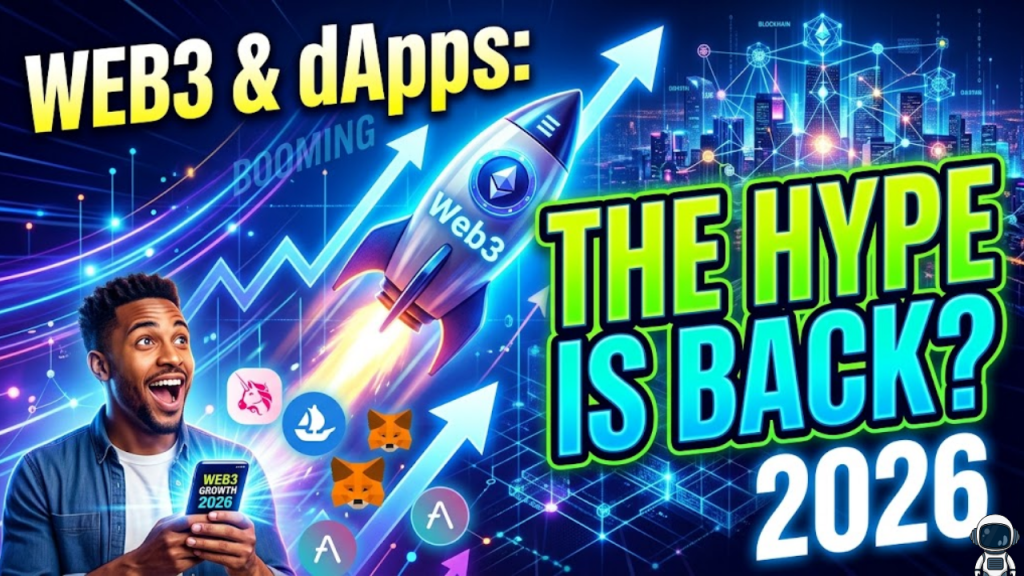
Is the Web3 hype back in 2026? The answer is yes, but it looks nothing like the speculative bubble of 2021. In 2026, the narrative has shifted from “get-rich-quick” schemes to Institutional Utility. While the public noise has quieted, the actual building has accelerated. Web3 is no longer a “buzzword”; instead, it has become a silent infrastructure layer for global finance, real-world asset (RWA) tokenization, and AI data verification.
Today, the most successful Decentralized Applications (dApps) are those that users don’t even realize are running on a blockchain.
The 2026 Shift: Hype vs. Utility
In 2026, we have moved from the “Experimental Phase” to the “Infrastructure Phase.” The focus is now on making the technology invisible and useful.
| Feature | 2021 Hype Era | 2026 Utility Era |
| Primary Driver | Speculation & NFTs | Institutional DeFi & RWAs |
| User Experience | Seed phrases & Gas fees | Social Logins & Gasless TXs |
| Architecture | Monolithic (Single Chain) | Modular & Interoperable |
| Regulation | “Wild West” (Uncertain) | Clear Frameworks (EU/US/UAE) |
| AI Integration | None | AI Agents & Data Provenance |
3 Trends Defining Web3 in 2026
To capitalize on the 2026 “Quiet Hype,” you must master these three structural shifts.
1. Tokenization of Real-World Assets (RWA)
This is the “Sleeping Giant” of 2026. Financial institutions are moving trillions of dollars onto the blockchain by tokenizing real estate, gold, and government bonds. Consequently, these assets are becoming fractionalized, allowing anyone to own a small piece of a skyscraper and earn rent automatically via smart contracts.
2. Account Abstraction (The End of the Wallet)
The biggest barrier to Web3 was the “Wallet Headache.” In 2026, Account Abstraction (EIP-4337) has become the standard. Users can now sign up for dApps using their email or FaceID. The blockchain bits, like private keys and gas fees, happen automatically in the background, making the experience identical to a Web2 app.
3. Modular Blockchains and Layer 2s
We no longer ask one chain to do everything. Instead, we use a “Lego-style” architecture. One layer handles the speed, another handles the data storage, and the main chain handles the security. This modular design has reduced transaction costs to nearly zero, enabling “App-Chains” built for specific purposes like gaming or stock exchanges.
Frequently Asked Questions (FAQ)
1. Is it still worth becoming a Web3 developer in 2026?
Yes. Demand for qualified Web3 talent is currently outpacing supply. Specifically, roles for Smart Contract Auditors and AI-Blockchain Architects command a 30% to 60% salary premium over traditional Web2 roles.
2. Can AI replace Web3 developers?
AI is a powerful tool for generating boilerplate code, but it cannot handle the Economic Modeling or Security Auditing required for decentralized systems. In 2026, the most valuable developers are “AI-augmented” engineers who use AI to work faster.
3. What is the difference between Web3 and Web 3.0?
While often used interchangeably, Web 3.0 refers to the “Semantic Web” (intelligent, interconnected data). Web3 refers specifically to the decentralized web built on blockchain technology.
4. Why do I see an Apple Security Warning on my dApp?
If your dApp attempts to authorize a transaction or access a hardware wallet over an unverified bridge on iOS, you may trigger an Apple Security Warning on your iPhone.
5. Does Web3 have a future in the Middle East?
Absolutely. Regions like the UAE (Dubai/Abu Dhabi) and Saudi Arabia have become global centers for Web3 innovation due to clear, forward-facing regulations like VARA.
6. What is “SocialFi”?
SocialFi is the 2026 trend where social media creators own their content and monetization through blockchain, rather than relying on centralized platform algorithms.
7. Do I need to buy crypto to use Web3 apps in 2026?
No. Thanks to Gas Sponsorship, many companies now pay the transaction fees for their users. You can use a dApp without ever owning a single token.
8. What happened to the “Four-Year Cycle”?
In 2026, many analysts believe the traditional four-year crypto cycle has ended. Massive institutional investment and real-world utility have replaced the purely speculative cycles of the past.
Final Verdict: The Revolution is Subtle
In 2026, the “Revolution” isn’t happening with fireworks; instead, it’s happening like plumbing or electricity, quietly and steadily. Web3 has matured into a practical tool for digital ownership and secure finance. The hype is back, but this time, it’s built on Value, not just Volume.
Ready to build on the new rails? Explore our guide on How to Become a Web Developer in 2026 or learn about the security of the future in Zero-Trust Architecture for Web Developers.
Authority Resources
- TradingView: Web3 and DApps in 2026 – A Utility-Driven Year – Analysis of the shift from speculation to practical application.
- Global Blockchain Show: Top Blockchain Trends to Watch in 2026 – Insights into the Middle East’s role in the decentralized economy.
- London Business News: Decoding Web3 Development Trends 2026 – Detailed breakdown of modularity and ZK-proofs.
- Grayscale: 2026 Digital Asset Outlook – Dawn of the Institutional Era – Financial analysis of regulatory clarity and market structure.