What is Cloud 3.0?
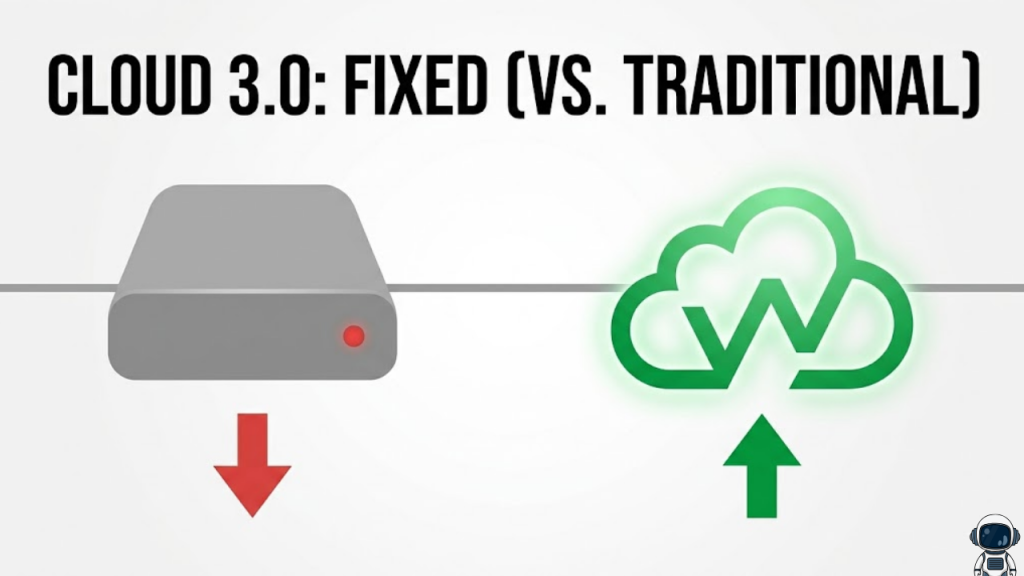
Cloud 3.0 is the third major evolution of cloud computing, defined by AI-native architecture, decentralized edge computing, and data sovereignty. In 2026, it has replaced the “centralized” model of traditional cloud. While earlier versions were about where your data lives, Cloud 3.0 is about how your data thinks and moves. It treats the entire internet, from massive data centers to tiny local sensors, as a single, intelligent “world computer” that is private by default and automated by AI.
In 2026, Cloud 3.0 isn’t just an upgrade; it is a paradigm shift that embeds intelligence into the very fabric of the network.
The Generational Gap: Cloud 1.0 vs. 2.0 vs. 3.0
To understand Cloud 3.0, you must see it in the context of what came before. Each era solved a specific problem of its time.
| Feature | Cloud 1.0 (2006-2015) | Cloud 2.0 (2016-2024) | Cloud 3.0 (2025+) |
| Core Tech | Virtual Machines (VMs) | Containers & Microservices | AI Agents & Data Mesh |
| Primary Goal | Cost (Lift & Shift) | Scalability (Agile/DevOps) | Intelligence & Sovereignty |
| Location | Centralized Data Centers | Multi-Cloud Regions | Distributed Edge & On-Prem |
| Management | Manual Configuration | Infrastructure as Code | Hyperautomation (AI-Driven) |
| Data Focus | Storage & Backup | Data Lakes & Big Data | Sovereign Data Fabric |
3 Pillars That Define Cloud 3.0 in 2026
The transition to Cloud 3.0 is driven by three essential requirements that traditional cloud simply cannot handle.
1. AI-Native Architecture
In 2026, AI is not “added” to the cloud; it is the foundation. Cloud 3.0 platforms are designed to run Generative AI and Large Language Models (LLMs) natively. This includes GPU-optimized scheduling and “predictive scaling,” where the cloud uses AI to guess when your traffic will spike before it happens, saving you up to 40% in operational costs.
2. Digital and Data Sovereignty
With the rise of “Sovereign Clouds,” data must now follow the laws of the land where it was created. Cloud 3.0 uses Localized Infrastructure to ensure that sensitive information—like healthcare or financial records—never leaves national borders, protecting organizations from extraterritorial legal reach and foreign surveillance.
3. Decentralized “Compute Anywhere”
Data has gravity. In 2026, it is too expensive to move petabytes of data to a central cloud. Cloud 3.0 brings the Compute to the Data. Whether it’s an edge node in a factory or a private server in an office, the cloud treats these distributed points as a single, cohesive resource pool.
Frequently Asked Questions (FAQ)
1. Do I need to leave AWS or Azure for Cloud 3.0?
No. Major providers like Microsoft and Google are evolving into Cloud 3.0 platforms. However, you will likely use them as part of a Hybrid Orchestration model, where your sensitive data stays in a local sovereign cloud while your public apps run on their global infrastructure.
2. Is Cloud 3.0 more expensive?
Initially, the setup is more complex. However, through Intelligent Automation, Cloud 3.0 systems can optimize their own costs in real-time. Gartner estimates that by late 2026, AI-driven cloud operations will be 30% more cost-effective than traditional manual models.
3. What is a “Data Fabric”?
In Cloud 3.0, we stop using “Data Lakes” (one giant silo). Instead, we use a Data Fabric that connects different data sources regardless of where they live. Your apps query the fabric, and the fabric finds the data instantly, keeping it where it belongs for compliance.
4. Why do I see an Apple Security Warning on my Cloud 3.0 dashboard?
If your distributed cloud nodes use self-signed certificates or unverified tunnels to communicate across regions, you may trigger an Apple Security Warning on your iPhone or Mac.
5. What is “Hyperautomation”?
This is the use of AI agents to manage your entire cloud stack. In 2026, these agents handle monitoring, security patching, and cost optimization without any human intervention.
6. Is Cloud 3.0 the same as Web 3.0?
No. Web 3.0 is about decentralized ownership and blockchain. Cloud 3.0 is about decentralized infrastructure and AI intelligence. While they often work together, they solve different problems.
7. How does Cloud 3.0 help with Cybersecurity?
Cloud 3.0 uses AI-driven security frameworks that learn what “normal” behavior looks like. If a user logs in from an unusual location or tries to move a large amount of data, the system detects the anomaly and blocks the threat in real-time.
8. Who is the biggest user of Cloud 3.0?
Government agencies, healthcare providers, and global financial institutions are the early adopters because they require the extreme Security and Sovereignty that Cloud 3.0 provides.
Final Verdict: Intelligence Over Infrastructure
In 2026, the cloud is no longer just a place to “rent a server.” Cloud 3.0 has transformed the internet into an intelligent, sovereign, and distributed ecosystem. By moving beyond traditional cloud, businesses can finally build applications that are as smart as the users they serve.
Ready to modernize? Explore our guide on Edge Functions vs. Serverless to see where your code should live in a Cloud 3.0 world, or discover the Top Tech Careers to Start in 2026.
Authority Resources
- TechAlb: The Rise of Cloud 3.0 in 2026 – A deep dive into hybrid orchestration and sovereign data control.
- CTO Magazine: Why 2026 is the Year of Smart Cloud – Insights into how AI automation is driving 60% of cloud operations.
- Vofox: Cloud 3.0 Explained for AI-Ready Apps – A developer’s perspective on building for multi-cloud and data fabric.
- Zentrix Infotech: Sovereign & Hybrid Cloud Security – Practical benefits of Cloud 3.0 for data residency and compliance.