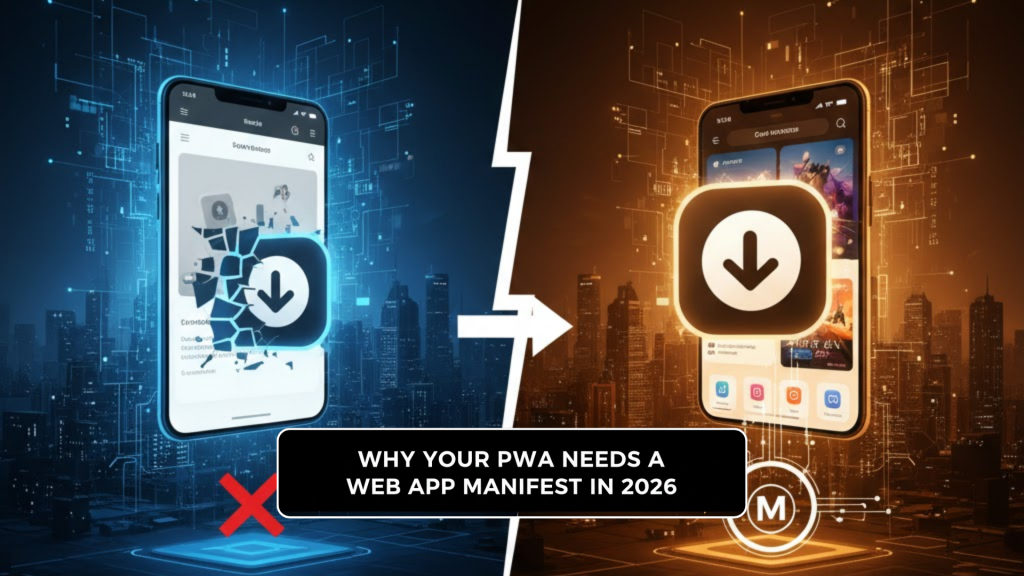
What is the role of a Web App Manifest in 2026? The Web App Manifest is a JSON file that serves as the “identity card” for your Progressive Web App (PWA). In 2026, it is no longer just a file for icons; rather, it is a sophisticated capabilities descriptor that tells the operating system how to integrate your web app into the native environment. Without it, your site is just a tab in a browser; with it, your app becomes an installable, standalone entity that lives in the user’s app drawer, taskbar, or home screen.
As of 2026, every major browser, including Safari on iOS 26 and Chrome on Android; fully supports the manifest specification, making it the single most important file for cross-platform discoverability and installation.
Key Benefits: The 2026 Installation Criteria
In 2026, the criteria for a “Good” PWA have stabilized. To trigger the native installation prompt, your manifest must meet specific standards.
| Feature | Impact on the User Experience | Required Manifest Member |
| Standalone UI | Removes the URL bar and browser chrome | "display": "standalone" |
| Splash Screen | Shows a branded logo while the app loads | "background_color" & "icons" |
| App Shortcuts | Provides 3D Touch-style quick actions | "shortcuts" |
| Deep Linking | Defines which URLs “belong” to the app | "scope" |
| Theme Sync | Matches the OS status bar color | "theme_color" |
3 Reasons Why the Manifest is Critical in 2026
1. Unified Cross-Platform Installation
In 2026, PWA is the only format that allows Universal Installation. One manifest file works for iOS, Android, macOS, Windows, and ChromeOS. Instead of spending £50,000 to £250,000 building separate native apps for each store, you can maintain a single codebase that provides a comparable experience.
2. Native OS Integration (Agentic Era)
Modern manifests now support File Handlers and Protocol Handlers. This means your PWA can be set as the “default app” for specific file types (like .pdf or .csv). When a user opens an associated file, the OS automatically launches your PWA, exactly like a native application.
3. Discoverability and SEO Gains
Unlike native apps hidden behind app store algorithms, PWAs are fully indexable by Google. In 2026, search engines use your manifest data to “rank and surface” your app content directly in organic search results. This allows your app to appear for competitive keywords while simultaneously serving as your mobile experience.
How to Implement Your Manifest Correctly
To ensure your PWA is recognized in 2026, follow this standard implementation:
- Create
manifest.webmanifest: Use the.webmanifestextension for better MIME type support (application/manifest+json). - Define Maskable Icons: Ensure you include maskable icons so your app looks perfect on Android’s adaptive icon shapes.
- Link on Every Page: Add the link tag to the
<head>of every HTML file:<link rel="manifest" href="/app.webmanifest">.
Frequently Asked Questions (FAQ)
1. Is manifest.json still okay to use in 2026?
Yes, but the .webmanifest extension is preferred by modern web standards for its specific content-type registration.
2. Why is my PWA not triggering the install prompt?
Common causes include: not being served over HTTPS, missing a Service Worker with a fetch handler, or a manifest that lacks the 192px and 512px icon sizes.
3. Can I use CSS variables in the manifest?
No. The manifest is a static JSON file. For dynamic theme colors (like Dark Mode), you should use a meta tag in your HTML with a media query to override the manifest’s default value.
4. What is the “Scope” member for?
The "scope" property defines the navigation boundary of your PWA. If a user clicks a link outside this scope, the browser will open it in a regular tab instead of within your standalone app window.
5. Why do I see an Apple Security Warning on my PWA?
In 2026, if your PWA attempts to access sensitive APIs (like Bluetooth or NFC) without an explicit user interaction, or if it lacks a valid SSL certificate, you may trigger an Apple Security Warning on your iPhone.
6. Do I need different manifests for iOS and Android?
No. The goal of the 2026 specification is to use a single manifest. However, you should provide different icon sizes to ensure compatibility with Apple’s “Add to Home Screen” and Android’s adaptive shapes.
7. What is “JIT-installed” Wasm?
In some 2026 payment apps, the manifest can reference a Service Worker that is “Just-In-Time” installed to handle secure background tasks like payment processing.
8. Who is the leader in PWA support in 2026?
Microsoft Edge on Windows currently offers the deepest integration, allowing PWAs to run on startup, appear in the Windows Store, and handle native file associations.
Final Verdict: The Bridge to Native
In 2026, the Web App Manifest is no longer optional. It is the bridge that allows your web application to cross the gap into a native-like experience. By providing a clean, structured identity, you unlock higher engagement, better retention, and a permanent spot on your user’s device.
Ready to build? Check out our guide on Next.js 16 vs. Nuxt 4 to see which framework handles PWA generation best, or explore the Top Dev Skills Needed to Shine in 2026.
Authority Resources
- MDN Web Docs: Web Application Manifest Reference – The technical specification for all manifest members.
- web.dev: Web App Manifest Guide – Best practices for icons, colors, and display modes.
- Microsoft Edge: Overview of PWAs in 2026 – How manifests drive native integration on desktop.
- Digital Applied: Progressive Web Apps 2026 Performance – Industry data on the business impact of installable PWAs.