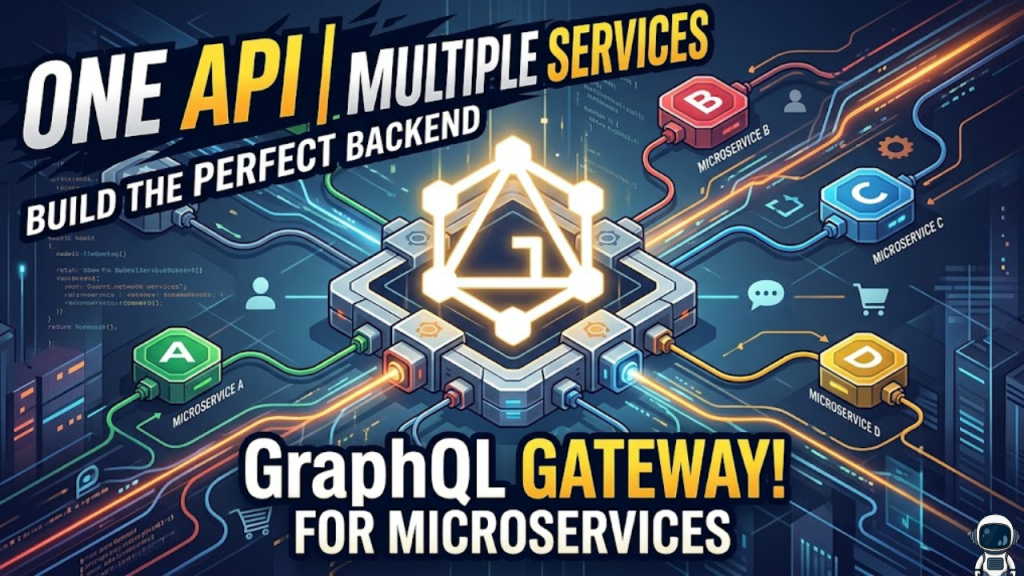
What is a GraphQL Gateway in 2026?
A GraphQL Gateway (often called a “Router” or “Supergraph”) acts as the central brain of a microservices architecture. In 2026, the standard approach is GraphQL Federation. Instead of one team maintaining a massive, bloated gateway, each microservice (subgraph) owns its own portion of the schema. The gateway then automatically composes these pieces into one “Supergraph,” allowing clients to fetch data from ten different services with a single query.
By 2026, over 60% of developers have moved to this model to eliminate the “N+1” request problem where the frontend has to hit multiple REST endpoints for a single screen.
3 Pillars of a 2026 GraphQL Gateway
In 2026, the ecosystem has converged around high-performance, binary routers that prioritize speed and safety.
1. Federated Schema Composition
Stop using “Schema Stitching.” In 2026, use Apollo Federation 2.0 or Cosmo. These protocols allow subgraphs to “extend” each other. For example, your Users service can define a user, and your Reviews service can “extend” that user with a list of reviews. The gateway handles the complex “stitching” logic automatically.
2. The Native Router (Rust-Based)
The 2026 standard is to move away from Node.js gateways toward compiled binaries like the Apollo Router or Hive Router. Built in Rust, these routers handle query planning and execution with sub-millisecond latency. Benchmarks show they are up to 10x faster and use 80% less memory than older JavaScript-based gateways.
3. Declarative Query Planning
A modern gateway doesn’t just “proxy” requests. It creates a Query Plan, a set of instructions on which services to hit in what order. In 2026, you can preview these plans in your IDE to ensure that adding a new field doesn’t accidentally add three unnecessary network hops.
Security: The “Zero-Trust” Gateway
In 2026, the gateway is the primary enforcer of your Zero-Trust policy.
- JWT Propagation: The gateway verifies the user’s JWT once and then propagates the identity (often via a “Context” header) to every downstream microservice.
- Query Cost Analysis: To prevent Denial-of-Service (DoS) attacks, the gateway calculates a “cost” for every query before executing it. If a user tries to request 1,000 nested items, the gateway rejects the query before it even touches your microservices.
- Persisted Queries: For public-facing apps, only allow specific, “pre-approved” queries. This prevents attackers from sending arbitrary, complex queries to discover your schema.
Frequently Asked Questions (FAQ)
1. Can I use GraphQL as a gateway for REST services?
Yes! This is a very common 2026 pattern. You can use GraphQL Yoga or Apollo Router to wrap your existing REST APIs in a GraphQL layer. This allows you to gain the benefits of GraphQL on the frontend without rewriting your backend.
2. What is the difference between a Gateway and a Router?
In 2026, “Gateway” refers to the architectural pattern. “Router” (like the Apollo Router) refers to the specific, high-performance software that executes that pattern. Most new 2026 projects should use a native Router.
3. How do I handle “Breaking Changes” in a Supergraph?
Use a Schema Registry (like Apollo Studio or Hive). In 2026, these tools perform “Composition Checks” every time a team pushes an update. If an update would break the Supergraph, the CI/CD pipeline blocks it automatically.
4. Why do I see an Apple Security Warning on my GraphQL endpoint?
If your gateway attempts to use Introspection (letting anyone see your entire schema) over a non-secure connection, you may trigger an Apple Security Warning on your iPhone. Always disable introspection in production.
5. What is the “N+1” problem in GraphQL?
This happens when a query fetches a list of items and then makes a separate request for each item’s details. In 2026, we solve this at the gateway level using DataLoader patterns and efficient query planning.
6. Is GraphQL Federation hard to scale?
Quite the opposite. Federation is designed for scale. It allows 50 different teams to work on 50 different services simultaneously without stepping on each other’s toes, all while presenting a single API to the user.
7. Which language is best for subgraphs in 2026?
Any language! Since subgraphs communicate via a standard protocol, you can have a Users service in Go, a Payments service in Rust, and a Legacy service in Java, all working together in one Supergraph.
8. What is “Enterprise GraphQL”?
This refers to the 2026 trend of adding Governance, Rate Limiting, and Role-Based Access Control (RBAC) directly into the gateway layer to ensure the API is safe and manageable for large organizations.
Final Verdict: The Unified Future of APIs
In 2026, a GraphQL Gateway is the heart of a resilient microservices architecture. By consolidating your fragmented APIs into a single, type-safe supergraph, you drastically improve the developer experience and provide a faster, more reliable product to your end users.
Ready to unify your services? Explore our guide on Zero-Trust Architecture for Web Developers to secure your gateway, or learn about the Top Dev Skills Needed to Shine in 2026.
Authority Resources
- Apollo GraphQL: Why a Federated Graph is Best for Microservices – The industry standard for supergraph architecture.
- The Guild: GraphQL Hive Performance Benchmarks – Real-world data on 2026 gateway efficiency and reliability.
- Refonte Learning: API Engineering in 2026 – A look at how GraphQL and gRPC are replacing REST for internal services.
- StackHawk: A Developer’s Guide to GraphQL Security – Critical best practices for protecting your federated API.