Is space the new factory for the world’s most advanced glass?
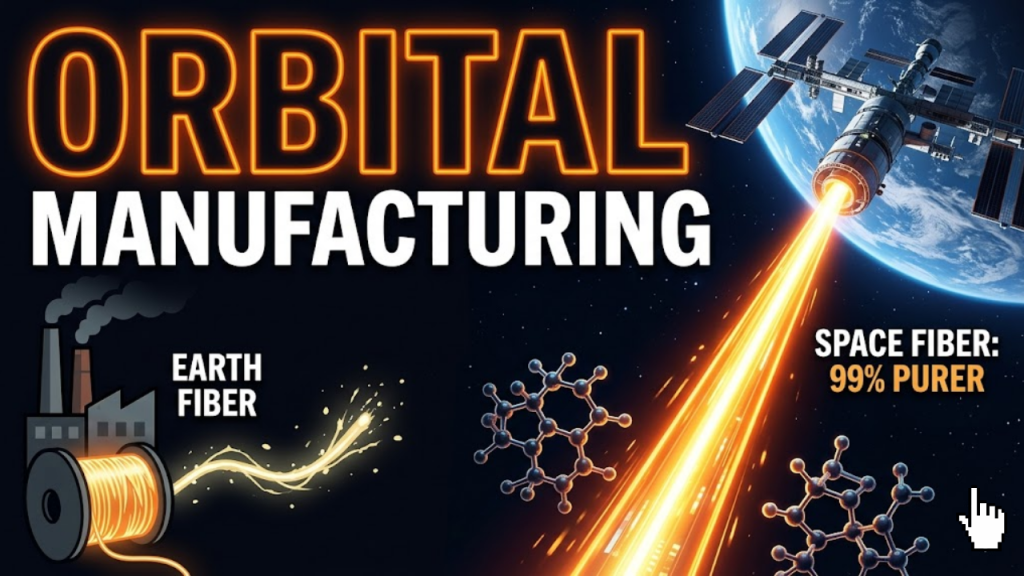
Many researchers believe that the answer is yes. For decades, engineers have struggled to manufacture ZBLAN fluoride glass fiber on Earth because gravity ruins the process. On our planet, gravity induces crystallization and impurities within the glass structure during fabrication. In contrast, the microgravity environment of Low Earth Orbit (LEO) eliminates these gravitational forces entirely. Consequently, companies are now actively racing to build “orbital factories” that produce fiber optics with signal loss up to 100 times lower than conventional silica fiber.
In 2026, we are witnessing a shift where the unique conditions of space, microgravity, vacuum, and extreme temperature stability, are becoming a viable asset for commercial material production.
The Gravity Problem: Why Earth Fails at ZBLAN
Silica-based fiber optics serve as the backbone of today’s internet. However, silica has reached its physical performance limits. ZBLAN, a heavy metal fluoride glass, theoretically outperforms silica by a massive margin. Unfortunately, the moment you melt ZBLAN on Earth, gravity interferes with the delicate molecular structure.
- Crystallization: As the glass cools, gravity encourages the growth of crystals. These microscopic defects act as “roadblocks” for light, scattering signals and causing massive data loss.
- Buoyancy and Sedimentation: On Earth, gravity forces denser materials to settle, leading to uneven density in the glass. This lack of homogeneity prevents ZBLAN from reaching its potential as a low-loss medium.
The Microgravity Advantage
Manufacturing in orbit solves these issues by creating a stable, undisturbed environment. By moving production to Low Earth Orbit, we unlock three major performance breakthroughs:
- Suppression of Crystallization: In the absence of buoyancy and sedimentation, the fluoride glass forms a much more uniform structure. This suppresses the crystallization that plagues terrestrial production.
- Surface Tension Dominance: Without the weight of gravity, surface tension becomes the dominant force. This allows engineers to shape the fiber with extreme precision, forming a more perfect geometry that light can travel through without interference.
- Purity at Scale: Because the environment is naturally undisturbed, researchers can achieve a level of material purity that is practically impossible to replicate in an Earth-bound factory.
Potential Impact on 2026 Technology
If orbital manufacturing succeeds at scale, the impact on telecommunications, defense, and healthcare will be profound.
- Next-Generation Telecommunications: With 100 times less signal loss, we could potentially create transoceanic cables that require no signal repeaters. This would reduce latency and energy consumption for global data centers.
- Advanced Medical Imaging: ZBLAN fiber transmits light from ultraviolet to mid-wave infrared ranges. This enables ultra-sensitive medical sensors and laser scalpels that offer doctors unparalleled precision during surgery.
- Defense and Sensing: High-power fiber lasers for LiDAR and infrared countermeasures benefit significantly from lower signal loss. Consequently, this leads to safer airborne platforms and more precise remote sensing.
Frequently Asked Questions (FAQ)
1. Is it affordable to manufacture in space?
Currently, the cost is high. However, the value of the final product, ultra-low-loss fiber, is also extremely high. Many companies are developing compact, automated payloads to minimize launch mass, making the unit cost per kilometer of fiber more viable.
2. Can we automate the whole process?
Yes. Modern orbital factories are designed to be autonomous. Developers are now creating specialized software interfaces that allow ground teams to monitor fiber draw processes in real time via satellite links.
3. What is the biggest challenge right now?
The primary challenge is the “down-mass” constraint. It is currently difficult and expensive to bring large quantities of delicate materials back to Earth without damaging them during the high-heat re-entry phase.
4. Why do I see an Apple Security Warning on space manufacturing data?
If you access sensitive research or proprietary orbital telemetry through an insecure public network or non-encrypted satellite link, you may trigger an Apple Security Warning on your iPhone.
5. Who are the main players in this market?
In 2026, companies like OrbiSky, Space Forge, and BioOrbit are leading the charge. They are actively securing government contracts to prove that in-orbit manufacturing is a scalable commercial market.
6. Will this make our internet faster?
Yes. By reducing signal loss, data can travel much further before it needs a boost. This decreases the number of “hops” a signal must take, which improves overall global latency.
7. Does this affect the environment?
Space-based manufacturing is surprisingly clean. Because the factory is a closed system in orbit, it avoids the hazardous waste often associated with heavy-metal glass manufacturing on Earth.
8. How close are we to commercial production?
We are in the study and prototype phase. Several companies have successfully demonstrated small-scale fiber drawing on the International Space Station, with commercial-scale “factory” satellites planned for 2027 and 2028.
Final Verdict: The Space-Made Future
In 2026, orbital manufacturing is no longer a science fiction concept. It is a strategic frontier. By leveraging the unique laws of physics found in microgravity, we are opening the door to a new era of fiber optics that will power the next generation of global data, medicine, and defense.
Ready to explore more frontier tech? Explore our guide on Using WebGL and Three.js for 3D Product Showcases or learn how to optimize your infrastructure in Zero-Trust Architecture for Web Developers.
Authority Resources
- UK Space Agency: In-Orbit Manufacturing Research – The latest government contracts for LEO manufacturing studies.
- ISS National Lab: ZBLAN Fiber Production – Technical overview of manufacturing in microgravity environments.
- NASA TechPort: Orbital Fiber Optic Production Module – Official NASA project documentation for orbital optical modules.
- Payload Space: UK Investment in In-Orbit Manufacturing – Analysis of the commercial viability of space-grown materials.