
Technology

The Impact of WebAssembly (Wasm) on Browser Performance

The Impact of WebAssembly (Wasm) on Browser Performance

What is the impact of WebAssembly on browser performance in 2026? The impact is a total removal of the “JavaScript performance ceiling.” WebAssembly (Wasm) allows web applications to execute at near-native speeds by providing a low-level, binary compilation target for languages like C++, Rust, and Go. In 2026, the finalization of the Wasm 3.0 specification […]

The Impact of WebAssembly (Wasm) on Browser Performance Read More »

Svelte 5 Runes: Is This the End of Complex State Management? (2026)

Svelte 5 Runes: Is This the End of Complex State Management? (2026)

What are Svelte 5 Runes? Runes are explicit, signal-based primitives that unify reactivity inside and outside of components. In 2026, they have fundamentally changed how we build apps by allowing reactive state to live in standard .svelte.ts files without the boilerplate of “stores” or external libraries. With the introduction of $state, $derived, and $effect, Svelte

Svelte 5 Runes: Is This the End of Complex State Management? (2026) Read More »

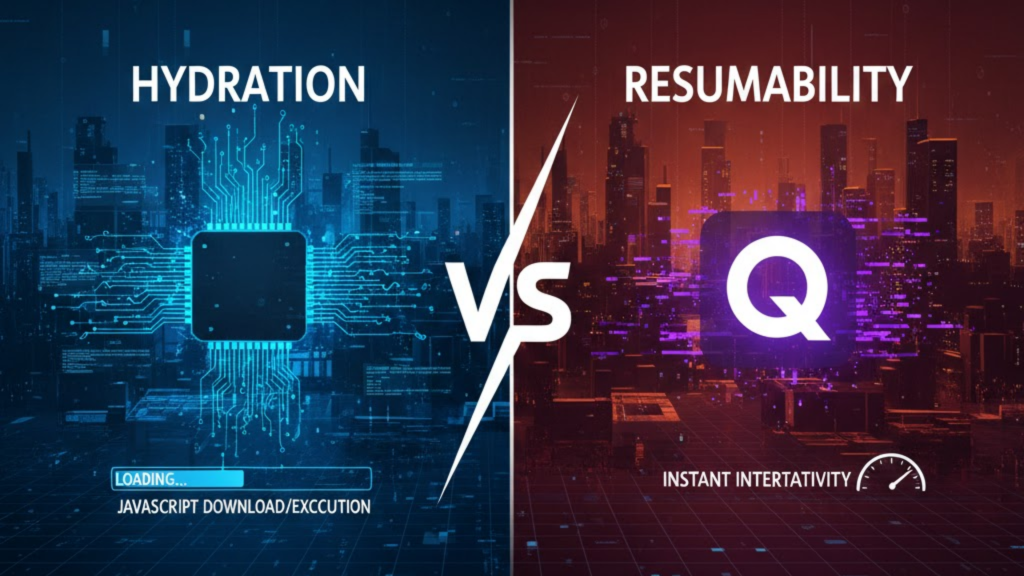
Hydration vs. Resumability Why Qwik is Dominating Performance (2026)

Hydration vs. Resumability: Why Qwik is Dominating Performance (2026)

What is the difference between hydration and resumability? In 2026, Hydration is viewed as a “performance tax.” It is the process where a browser downloads the entire component tree and re-executes all the JavaScript to attach event listeners before a page becomes interactive. Resumability, pioneered by the Qwik framework, skips this step entirely. It serializes

Hydration vs. Resumability: Why Qwik is Dominating Performance (2026) Read More »

Building "Backendless" Apps with Server Functions and TypeScript (2026)

Building “Backendless” Apps with Server Functions and TypeScript (2026)

What exactly is a “Backendless” app? In 2026, “Backendless” doesn’t mean your app has no backend; rather, it means you no longer write, maintain, or deploy a separate backend server. Instead, you use Server Functions—asynchronous, server-only functions that you call directly from your frontend components like regular TypeScript functions. This “Zero-API” approach eliminates the need

Building “Backendless” Apps with Server Functions and TypeScript (2026) Read More »

Probability of Getting a Web Developer Job in 2026: The Hard Reality

Probability of Getting a Web Developer Job in 2026: The Hard Reality

What is the actual probability of getting a web developer job in 2026? The probability is high for those with specialized skills but significantly lower for “generalist” juniors. Specifically, while the US Bureau of Labor Statistics projects a 13% to 27% growth rate for web development roles through 2026, the entry-level market has seen a

Probability of Getting a Web Developer Job in 2026: The Hard Reality Read More »

How the React Compiler Eliminates useMemo Once and For All

How the React Compiler Eliminates useMemo Once and For All

What is the React Compiler? The React Compiler is a build-time tool that automatically optimizes your application by handling memoization and reducing unnecessary re-renders. In 2026, it is the industry standard for production React apps. It analyzes your JavaScript code to understand the “Rules of React,” allowing it to safely cache components and values without

How the React Compiler Eliminates useMemo Once and For All Read More »