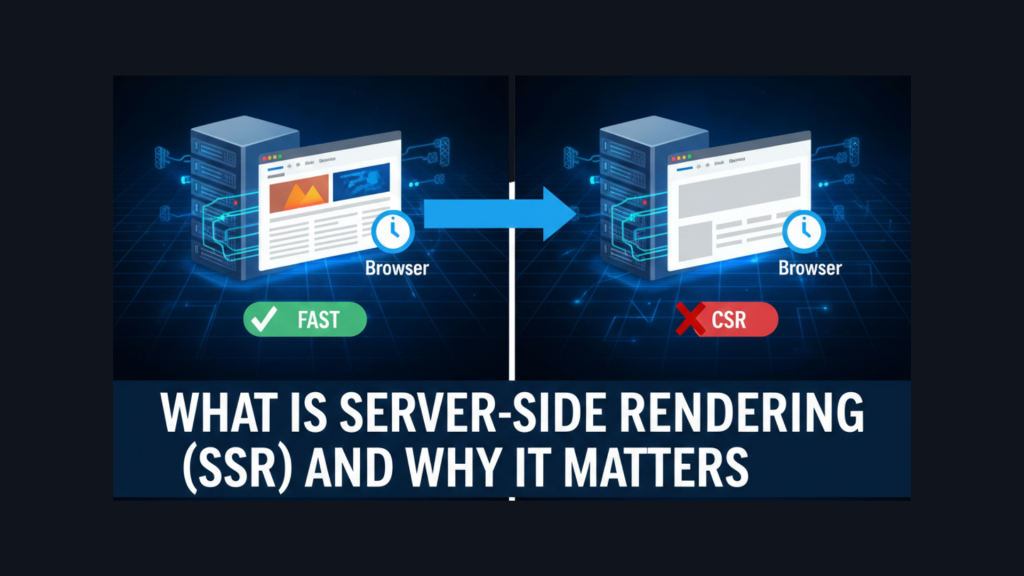
If you have ever visited a website that loaded instantly, even on a slow connection, you likely experienced Server-Side Rendering (SSR). In 2026, SSR is not just a buzzword; it is a fundamental strategy for building fast, SEO-friendly web applications. Unlike traditional client-side rendering, SSR delivers fully-formed HTML to the browser, significantly improving initial load times and search engine visibility.
At WeBlogTrips, we empower developers to build exceptional user experiences. Consequently, we created this guide to explain What Is Server-Side Rendering (SSR) and Why It Matters so you can leverage its power for your next project.
Visual Comparison: SSR vs CSR
| Feature | Server-Side Rendering (SSR) | Client-Side Rendering (CSR) |
| Initial Load | Fast (Full HTML delivered) | Slow (Empty HTML, then JS loads) |
| SEO | Excellent (Bots see content immediately) | Poor (Bots struggle with empty pages) |
| User Experience | Instant content, then interactive | Delay before interaction |
| Server Load | Higher (Renders on server) | Lower (Browser renders) |
| Common Frameworks | Next.js, Nuxt.js, SvelteKit | Create React App, Vue CLI |
1. What Is Server-Side Rendering (SSR) Under the Hood?
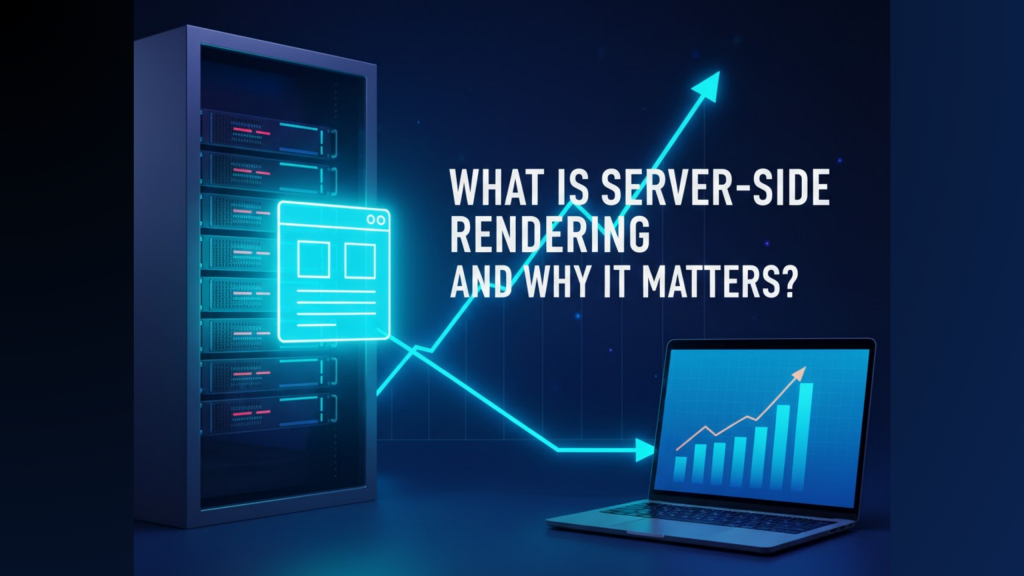
To understand What Is Server-Side Rendering (SSR) and Why It Matters, imagine the process. When a user requests a page, the server does not just send an empty HTML file. Instead, the server takes your React, Vue, or Angular code, executes it on the server, and generates a complete HTML document.
The browser then receives this fully-formed HTML, which immediately displays the content to the user. After the HTML loads, the JavaScript “hydrates” the page, making it interactive. This “content-first” approach is the core of What Is Server-Side Rendering (SSR) and Why It Matters.
2. The SEO Advantage of Server-Side Rendering (SSR)
One of the most compelling reasons to use Server-Side Rendering (SSR) is for Search Engine Optimization (SEO). Search engine crawlers (like Googlebot) are programmed to read HTML.
With traditional Client-Side Rendering (CSR), the server sends an empty HTML file that bots struggle to understand. They have to wait for the JavaScript to execute, which can sometimes lead to content being missed or indexed poorly. However, with Server-Side Rendering (SSR), the bots immediately see all your content, giving your site a significant ranking boost.
3. User Experience and Performance Boost
Beyond SEO, What Is Server-Side Rendering (SSR) and Why It Matters deeply affects user experience. Studies show that users abandon websites that take longer than 3 seconds to load.
SSR directly tackles this by providing the “First Contentful Paint” (FCP) almost instantly. Even if the JavaScript is still loading in the background, the user sees your content and can start reading. This perceived speed makes your application feel much faster and more responsive, especially on mobile devices or slower networks.
Frequently Asked Questions (FAQ)
1. Does SSR mean my app is no longer a Single Page Application (SPA)?
No. An SSR application can still be an SPA. The initial render happens on the server, but after that, client-side routing takes over, and subsequent page transitions often behave like a traditional SPA without full page reloads.
2. Is SSR always the best choice?
Not always. What Is Server-Side Rendering (SSR) and Why It Matters is about trade-offs. For highly interactive, authenticated dashboards that are not meant to be indexed by search engines, CSR might be simpler. SSR adds server complexity and can increase hosting costs.
3. Can an SSR application trigger an Apple Security Warning?
If your SSR framework attempts to fetch or render sensitive user data without proper encryption or authentication, you might trigger an Apple Security Warning on your iPhone. Always ensure your server-side data handling adheres to strict security protocols.
Final Verdict: What Is Server-Side Rendering (SSR) and Why It Matters
To summarize What Is Server-Side Rendering (SSR) and Why It Matters:
- SSR delivers full HTML to the browser, making sites load faster.
- It provides a huge boost to SEO, as search engines see content immediately.
- It creates a superior user experience by showing content quickly.
For any public-facing website in 2026, understanding and implementing Server-Side Rendering is crucial for success.
More From Weblogtrips
- React vs Next.js: What Should You Use in 2026?: See how Next.js leverages SSR.
- React Suspense and Error Boundaries: A Modern Guide: Essential partners for the
use()Hook. - React Query vs useEffect for Data Fetching: How modern data libraries integrate with Suspense.
- What Is Server-Side Rendering and Why It Matters: A deep dive into Next.js’s core strength.
- Why JavaScript Is Single-Threaded: How the main thread handles the Garbage Collector.
- React 18 useEffect: Why It Runs Twice: Why cleanup functions are the key to memory safety.
- Promise vs async/await: What Actually Happens?: How orders move through the kitchen.
- JavaScript Closures Explained Like You’re 5: How memory is preserved during async suspension.
- Why Your Website Is Slow and How to Fix It: How Next.js tackles performance bottlenecks.
- let vs var vs const Explained with Real Examples: Why block scope is the best partner for closures.
- REST API vs GraphQL Explained for Beginners: APIs are where most CORS errors live.
- Best Website Hosting 2026: Find hosts with integrated CDN features.
- HTML vs HTML5: What’s the Real Difference?: The foundation that holds your CSS.
External Links
- MDN: Server-side rendering: The official definition and explanation.
- Google Developers: Hydration: A deep dive into how JavaScript makes SSR pages interactive.
- Next.js Documentation: Rendering Methods: Practical examples of implementing SSR.