
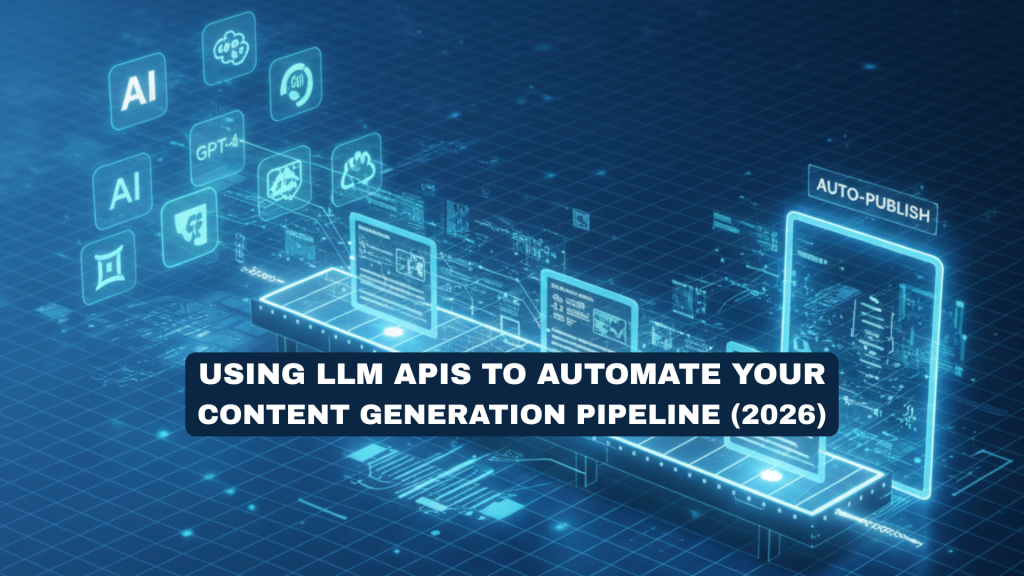
How do you build a content engine that actually delivers ROI? In 2026, the answer lies in an automated content generation pipeline. By leveraging LLM APIs like Gemini 3.0 and Claude 4.5, businesses are moving away from manual drafting toward a system of agentic orchestration. Consequently, this modern approach allows you to scale from one blog post a week to ten high-quality articles per day while maintaining a consistent brand voice.
If you want to stay competitive, you must stop treating AI as a simple chatbot. Instead, you should start treating it as a modular workflow engine. Automated content generation pipeline systems reduce manual labor by up to 70% and have become the new standard for digital growth.
What is an automated content generation pipeline exactly?
An automated content generation pipeline is a multi-stage software system that uses LLM APIs to research, draft, and optimize digital content. Unlike a simple “prompt and paste” method, this 2026 workflow uses AI agents to handle specific tasks in a sequence. For example, one agent might gather real-time data from search APIs, while another uses that data to build an SEO-optimized outline.
Furthermore, the ultimate goal of an automated content generation pipeline is to create a “hands-off” system. As a result, you only need to perform a final “vibe check” before publishing your work.
The Performance Gap: Traditional vs. AI-Driven Flow
| Feature | Traditional Manual Pipeline | Modern Content Automation (2026) |
| Research Time | 2 to 4 hours (Manual Search) | 30 seconds (Real-time Agentic Search) |
| Drafting Cost | $150+ per technical article | Less than $1.50 in API tokens |
| Publishing Speed | Days or weeks | Minutes (Auto-sync to CMS) |
| SEO Accuracy | Manual keyword research | Automated Semantic Entity Mapping |
| Output Volume | Limited by headcount | Scalable on demand |
Why should you automate your content pipeline in 2026?
The industry is shifting rapidly from “AI-assisted” to “AI-First” development. In fact, over 80% of enterprises now use generative AI to manage their digital workflows. Therefore, an automated pipeline is the primary tool for these organizations to maintain authority without exploding their budget.
1. Massive cost optimization
Using LLM APIs like Gemini 2.5 Flash allows you to generate content at a fraction of the cost of legacy models. Because prices have dropped to as low as $0.10 per million tokens, you can run an entire month of content for the price of a single coffee.
2. Real-time relevance and data grounding
Modern systems use Retrieval-Augmented Generation (RAG) to ensure facts are accurate. Specifically, your automated content generation pipeline can pull the latest market trends from the web and integrate them into your posts. Thus, you never publish outdated information.
3. Hyper-personalization at scale
In 2026, your automated content generation pipeline can create personalized variants of the same article for different audience segments. For instance, you can generate a “beginner” version and a “technical” version of a post simultaneously. This increases your reach with zero extra effort.
How to build an automated content generation pipeline with LLM APIs?
Building an automated content generation pipeline requires a “Modular Agent” strategy. You don’t need a massive engineering team; rather, you just need to connect the right APIs.
Step 1. Select your LLM API providers
In 2026, model swapping is a best practice. Because different models excel at different tasks, you should use a mix:
- For Research: Use Gemini 1.5 Pro for its massive context window.
- For Drafting: Use Claude 4.5 Sonnet for its superior, human-like storytelling.
- For High Volume: Use Llama 3.3 for lightning-fast processing.
Step 2. Orchestrate your AI agents
Additionally, you should use an orchestration tool like n8n or CrewAI to chain your tasks:
- The Researcher: Pulls data from specialized search engines.
- The Architect: Creates a semantic SEO outline based on that research.
- The Writer: Expands the outline using your brand’s style guide.
Step 3. Integrate directly with your CMS
Finally, connect your automated content generation pipeline to WordPress or Ghost using their REST APIs. This allows your system to create a draft, set the metadata, and upload a custom AI-generated feature image automatically.
Case Study: 2,100% ROI with agentic content workflows
In a recent 2026 marketing use case, a technical agency implemented an automated content generation pipeline and saw a 2,100% ROI in the first year.
Initially, they struggled with high freelance costs. However, by using agentic workflows to handle routine documentation, they freed their senior engineers to focus on high-value projects. Consequently, their payback period for the system was less than four months, proving that an automated pipeline is a massive financial asset.
FAQs: Mastering your automated content generation pipeline
1. Does an automated content generation pipeline hurt SEO?
No. Google’s 2026 algorithm rewards helpfulness, not the method of production. If your automated content generation pipeline delivers unique insights, it will rank higher than poor human posts.
2. What is the cheapest LLM API for content?
As of 2026, Gemini 2.5 Flash is the leader in cost-efficiency for a high-volume automated content generation pipeline.
3. How do I stop AI hallucinations in my pipeline?
You should use RAG (Retrieval-Augmented Generation). By feeding your system specific facts, you “ground” the AI and prevent it from making up statistics.
4. Can a non-coder build an automated content generation pipeline?
Yes. No-code tools like Make.com allow you to connect LLM APIs to your CMS using visual drag-and-drop interfaces.
5. How many posts can an automated content generation pipeline create?
Technically, you can create thousands. However, we recommend a “Human-in-the-loop” approach to ensure the highest quality before going live.
6. Why do I see an Apple Security Warning on my mobile app?
If you trigger an Apple Security Warning on your iPhone, it is likely because your API keys are exposed in the client code or you are using insecure connections.
7. Does an automated content generation pipeline handle images?
Yes. Modern systems integrate with DALL-E 3 or Midjourney APIs to generate custom featured images for every post.
8. What is “Agentic Orchestration” in this context?
This refers to coordinating multiple independent AI agents to complete a complex task, which is the heart of an automated content generation pipeline.
Conclusion: The future belongs to the orchestrators
Building an automated content generation pipeline is the single most effective way to scale your digital presence in 2026. By automating the routine aspects of drafting, you can focus on brand strategy.
Ready to transform your workflow? Start by building your first AI Agent to Scaffold Web Apps or explore our AI-First Development guide to see why this is the new industry standard.
More From Weblogtrips
- Why AI-First Development is the New Industry Standard: The strategic shift behind automation.
- How to Use AI Agents to Scaffold Web Apps from Figma: Applying automation to design.
- Building Your Own AI Design Assistant with Gemini and React
- GitHub Copilot vs. Windsurf: Which One Wins?: Choosing your primary AI-First orchestration tool.
- How to Use AI Agents to Scaffold Web Apps from Figma: See how agentic tools handle the design-to-code leap.
- What is Agentic AI and How Does it Differ from Generative AI?
- React Query vs useEffect for Data Fetching: Why agents use modern data-sync libraries.
- React Functional Components vs Class Components: Using modern React for your assistant’s UI.
- Common JavaScript Memory Leaks: Why holding onto old references can crash your app.
- Why Your Website Is Slow and How to Fix It: See how event bloat contributes to slow sites.
- Why JavaScript Is Single-Threaded: How the engine manages memory references.
- Promise vs async/await: What Actually Happens?: How orders move through the kitchen.
- JavaScript Closures Explained Like You’re 5: How memory is preserved during async suspension.
- Why Your Website Is Slow and How to Fix It: CDNs are the #1 fix for global slowness.
- let vs var vs const Explained with Real Examples: Why block scope is the best partner for closures.
- REST API vs GraphQL Explained for Beginners: APIs are where most CORS errors live.
- Best Website Hosting 2026: Find hosts with integrated CDN features.
External Links
- Dify.ai: Open-Source LLM App Development: A powerful visual workflow builder for content pipelines.
- CrewAI: Multi-Agent Orchestration: The leading framework for chaining AI agents.
- Google Gemini API Documentation: Deep dive into context caching and rate limits.