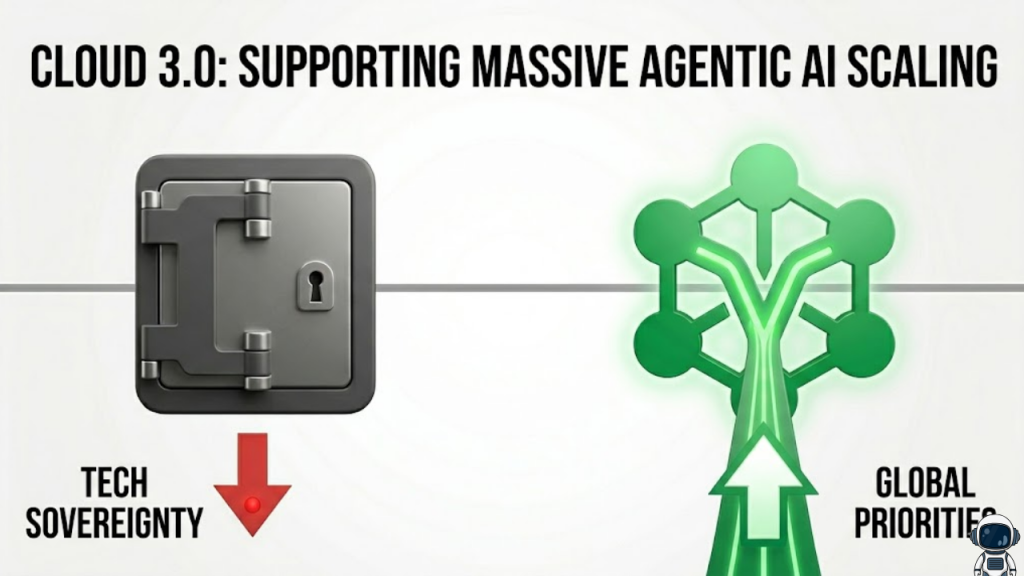
How does Cloud 3.0 support Agentic AI? Cloud 3.0 represents a paradigm shift from passive storage to Intelligent Infrastructure. In 2026, it supports the massive scaling of Agentic AI by acting as an autonomous “Operating System” for agents. Unlike Cloud 2.0, which required humans to manually provision servers, Cloud 3.0 uses AI-driven AIOps to predict agent workloads, automatically scale GPU clusters, and enforce zero-trust security in real time.
This ensures that thousands of AI agents can coordinate complex, multi-step workflows across an entire enterprise without a single human administrator needing to adjust a dashboard.
3 Pillars of Cloud 3.0 for Agentic Scale
To handle the “thinking” requirements of 2026 AI, Cloud 3.0 foundations rely on three critical scaling technologies.
1. Autonomous Scaling and Self-Healing
Agentic AI workloads are unpredictable because agents make their own decisions.
- The Strategy: Cloud 3.0 uses Predictive Scaling. By analyzing agent behavior patterns, the cloud provisions thousands of H200/B200 GPU instances before a spike occurs. If a node fails during a 5,000-step reasoning chain, the infrastructure “self-heals” by instantly migrating the agent’s memory to a healthy node.
2. Distributed Edge Intelligence
Agents often need to act near the data source (like a smart factory or a user’s phone).
- The Strategy: Cloud 3.0 pushes the “Agentic Brain” to the Edge. By running inference at the edge of the network, Cloud 3.0 reduces latency to under 5ms, allowing agents to make split-second decisions that would be impossible if they had to wait for a round-trip to a central data center.
3. Agent-to-Agent (A2A) Protocols
Scaling isn’t just about more power; it’s about better communication.
- The Strategy: Cloud 3.0 provides a native Execution Layer for protocols like A2A and AP2 (Agent Payments Protocol). This allows a “Procurement Agent” from one company to securely negotiate and pay a “Logistics Agent” from another company using built-in cloud guardrails.
The 2026 Tech Stack for Agentic Scale
If you are architecting a system today, these Cloud 3.0 components are your building blocks.
- Unified Data Foundation: Agents fail if data is “siloed.” Cloud 3.0 treats data ingestion as a product, ensuring batch, real-time, and unstructured data are instantly usable by every agent in the system.
- Observability Agents: Instead of static alerts, Cloud 3.0 uses “Meta-Agents” that monitor other agents. They correlate billions of signals using distributed tracing (like AWS X-Ray) to understand not just what happened, but why an agent made a specific choice.
- Sovereign Data Clouds: For 2026 compliance, Cloud 3.0 allows agents to process sensitive data within specific geographic or legal boundaries (Sovereignty), ensuring AI autonomy doesn’t violate national privacy laws.
Frequently Asked Questions (FAQ)
1. What is the difference between Cloud 2.0 and Cloud 3.0?
Cloud 2.0 was about “Rentable Infrastructure” (hosting). Cloud 3.0 is about “Cognitive Infrastructure” (thinking). It doesn’t just host your code; it understands, adapts, and optimizes itself based on what your AI agents are doing.
2. Is scaling Agentic AI expensive?
It can be. However, Cloud 3.0 uses AI-Driven Cost Optimization to identify “dead” agents or inefficient reasoning paths, automatically shutting them down to prevent “Cloud Bill Shock”.
3. Can I run Cloud 3.0 on my own hardware?
Most 2026 implementations use a Hybrid Cloud model. You run sensitive agentic workflows on-premise while using the public cloud’s massive GPU clusters for heavy inference and scaling.
4. Why do I see an Apple Security Warning on my Cloud 3.0 dashboard?
If your administrative agents attempt to access local system logs or hardware identifiers on your device without a Zero-Trust certificate, you may trigger an Apple Security Warning on your iPhone.
5. What is the “A2A” Protocol?
The Agent-to-Agent Protocol is a 2026 standard that allows AI agents from different providers (like Google, Microsoft, and OpenAI) to discover and securely collaborate with each other.
6. Does Cloud 3.0 eliminate DevOps?
No, it evolves it. In 2026, Agentic Cloud Operations (AIOps) handle the “toil” of server management, allowing DevOps engineers to focus on defining the high-level governance and policies that the agents must follow.
7. How does Cloud 3.0 protect against “Agent Hallucinations”?
It builds Trust into the Platform. By enforcing real-time data quality checks and “visibility guardrails,” the infrastructure can catch an agent’s logic error before it executes a high-cost transaction.
8. Who are the leaders in Cloud 3.0 for 2026?
Google Cloud (Vertex AI), Azure (Copilot Agents), and AWS (Strands Agents) currently lead the market, along with AI-native explorers like Nebius.
Final Verdict: Infrastructure That Thinks
In 2026, Cloud 3.0 has turned the cloud into a living, intelligent system. By providing the autonomous scaling, edge intelligence, and secure coordination required for Agentic AI, it has made “Intelligence at Scale” a reality for every business.
Ready to build your agentic foundation? Explore our guide on Converting Your WordPress Site into a PWA to learn about modern web delivery, or discover the Zero-Trust Architecture for Web Developers to secure your cloud.
Authority Resources
- McKinsey: Building the Foundations for Agentic AI at Scale – Strategic principles for modernizing data architecture.
- Google Cloud: 5 Insights to Build Your Agentic AI Advantage – A look at the A2A and AP2 protocols driving scale.
- Azure Blog: Agentic Cloud Operations and Azure Copilot – How Microsoft is redefining the operating model for AI workloads.
- EkasCloud: Cloud 3.0 – The Intelligent Infrastructure Revolution – Understanding the shift to cognitive and self-optimizing systems.