What is Cloud Portability?
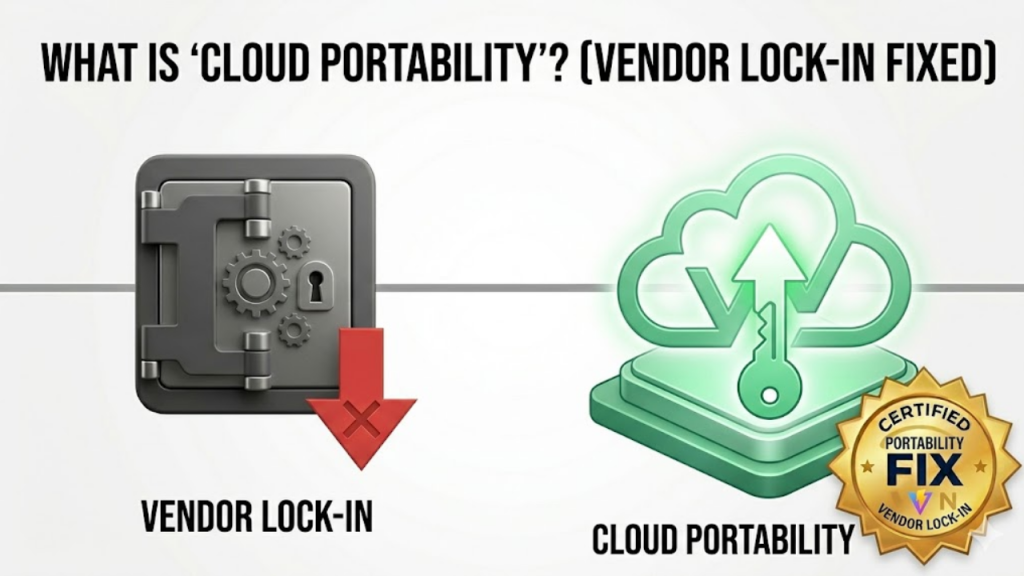
Cloud portability is the ability to move applications and data from one cloud provider to another without needing to rewrite code or change configurations. In 2026, this is no longer a “nice-to-have” feature; rather, it is a core business strategy. It ensures that your software isn’t “trapped” inside a specific vendor’s ecosystem, allowing you to migrate your stack whenever better pricing, stricter compliance, or superior performance is found elsewhere.
Without portability, your business is subject to Vendor Lock-in, where the cost and complexity of leaving a provider become so high that you are forced to stay, regardless of price hikes or service outages.
3 Pillars of Cloud Portability in 2026
To achieve true portability and avoid lock-in, you must build your infrastructure using “Provider-Agnostic” patterns.
1. Containerization (The “Standard Box”)
In 2026, Docker and Kubernetes are the foundation of portability. By wrapping your app in a container, you ensure it runs the exact same way on an AWS server as it does on a private on-premise cluster. This “Standardized Shipping” eliminates the “it works on my machine” problem across different clouds.
2. Infrastructure as Code (IaC)
Stop clicking buttons in a web portal.
- The Strategy: Use tools like Terraform or Pulumi to define your servers, networks, and databases in code files. When you want to switch providers, you simply update your “Provider Block” and redeploy. This allows you to recreate your entire infrastructure in a new cloud in minutes instead of months.
3. Open Standards and APIs
Vendor lock-in often happens because of “Proprietary APIs.”
- The Strategy: Instead of using a provider’s unique “AI Service” or “Special Database,” use open-source alternatives like PostgreSQL or Redis. These tools have the same interface regardless of which cloud hosts them, making your data migration seamless.
Why Portability is a 2026 Business Essential
In the current market, “Optionality” is your greatest financial lever.
- Cost Negotiation: When you have a portable architecture, you can play cloud providers against each other. If Vendor A raises prices, you can show them your “Migration Plan” to Vendor B to secure a better discount.
- Regulatory Compliance: New 2026 laws (like the Data Act in the EU) require firms to prove they have a “Cloud Exit Plan.” Portability is the only way to satisfy these legal audits.
- Reliability (Multi-Cloud): If a single cloud region goes down, a portable app can instantly “failover” to a different provider, ensuring your service stays online while your competitors are in the dark.
Frequently Asked Questions (FAQ)
1. Is Cloud Portability expensive to build?
Initially, yes. It requires more “upfront” engineering to avoid proprietary features. However, in 2026, the long-term savings from avoiding price hikes and high egress fees far outweigh the initial setup cost.
2. What is the difference between Portability and Interoperability?
Portability is moving the whole app from A to B. Interoperability is having an app in Cloud A talk to a database in Cloud B. Both are essential for a modern “Hybrid” strategy.
3. Does “Serverless” cause vendor lock-in?
Often, yes. Many “Serverless” functions use proprietary triggers and events that only work on one platform. To keep them portable, use Knative or similar tools that allow serverless code to run on any Kubernetes cluster.
4. Why do I see an Apple Security Warning on my cloud dashboard?
If your multi-cloud management tool attempts to access system-level hardware identifiers without proper encryption, you may trigger an Apple Security Warning on your iPhone or Mac.
5. What are “Egress Fees”?
These are the fees cloud providers charge you to “take your data out.” In 2026, high egress fees are the most common form of “Financial Lock-in.” Designing for portability includes minimizing the data that needs to move between providers.
6. Can I use AI to help with cloud portability?
Yes. In 2026, AI-Native Cloud tools can automatically “refactor” code to remove vendor-specific dependencies and suggest more portable open-source alternatives.
7. What is “Cloud Repatriation”?
This is the 2026 trend of moving workloads out of the public cloud and back onto private servers (on-premise) to save money. You can only do this efficiently if your app was built for portability in the first place.
8. Who is the “least locked-in” provider?
Providers that support Bare Metal and standard Kubernetes services are generally the most portable. Avoid providers that “nest” their services so deeply that you can’t use one without the other.
Final Verdict: Build for the Exit
In 2026, the best cloud strategy is one that includes an exit plan. By prioritizing Cloud Portability, you protect your business from price surges, outages, and legal risks, ensuring your technology serves your goals, not your vendor’s bottom line.
Ready to break free? Explore our guide on Edge Functions vs. Serverless to see which architecture is easier to move, or learn about Zero-Trust Architecture for Web Developers to secure your portable stack.
Authority Resources
- SmartX: What is Cloud Portability and Why It Matters – A clear breakdown of portability vs. interoperability.
- DataBank: Hybrid Cloud Trends 2026 – Analysis of why portability is becoming a strategic imperative.
- Volico: Cloud Repatriation in 2026 – Understanding the move toward control and flexibility.
- CACI: Cloud Migration Challenges 2026 – How to make conscious choices about where to accept lock-in.