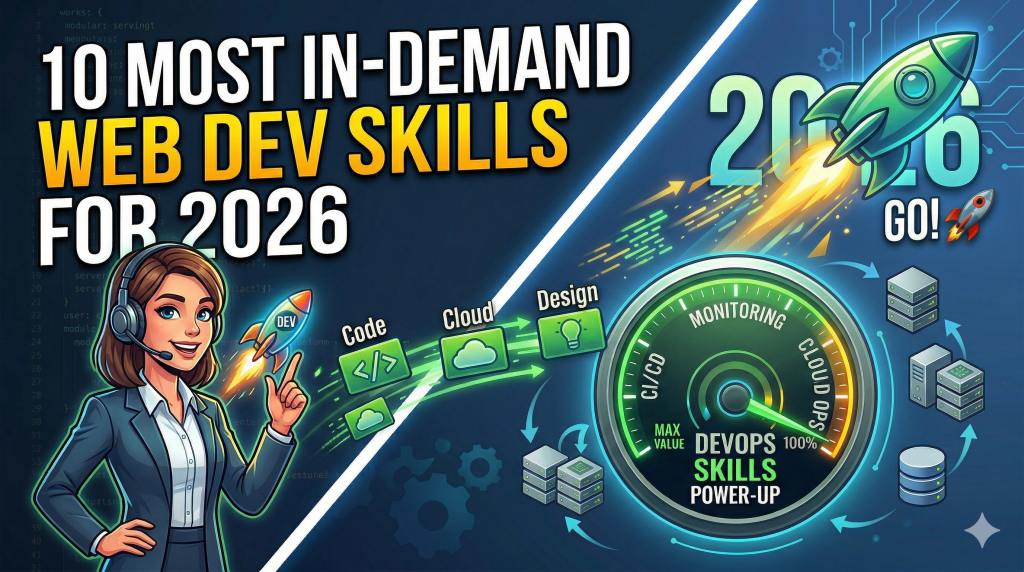
What are the most in-demand web dev skills for 2026? The list is led by AI Orchestration, Cloud-Native Architecture, and Cybersecurity. While the “Holy Trinity” (HTML, CSS, JS) remains the foundation, the 2026 market demands “Agentic Fluency”, the ability to build apps that don’t just display data, but act on it. Specifically, developers who can bridge the gap between Large Language Models (LLMs) and production-ready interfaces now command a 28% salary premium.
In 2026, a “Senior” developer is defined by their architectural judgment, not just their typing speed.
The 2026 Skills Index: Demand & Salary Impact
In 2026, specialization beats generalism. Consequently, the highest-paying roles require a deep understanding of infrastructure and data integrity.
| Skill Area | Top Technology | Salary Impact (Avg. Incr.) |
| AI Orchestration | LLM APIs, LangChain, MCP | +28% |
| Cloud-Native Architecture | AWS, Kubernetes, Terraform | +12% |
| Secure-by-Design | Zero-Trust, OWASP, FIDO2 | +15% |
| TypeScript Mastery | Type-safe APIs, Design Systems | Standard Requirement |
| Data Engineering | Kafka, Vector DBs, SQL | +9% |
The 10 Essential Skills for 2026
1. AI Integration & Agentic Workflows
You must move beyond simple chat boxes. In 2026, developers use Model Context Protocol (MCP) to allow AI to interact with external tools and databases safely. Furthermore, you should know how to implement RAG (Retrieval-Augmented Generation) to make your apps smarter using custom data.
2. Full-Stack TypeScript
TypeScript is no longer “optional.” It is the bedrock of maintainable enterprise software. Mastering Type-Safe APIs and advanced utility types ensures that your front-end and back-end remain perfectly synced as your application scales.
3. Cloud-Native & Serverless Deployment
Hiring managers expect you to know more than just “how to code.” You must understand Infrastructure as Code (IaC) using tools like Terraform or Pulumi. This allows you to deploy and scale your apps on AWS, Azure, or Vercel without a dedicated DevOps team.
4. Zero-Trust Security at the Code Level
As cyber threats grow, security must be “Shifted Left.” This means implementing Authentication and Authorization (OAuth, JWT) and following OWASP Top 10 guidelines from the very first line of code you write.
5. Advanced Performance Optimization
Speed equals revenue. In 2026, you must master WebAssembly (Wasm) for heavy tasks and optimize for Interaction to Next Paint (INP). Users expect a near-instant experience, regardless of their device or location.
6. Progressive Web Apps (PWA) 2.0
With Apple expanding PWA support, “Web-as-App” is booming. You should know how to use Service Worker APIs for background sync, biometric auth, and push notifications to deliver a native-app feel without the App Store fees.
7. Modern API Design (GraphQL & gRPC)
Rest APIs are great, but for complex 2026 data needs, you need GraphQL or gRPC. These allow for efficient data fetching and real-time updates, reducing network overhead for mobile and “Edge” users.
8. Observability & Monitoring
Writing code is one thing; keeping it running is another. You must understand how to use Logs, Metrics, and Tracing (Prometheus, Grafana) to troubleshoot distributed systems and optimize cloud costs in real-time.
9. Accessibility (WCAG 2.2 & 3.0)
Legal compliance is a massive 2026 driver. Mastering Semantic HTML and ARIA patterns ensures your apps are usable for everyone and protected against accessibility-related lawsuits.
10. Technical Leadership & Critical Thinking
In the AI era, your “Soft Skills” are your “Hard Skills.” Clear communication, architectural decision-making, and the ability to audit AI-generated code are what will separate you from junior-level workers.
Frequently Asked Questions (FAQ)
1. Is HTML and CSS still important in 2026?
Yes, they remain the bedrock of the web. However, you must now focus on Semantic HTML for SEO and Utility CSS (Tailwind) for rapid, consistent styling across teams.
2. Which framework should I learn: React or Next.js?
In 2026, Next.js is the dominant meta-framework for React. It handles the “plumbing”—routing, SSR, and API layers—allowing you to focus on the high-value logic of your application.
3. Do I need to learn Python for web development?
Yes, it is highly recommended. Python is the primary language for AI and Machine Learning integration. Even as a front-end specialist, knowing basic Python allows you to collaborate with data teams more effectively.
4. Why do I see an Apple Security Warning on my 2026 dev tools?
If your AI-assisted IDE or local proxy attempts to access system-level identifiers without a secure certificate, you may trigger an Apple Security Warning on your iPhone.
5. How much do AI-fluent developers earn?
On average, roles requiring AI integration skills pay 28% more than traditional roles, with many senior AI engineering positions exceeding $195,000 in the US.
6. Is SQL still relevant with the rise of Vector DBs?
Absolutely. SQL remains the foundation of data management. While Vector DBs are essential for AI search, traditional relational databases still power the vast majority of business logic.
7. What is “Model Context Protocol” (MCP)?
MCP is a 2026 standard that allows AI models to connect seamlessly with local tools and data. Mastering this allows you to build “Agentic” apps that can actually do things for the user.
8. Can I get a job with just “Soft Skills”?
No. But in 2026, you cannot get a high-paying job without them. Companies want “T-Shaped” developers who have deep technical skill in one area and broad communication skills across all.
Final Verdict: Become the Architect
In 2026, the “In-Demand” developer is the one who understands how all the pieces fit together. By mastering AI Orchestration, Cloud Architecture, and Security, you move beyond the “Code Writer” role and become a “System Architect” who builds the future of the internet.
Ready to start? Explore our guide on How to Become a Web Developer in 2026 or master the latest tools in Next.js 16 vs. Nuxt 4: The Meta-Framework Showdown.
Authority Resources
- Gloroots: Top 10 In-Demand Developer Skills in 2026 – Real-world examples of how AI and cloud are shifting the job market.
- LSE: The 10 Most In-demand Tech Careers of 2026 – Detailed breakdown of salary and growth in the UK digital economy.
- Pluralsight: The 6 Most In-demand Tech Skills in 2026 – Focus on cloud computing, cybersecurity, and agentic AI.
- Zero To Mastery: Highest Paying Tech Jobs in 2026 – Average salary data for AI engineers, data scientists, and cloud architects.