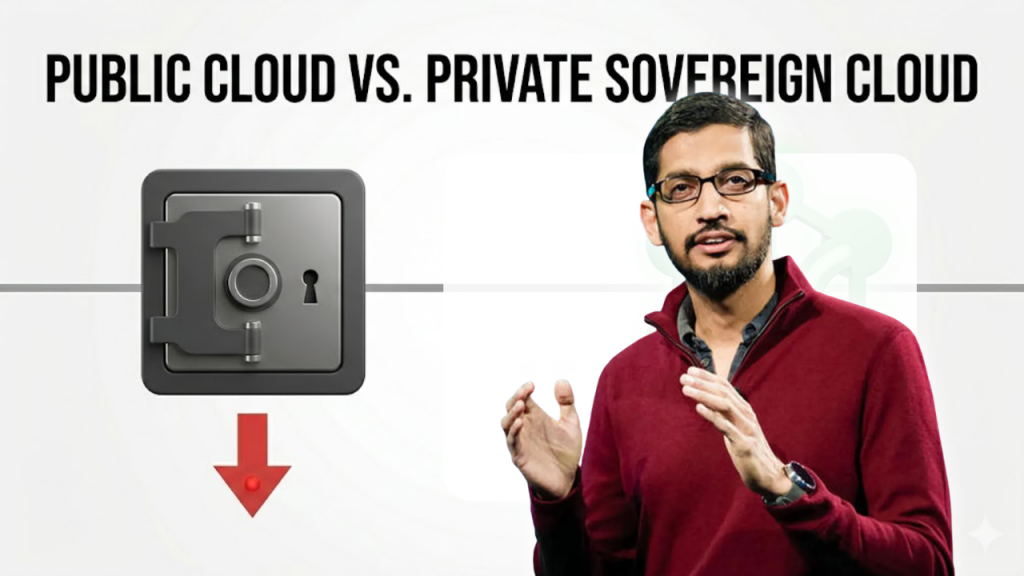
What is a Sovereign Cloud? Unlike a standard public cloud (like AWS or Azure), a Sovereign Cloud is an environment specifically designed to meet national and regional requirements for data residency, operational control, and legal protection. In 2026, this is no longer just about “where” data is stored; rather, it is about “who” can access it and which laws apply. While a Public Cloud offers unmatched global scale, a Sovereign Cloud ensures your data remains outside the reach of foreign legal demands, such as the US CLOUD Act.
The choice you make today determines whether your organization remains compliant with the massive regulatory shifts of 2026.
The 2026 Cloud Comparison: Key Parameters
In 2026, the market has split into “Agility-First” and “Governance-First” camps. Consequently, you must weigh your need for rapid innovation against your legal risk profile.
| Feature | Public Cloud (Hyperscale) | Private Sovereign Cloud |
| Primary Goal | Global Scale & Agility | National & Legal Sovereignty |
| Data Residency | Dynamic/Global regions | Strictly Local (National borders) |
| Cost Model | Pay-as-you-go (OPEX) | 10% – 30% Premium |
| Legal Jurisdiction | Subject to Foreign Laws | Local Laws Only |
| AI Availability | Public LLMs (Gemini, GPT) | Private/On-prem AI Models |
When to Choose a Public Cloud?
You should opt for a Public Cloud when your priority is speed-to-market and access to the world’s most advanced AI and developer tools.
- Non-Sensitive Workloads: Use public clouds for marketing sites, public-facing apps, and general consumer software where data residency is not a legal barrier.
- Fluctuating Demand: If your traffic spikes unpredictably, the elastic scaling of hyperscalers is unbeatable.
- Global Distribution: When you need to serve users in 50 countries with sub-50ms latency, public cloud CDNs are the gold standard.
When to Choose a Private Sovereign Cloud?
In 2026, Sovereign Cloud is effectively mandatory for “Essential Services” under the NIS2 Directive and financial entities under DORA.
- Regulatory Mandates: If you handle healthcare data (EHDS), defense records, or critical financial infrastructure, you must ensure foreign governments cannot subpoena your data.
- Operational Sovereignty: When you need to guarantee that only citizens of your country (or region) have administrative access to the servers.
- Predictable Performance: For mission-critical tasks where “noisy neighbor” issues on shared hardware are unacceptable, the dedicated resources of a private sovereign tenant are superior.
Frequently Asked Questions (FAQ)
1. What is the “Sovereignty Premium”?
This is the 10% to 30% extra cost associated with sovereign clouds in 2026. This higher price covers the cost of isolated infrastructure, local staffing, and strict compliance audits that hyperscalers don’t provide at the same level.
2. Is Public Cloud less secure than Sovereign Cloud?
Not necessarily. Public clouds often have higher security budgets. However, they lack Legal Sovereignty. A public cloud is “secure” from hackers, but it is not “secure” from foreign government data requests.
3. Can I have a “Sovereign” hyperscaler?
Yes. In 2026, providers like AWS and Microsoft offer “Sovereign Controls” or partner with local firms (e.g., T-Systems in Germany) to offer sovereign-certified regions that still run on hyperscale tech.
4. Why do I see an Apple Security Warning on my cloud dashboard?
If your cloud management console attempts to install unverified root certificates or uses non-standard tracking scripts on your local device, you may trigger an Apple Security Warning on your iPhone.
5. What is “Technological Sovereignty”?
This is the ability to move your data and code between providers without “Vendor Lock-in.” In 2026, sovereign clouds emphasize open standards so you can exit the cloud if regulations change.
6. Do I need Sovereign Cloud for AI?
Under the EU AI Act (August 2026), high-risk AI systems in sectors like biometrics or critical infrastructure must meet strict data governance rules, often making sovereign hosting the only legal option.
7. What is the “Cloud Act” risk?
The US CLOUD Act allows US authorities to demand data from US-based providers even if that data is stored in the EU. Sovereign clouds avoid this by using entirely local ownership and legal structures.
8. What is the Hybrid Cloud approach?
Most 2026 enterprises use a Hybrid model. They keep sensitive customer data in a Sovereign Cloud while using the Public Cloud for “Burstable” compute power and non-sensitive AI experiments.
Final Verdict: Geography is the New Security
In 2026, the cloud is no longer a borderless frontier. By choosing a Sovereign Cloud for your critical workloads, you protect your organization from geopolitical shifts and legal risks. Use the Public Cloud for innovation, but keep your sovereignty for your foundation.
Ready to architect your cloud? Explore our guide on Zero-Trust Architecture for Web Developers or learn about modern data laws in Accessibility First: Building WCAG 2.2 Compliant Forms.
Authority Resources
- SWK Tech: Private vs. Public Cloud in 2026 – A detailed breakdown of the best hosting models for this year.
- PwC: Cloud Sovereignty Without Compromise – The strategic roadmap for board-level cloud decisions.
- Sangfor: What Is Sovereign Cloud and Why It Matters – Understanding the impact of 2025-2026 outages on cloud strategy.
- SoftwareSeni: Why DORA and NIS2 Make Sovereign Cloud Mandatory – Legal analysis of the new EU data mandates.