If you are still starting your projects with a blank text editor and a manual requirements document, you are falling behind. In 2026, the tech world has reached a “tipping point” where AI-First Development has replaced traditional coding as the baseline for any serious project. This shift has reduced development cycles from weeks to hours and turned software engineers into “System Orchestrators.”
At WeBlogTrips, we track the evolution of the SDLC (Software Development Life Cycle). Consequently, we created this guide to explain Why AI-First Development is the New Industry Standard and how it’s reshaping the $600 billion software industry.
The Evolution: Traditional vs. AI-First Development
| Feature | Traditional Development | AI-First Development (2026) |
| Core Workflow | Manual “Line-by-Line” Coding | Agentic Orchestration |
| Primary Skill | Syntax & Framework Mastery | “Vibe Engineering” & Intent |
| Testing | Scripted Unit Tests | Self-Healing QA Agents |
| Problem Solving | Deterministic (If/Then Rules) | Probabilistic (Pattern Inference) |
| Speed | 100% Human Output | 30-50% Productivity Boost |
| Role of Data | Secondary (Storage) | Primary (Fuel for Logic) |
1. From “Writing Code” to “Solving Problems”
The primary reason Why AI-First Development is the New Industry Standard is the shift in focus. In the traditional model, 70% of a developer’s time was wasted on “boilerplate” and syntax.
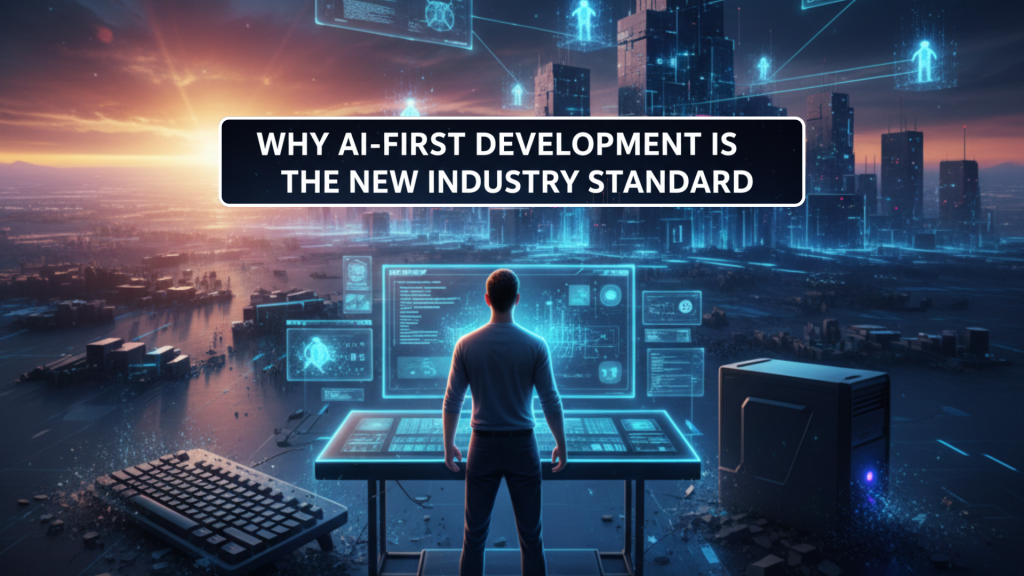
In 2026, AI agents handle the implementation details. This allows developers to focus on System Architecture and Strategic Problem Decomposition. We are no longer builders of bricks; we are the architects of cities.
2. The Rise of Agentic Workflows
The “Copilot” era is over. Today, we use Autonomous Agents that don’t just suggest the next line—they execute multi-step tasks independently. If you ask an agent to “Add social login,” it installs the dependencies, updates the database schema, writes the API route, and tests the UI without human intervention. This autonomy is the engine behind Why AI-First Development is the New Industry Standard.
3. Data-Centric Architecture: The New Logic
Traditional software relies on hardcoded rules (e.g., if user.age > 18). AI-First apps use learned patterns. Instead of writing thousands of “if” statements to detect fraud, developers feed the system data, and the AI infers the patterns. In 2026, “Data Readiness” has become the first step in the development roadmap, rather than an afterthought.
Frequently Asked Questions (FAQ)
1. Does AI-First mean humans aren’t coding anymore?
No. While AI handles roughly 60% of the work, humans are still required for the 20% of high-stakes work that requires judgment, ethics, and strategic oversight. You are the “Conductor” of an AI orchestra.
2. What is “Vibe Engineering”?
“Vibe Engineering” is a 2026 term for guiding an AI agent to achieve a specific look, feel, or behavior through high-level intent rather than manual CSS or logic. It’s about describing the outcome rather than the process.
3. Why does my AI-generated app trigger an Apple Security Warning?
If your AI agent hallucinates a dependency or uses an outdated, insecure library, you might trigger an Apple Security Warning on your iPhone. Security remains a human responsibility; you must audit AI-generated code to ensure it meets 2026 safety standards.
Final Verdict: Why AI-First Development is the New Industry Standard
To summarize the 2026 shift:
- Autonomy replaces assistance: Agents handle implementation, humans handle orchestration.
- Speed is the new baseline: Deployment cadences have moved from weekly to daily.
- Data is the code: Patterns and inference have replaced rigid, rule-based logic.
By adopting an AI-First mindset, you aren’t just working faster—you are working at a higher level of abstraction, enabling you to build complex systems that were impossible just three years ago.
More From Weblogtrips
- Building Your Own AI Design Assistant with Gemini and React
- GitHub Copilot vs. Windsurf: Which One Wins?: Choosing your primary AI-First orchestration tool.
- How to Use AI Agents to Scaffold Web Apps from Figma: See how agentic tools handle the design-to-code leap.
- What is Agentic AI and How Does it Differ from Generative AI?
- React Query vs useEffect for Data Fetching: Why agents use modern data-sync libraries.
- React Functional Components vs Class Components: Using modern React for your assistant’s UI.
- Common JavaScript Memory Leaks: Why holding onto old references can crash your app.
- Why Your Website Is Slow and How to Fix It: See how event bloat contributes to slow sites.
- Why JavaScript Is Single-Threaded: How the engine manages memory references.
- Promise vs async/await: What Actually Happens?: How orders move through the kitchen.
- JavaScript Closures Explained Like You’re 5: How memory is preserved during async suspension.
- Why Your Website Is Slow and How to Fix It: CDNs are the #1 fix for global slowness.
- let vs var vs const Explained with Real Examples: Why block scope is the best partner for closures.
- REST API vs GraphQL Explained for Beginners: APIs are where most CORS errors live.
- Best Website Hosting 2026: Find hosts with integrated CDN features.
External Links
- Anthropic: 2026 Agentic Coding Trends Report: Deep dive into the data behind the agentic shift.
- Thoughtworks: The Benefits of AI-First Engineering: Business metrics for AI-First transitions.
- Microsoft: What’s Next in AI for 2026: How AI is moving from “instrument” to “partner”.