What is Interdependent Resilience?
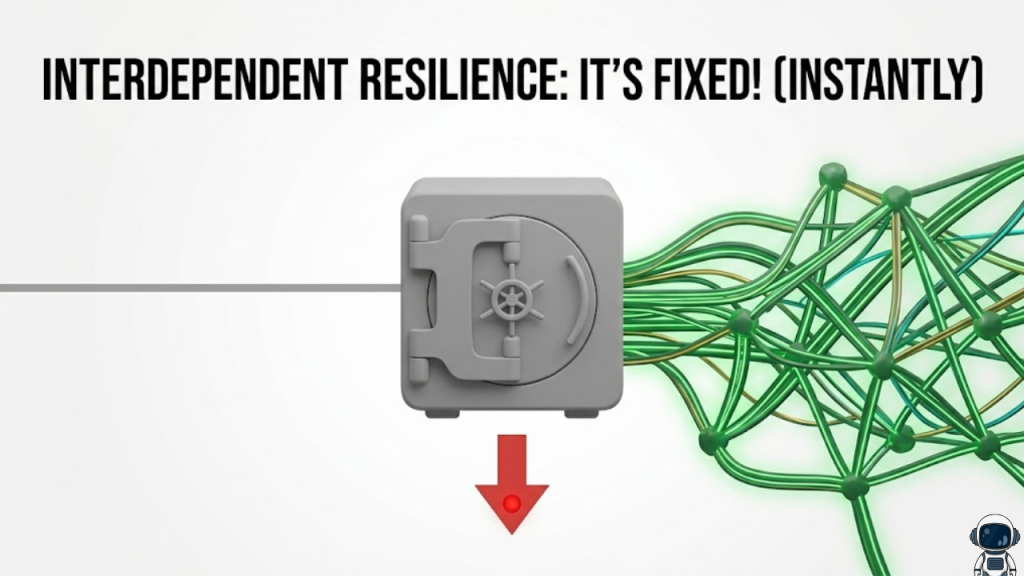
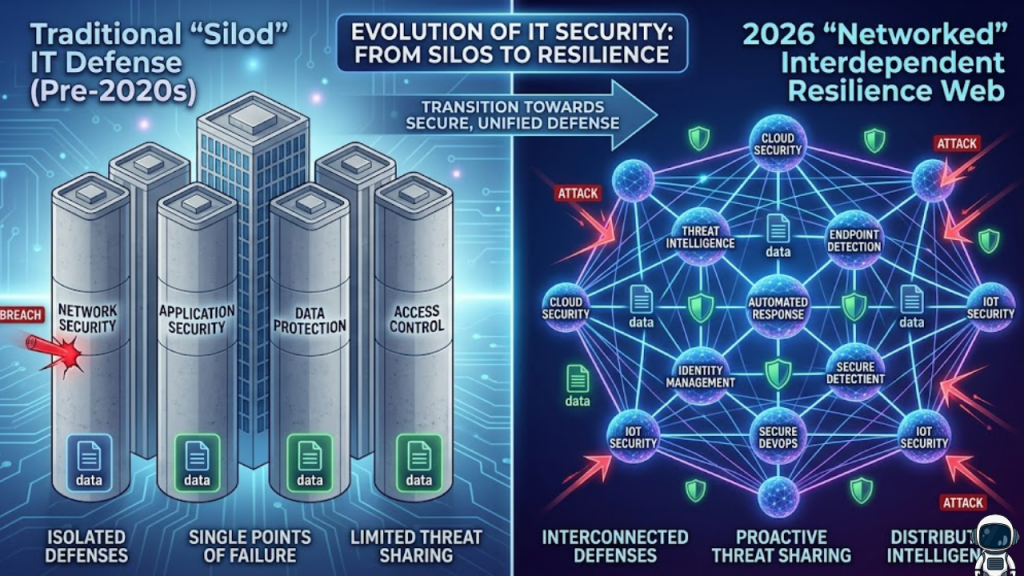
Interdependent Resilience is a strategy that assumes your IT infrastructure is only as strong as the ecosystem it connects to. In 2026, we have moved beyond “Single-Point Resilience” (protecting one server) to “Networked Resilience.” This approach recognizes that an attack on a power grid, a satellite provider, or a third-party API is effectively an attack on your own business. Consequently, infrastructure is now designed to detect, contain, and recover from shocks that originate outside your own perimeter.
In 2026, the goal is no longer to be “unbreakable” in isolation, but to be “recoverable” in a connected world.
3 Shifts Driving Interdependent Resilience in 2026
The transition from isolated defense to networked resilience is driven by three major 2026 realities.
1. From “Protect the Perimeter” to “Protect the Ecosystem”
Ransomware groups in 2026 act as proxies for hostile states, targeting entire supply chains rather than single firms.
- The Strategy: Infrastructure is now built with “Blast Radius” containment. If a partner’s API is compromised, your system automatically “shunts” that connection to prevent the infection from propagating into your core workloads.
2. Identity as the Critical Infrastructure
By 2026, data protection has shifted from “Backups” to “Business Recovery.”
- The Strategy: Identity systems (directory services and cloud access) are now treated with the same importance as the data itself. Without recoverable identities, a company cannot “wake up” after a crash, even if the data is technically safe.
3. Application-Level vs. Hardware-Level Metrics
In the past, we measured uptime by “Is the server on?” In 2026, we measure it by “Is the service accessible?”
- The Strategy: Resilience is measured by the availability of the access paths between users and applications. If your cloud provider is up, but the regional ISP or the identity provider is down, your infrastructure has failed its resilience goal.
The 2026 Resilience Toolkit
To achieve interdependent resilience, IT teams are adopting these three “Agentic” tools:
- Predictive AI Orchestration: Nearly half of all business applications in 2026 include built-in AI agents. These agents predict risk and automate “self-healing” decisions, like moving workloads to a different region before a storm or cyber-attack hits.
- Live Business Impact Analysis (BIA): Static, annual disaster recovery plans are obsolete. In 2026, we use “Live BIA” software that visualizes interdependencies in real-time, showing exactly how a failure in a minor microservice will affect revenue 10 minutes later.
- Sovereign Cloud Ecosystems: To avoid “Total Dependency” on one provider, firms are using hybrid approaches that maintain local control over data while leveraging the global innovation of hyperscalers.
Frequently Asked Questions (FAQ)
1. How is this different from standard Disaster Recovery?
Disaster Recovery is reactive; it focuses on “What do we do after it breaks?” Interdependent Resilience is proactive and systemic; it focuses on “How do we survive a failure in a system we don’t even own?”.
2. Does this increase my IT costs?
Initially, yes. However, by 2026, “Fragility is a cost center.” The cost of a single systemic outage far outweighs the investment in resilient architecture. Most firms view this as a “cost-avoidance” strategy with high ROI.
3. Can small businesses achieve this?
Yes. In 2026, many MSPs offer “Resilience-as-a-Service,” allowing smaller firms to plug into the same coordinated defense ecosystems used by governments and banks.
4. Why do I see an Apple Security Warning on my infrastructure dashboard?
If your resilience monitoring tools attempt to scan hardware identifiers across different network layers without the correct 2026 security certificates, you may trigger an Apple Security Warning on your iPhone.
5. What is a “Cascade Failure”?
This occurs when a failure in one system (like an electric grid) triggers a failure in a connected system (like a data center), which then triggers a failure in a third system (like a banking app). Interdependent resilience is designed specifically to “break the chain” of these cascades.
6. Does “Resilience by Design” hurt performance?
No. Using Edge Computing brings processing closer to the user, which actually reduces latency while increasing resilience, as the local node can continue to function even if the central network is disrupted.
7. Is cloud repatriating a part of this?
Partially. Many firms in 2026 are bringing “mission-critical” data back to on-prem or regional sovereign clouds while keeping less sensitive workloads in the public cloud to maintain flexibility.
8. What is the “Collective Defence” model?
It is a 2026 framework where governments and private companies share real-time threat intelligence. If one regional power grid is attacked, all other operators are alerted instantly to “shield up” before the threat reaches them.
Final Verdict: Performance is the New Documentation
In 2026, resilience is not defined by what you document in a manual; rather, it is defined by how you perform under pressure. By building Interdependent Resilience, you ensure your business can withstand the “Accelerating Uncertainty” of the modern world.
Ready to shield your systems? Explore our guide on Zero-Trust Architecture for Web Developers or learn how to protect your identity systems in Why Passkeys are Replacing Passwords in 2026.
Authority Resources
- ResearchGate: Resilience of Interdependent Infrastructure Networks – A deep dive into the network-based perspective of systemic safety.
- Taylor Wessing: Digital Resilience in 2026 Trends – Strategic imperatives for service availability and recovery.
- 4C Strategies: Six Resilience Trends for 2026 – How operational resilience is moving into real-time reality.
- Arthur D. Little: Tech Strategies for 2026 – Rethinking operating models for long-term competitiveness.