What is the role of DevOps for a Product Engineer in 2026?
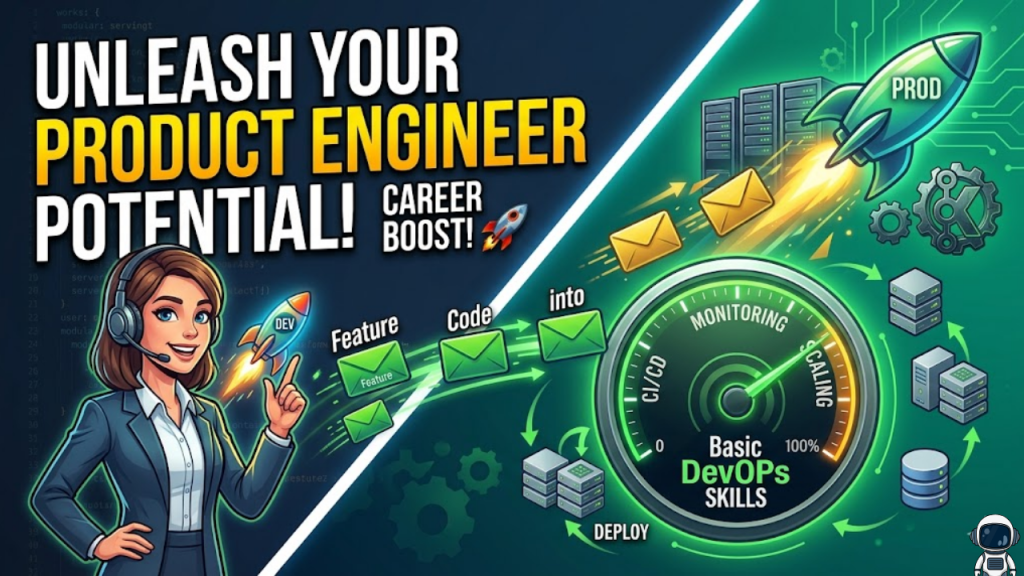
DevOps is no longer just a job title; rather, it is a core competency for modern software delivery. In 2026, a Product Engineer who understands DevOps can navigate the entire lifecycle of a feature, from the first line of code to the final production environment. By learning the basics of CI/CD pipelines, Cloud Infrastructure, and Observability, you eliminate the “Shadow Ops” bottlenecks that cause 30% to 40% of development delays.
Understanding the “how” and “where” your code runs ensures that your features are not only functional but also scalable, secure, and resilient.
3 Competitive Advantages of DevOps-Literate Engineers
In 2026, “vibe coding” and AI-assisted engineering have lowered the barrier to writing syntax. Therefore, your value lies in Orchestration and Accountability.
1. Reduced Cognitive Load via “Golden Paths”
Modern companies use Platform Engineering to create “Golden Paths”, pre-approved, self-service workflows for deployment.
- The Benefit: If you understand the basics of these paths (like Kubernetes or Terraform), you can deploy your own services without waiting for an operations team to “provision” a database for you. This autonomy increases your shipping velocity by up to 40%.
2. “Shift-Left” Security and Reliability
In 2026, security is a shared responsibility (DevSecOps).
- The Benefit: By understanding how to read a vulnerability scan or configure an IAM (Identity and Access Management) role, you catch security flaws during the build phase. This prevents the “Late-Night Firefighting” that occurs when a “small” config change causes a massive production outage.
3. Business Impact and FinOps
Cloud costs are a primary concern for CTOs in 2026.
- The Benefit: A Product Engineer who understands FinOps (Cloud Cost Management) can write code that is optimized for the cloud. By right-sizing your containers and using auto-scaling effectively, you directly improve the company’s bottom line, a metric that leads to faster promotions and higher bonuses.
The 2026 “Essential DevOps” Checklist
You do not need to be a Linux kernel expert. Instead, focus on these five functional areas:
- Containers (Docker/Podman): Learn to package your app so it runs identically on your laptop and in the cloud.
- CI/CD Pipelines (GitHub Actions/GitLab): Automate your testing and deployment so every “git push” is a production-ready event.
- Observability (Prometheus/Grafana): Learn to read logs and metrics. If a feature is slow, you should be able to tell if the problem is in your code, the network, or the database.
- Infrastructure as Code (Terraform/Pulumi): Understand how your infrastructure is defined. This allows you to “read” the environment your code lives in.
- Basic Networking: Understand ports, DNS, and load balancers. Knowing how traffic flows to your app is the first step in high-level troubleshooting.
Frequently Asked Questions (FAQ)
1. Will AI replace the need for me to learn DevOps?
No. In 2026, AI is a Force Multiplier. It can write your YAML files or suggest a scaling policy, but it cannot own the outcome. You still need the foundational knowledge to validate AI suggestions and make the final architectural decisions.
2. How long does it take to learn “Basic” DevOps?
Most Product Engineers can master the essentials in 3 to 4 months of part-time study. Focus on building a “Hello World” app that is fully automated from commit to cloud.
3. What is a “Self-Healing” system?
This is a 2026 standard where your infrastructure (like Kubernetes) automatically detects if your app has crashed and restarts it. Understanding this allows you to design apps that are “Resilient by Default”.
4. Why do I see an Apple Security Warning during my local dev?
If your local development environment attempts to use elevated privileges (sudo) or insecure networking tools to simulate a cloud environment, you may trigger an Apple Security Warning on your iPhone.
5. What is the “You Build It, You Run It” mantra?
This is the core of DevOps culture. It means the person who writes the code is also responsible for its performance in production. In 2026, this leads to higher quality code and faster incident recovery.
6. Can I get a higher salary with these skills?
Absolutely. “Full-Cycle” Product Engineers in 2026 often earn 15% to 25% more than those who only handle frontend or backend logic, with senior roles exceeding $200,000 in major tech hubs.
7. What is “Platform Engineering”?
It is the 2026 evolution of DevOps. While DevOps is the culture, Platform Engineering is the tooling (Internal Developer Platforms) that makes that culture easy for you to follow without being an infra expert.
8. Is Linux still relevant in 2026?
Yes. Linux remains the backbone of the cloud. Mastering the Command Line (CLI) is the single most important “Hard Skill” for any engineer looking to move into DevOps.
Final Verdict: Become the Architect of Your Own Code
In 2026, the best Product Engineers are those who understand the Full Stack, from the user’s “click” to the server’s “CPU cycle.” By learning basic DevOps, you stop being a “coder” and start being a Systems Architect, ensuring your career remains essential in the age of AI.
Ready to upskill? Explore our guide on How to Become a Web Developer in 2026 to see the full roadmap, or learn about the latest tools in Next.js 16 vs. Nuxt 4.
Authority Resources
- Lavatech Technology: Top 10 Reasons to Learn DevOps in 2026 – A look at the skyrocketing demand and career stability.
- KodeKloud: What Makes a Great DevOps Engineer 2026 – Understanding system behavior and failure patterns.
- Refonte Learning: DevOps Engineering Essential Trends 2026 – How speed, agility, and DevSecOps drive business value.
- Medium: Is DevOps a Good Career in 2026? – A comprehensive analysis of global demand and salary trends.