What is a WebSocket?
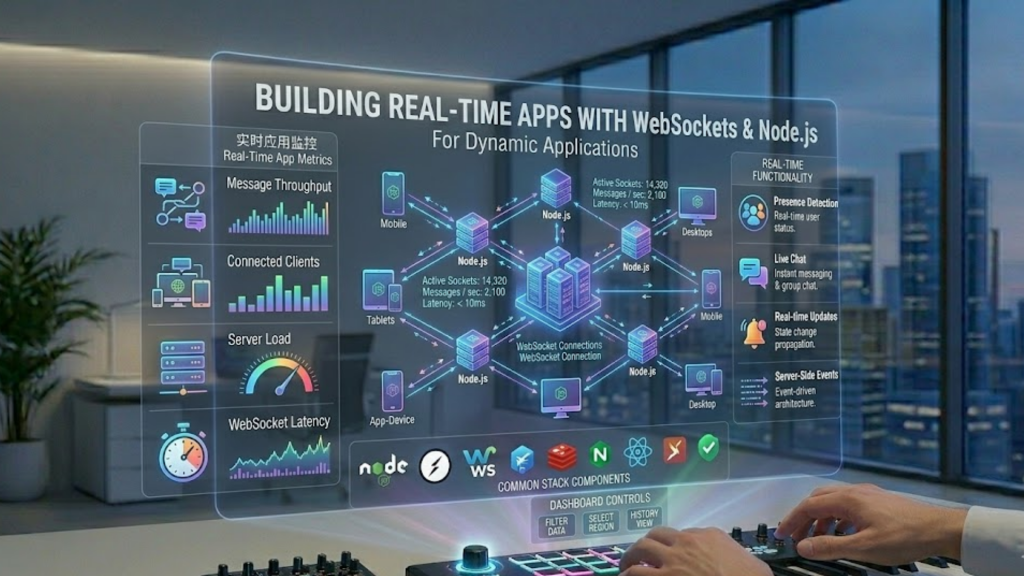
A WebSocket is a communication protocol that provides a full-duplex, persistent connection between a client and a server. Unlike traditional HTTP, which opens and closes a connection for every single piece of data, a WebSocket opens a “tunnel” that stays open. In 2026, this is essential for “Live” experiences where the server needs to push data to the user instantly—without waiting for the user to ask for it.
Node.js is the perfect partner for WebSockets because of its event-driven, non-blocking I/O. It can handle thousands of open “tunnels” on a single server without crashing, making it the industry standard for real-time scaling.
2026 Tech Comparison: HTTP vs. WebSockets
In 2026, we use WebSockets for “High-Frequency” updates and HTTP for “Low-Frequency” static data.
| Feature | Traditional HTTP | WebSockets (Node.js 2026) |
| Communication | One-way (Client asks, server acts) | Two-way (Bidirectional) |
| Connection | Ephemeral (Opens/Closes) | Persistent (Always Open) |
| Header Overhead | 200 – 2000 bytes per request | 2 – 14 bytes per frame |
| Latency | 200ms – 500ms (Polling) | 1ms – 10ms (Direct Push) |
| Ideal Use Case | Blogs, News, Static APIs | Chat, Games, Live AI, Trading |
3 Architectural Pillars for Real-Time Scaling
Building a real-time app that works for 10 users is easy; building one for 1,000,000 requires these 2026 patterns.
1. The Sticky Session Requirement
Because WebSockets are stateful (the server “remembers” you), you cannot use standard “Round-Robin” load balancing.
- The Strategy: You must enable Sticky Sessions (Session Affinity) on your load balancer (like Nginx or AWS ALB). This ensures that if a user reconnects, they are sent back to the exact same server instance that holds their socket reference.
2. Horizontal Scaling with Redis Pub/Sub
If User A is on Server 1 and User B is on Server 2, how do they chat?
- The Solution: Use Redis Pub/Sub. When Server 1 receives a message, it “publishes” it to Redis. Every other server instance “subscribes” to that Redis channel and “broadcasts” the message to their own connected users. This allows you to scale to an infinite number of servers.
3. Heartbeats (Ping/Pong)
In 2026, “Zombie Connections” are the #1 cause of memory leaks.
- The Implementation: Implement a Heartbeat. The server sends a “Ping” every 30 seconds. If the client doesn’t respond with a “Pong,” the server closes the connection and frees up the memory immediately.
Security Best Practices for 2026
Persistent connections are vulnerable if not properly secured.
- WSS Only: Never use
ws://. Always usewss://(WebSocket Secure) to ensure your data is encrypted during transit. - Token-Based Auth: Authenticate the user during the handshake. Use a JWT or session token to verify the user before the WebSocket is even allowed to open.
- Rate Limiting: Prevent “Socket Spam” by limiting the number of messages a single client can send per second.
Frequently Asked Questions (FAQ)
1. Should I use native ws or Socket.io in 2026?
Use native ws if you need raw performance and minimal overhead (e.g., high-frequency trading). Use Socket.io if you need built-in features like automatic reconnection, rooms, and fallbacks for older browsers.
2. Is WebSocket better than Server-Sent Events (SSE)?
If you only need a one-way stream (Server -> Client), SSE is simpler and more efficient. Use WebSockets only if the client also needs to talk back to the server frequently.
3. What is the “Thundering Herd” problem?
This happens when 10,000 clients all try to reconnect at the exact same millisecond after a server crash. To fix this, use Exponential Backoff with Jitter so clients space out their reconnection attempts.
4. Why do I see an Apple Security Warning on my socket app?
If your app attempts to use a non-secure ws:// connection or lacks a valid SSL certificate for your wss:// endpoint, you may trigger an Apple Security Warning on your iPhone.
5. How many connections can one Node.js server handle?
With proper OS tuning (increasing file descriptors), a single modern Node.js instance can handle over 100,000 concurrent connections.
6. Do WebSockets drain mobile battery?
Slightly more than traditional HTTP because the radio stays active to maintain the connection. However, modern 2026 mobile browsers are highly optimized for idle socket connections.
7. Can I use WebSockets with Serverless (Lambda)?
Standard Lambda doesn’t support persistent connections well. In 2026, you should use AWS IoT Core or Azure Web PubSub as a “bridge” between your serverless functions and your WebSockets.
8. What is the “Binary Frame” advantage?
WebSockets can send raw binary data (ArrayBuffer). This is much faster than JSON for sending images, audio, or game state data because it skips the “text-to-string” serialization step.
Final Verdict: Building the Interactive Web
In 2026, WebSockets and Node.js are the backbone of the “Live” internet. By mastering connection management and horizontal scaling, you can build applications that feel instant, responsive, and alive.
Ready to start your first real-time project? Explore our guide on Next.js 16 vs. Nuxt 4 to see how these frameworks handle real-time data, or learn about Interaction to Next Paint (INP) to ensure your UI can keep up with your socket speed.
Authority Resources
- Render: Building Real-Time Applications with WebSockets – Detailed architectural comparison of HTTP and WebSockets.
- Bacancy Technology: Node.js Trends to Watch in 2026 – Why Node.js remains the king of real-time event-driven apps.
- Socket.io: Performance Tuning Guide – Official documentation for optimizing 2026 real-time servers.
- Ably: Socket.IO vs WebSocket Performance Tradeoffs – Understanding overhead, latency, and scaling for global apps.