What is the impact on performance?
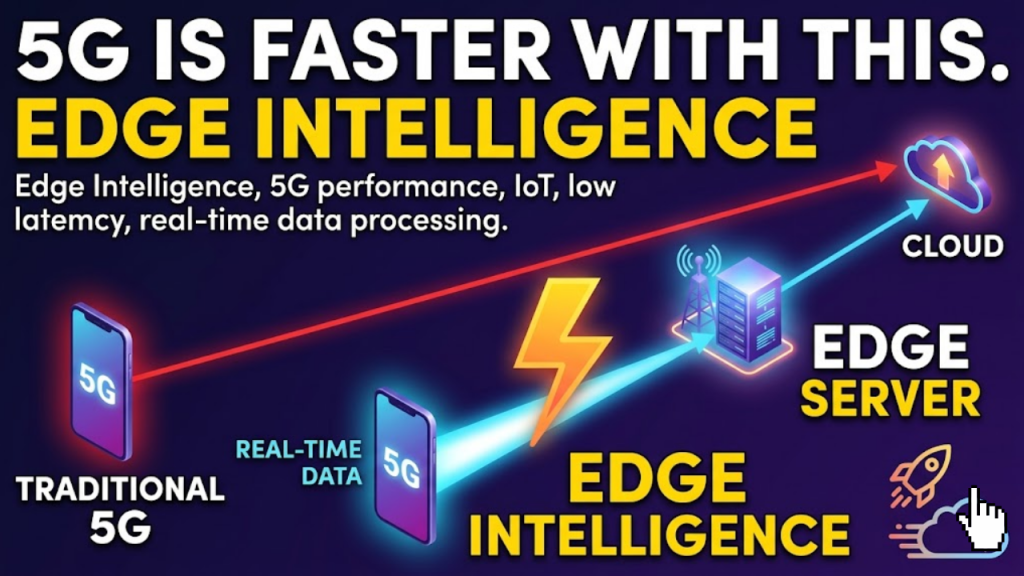
Edge Intelligence addresses the physical limits of data transmission speed. Even with 5G’s speed, sending raw data to a central cloud 500 miles away introduces a “speed of light” delay. In 2026, Edge Intelligence eliminates this by processing data at the Edge Node (like a 5G small cell) or the Endpoint (the device itself). This enables response times of less than 5 milliseconds, which is critical for safety-critical applications like autonomous driving and remote robotics.
The Performance Boost: 5G + Edge AI
In 2026, Gartner predicts that 75% of enterprise data will be processed at the edge, a massive shift from just 10% in 2018. This migration provides three specific performance advantages:
1. Near-Instantaneous Latency (URLLC)
5G introduces Ultra-Reliable Low-Latency Communications (URLLC), which targets end-to-end latency below 1 millisecond. Edge Intelligence utilizes this by performing AI inference locally.
- Result: Devices can make split-second decisions, such as a factory robot halting for an emergency or a drone avoiding a sudden obstacle, without waiting for a cloud response.
2. Bandwidth Offloading and Efficiency
5G can handle massive data, but streaming high-definition video from thousands of security cameras or sensors would still congest the network.
- Edge Impact: Edge Intelligence filters and analyzes data locally. Instead of sending 1TB of raw video to the cloud, the device only sends a small “alert” packet when it detects an anomaly (e.g., “Person detected in restricted zone”).
- Efficiency: This reduces backhaul congestion and minimizes unnecessary data transfer costs.
3. Extended Battery Life
Transmission is often the largest energy drain on a 5G device.
- Power Optimization: By processing data locally and only using the 5G radio for critical outputs, devices use significantly less power than those that constantly transmit raw data streams.
- Longevity: Research in 2026 shows that energy-aware partitioning between the device and the edge can extend battery life by up to 10 years for simple IoT sensors.
2026 Use Cases: Edge Intelligence in Action
| Industry | Edge Intelligence Application | Performance Gain |
| Automotive | V2X (Vehicle-to-Everything) | Real-time hazard sharing between cars with <10ms latency. |
| Manufacturing | Predictive Maintenance | On-site detection of machine faults to prevent downtime. |
| Retail | Customer Heatmapping | Instant in-store analytics without exposing customer privacy to the cloud. |
| Public Safety | Real-time Video Analytics | Millisecond detection of threats or fires directly at the camera node. |
Frequently Asked Questions (FAQ)
1. Is Edge Intelligence different from Edge Computing?
Yes. Edge Computing refers to the infrastructure (the hardware/servers at the edge), while Edge Intelligence refers to the AI/ML workloads running on that infrastructure to make smart decisions.
2. Does this affect 5G Standalone (5G SA) networks?
Yes. 5G SA removes the “LTE anchor” and connects devices directly to a 5G core, which further reduces signaling overhead and makes Edge Intelligence even more predictable and responsive.
3. Will my phone feel faster because of Edge Intelligence?
In 2026, yes. Applications like real-time language translation, AR navigation, and high-end gaming will offload complex AI tasks to a nearby 5G edge node, providing a lag-free experience that was previously impossible.
4. Why do I see an Apple Security Warning on my 5G IoT device?
If your 5G device attempts to share “Edge Intelligence” insights over an unencrypted local bridge or lacks proper certificate verification for the edge node, you may trigger an Apple Security Warning on your iPhone.
5. What is “eRedCap” in the 2026 context?
eRedCap (Enhanced Reduced Capability) is a 5G standard for industrial devices and wearables. It offers a middle ground: better power efficiency than full 5G but enough throughput to support modern edge-based AI products.
Final Verdict: Decentralized Speed
In 2026, the performance of 5G devices is no longer just about “bars” of signal. It is about how close the intelligence is to the data. By combining ultra-low-latency 5G with localized AI, Edge Intelligence ensures that devices can react to the world at the speed of thought.
Ready to explore the future of connectivity? Check out our guide on Converting Your WordPress Site into a PWA to see how edge caching improves mobile sites, or learn about the Impact of WebAssembly (Wasm) on Browser Performance.
Authority Resources
- MDN: Synergistic Impact of 5G on Cloud-to-Edge – Detailed technical breakdown of URLLC and eMBB.
- Ookla: 5G SA in 2026 – Latency and Resilience – Real-world performance data on standalone 5G rollouts.
- Digi: 5G Edge Computing for Industry 4.0 – Insights into industrial automation and robotics.
- floLIVE: Edge Computing in 2026 – Use Cases – Exploration of Edge AI and energy-aware architectures.