What is Quantum Networking?
Quantum networking is a framework that uses the principles of quantum mechanics, specifically entanglement and superposition, to transmit information encoded in quantum bits (qubits). Unlike classical networks that send 0s and 1s, quantum networks allow qubits to exist in multiple states simultaneously, enabling near-instant synchronization between remote nodes. In 2026, the technology has moved from lab experiments to Hybrid-Quantum infrastructure, where quantum processors are linked to create distributed computing clusters that far exceed the power of standalone systems.
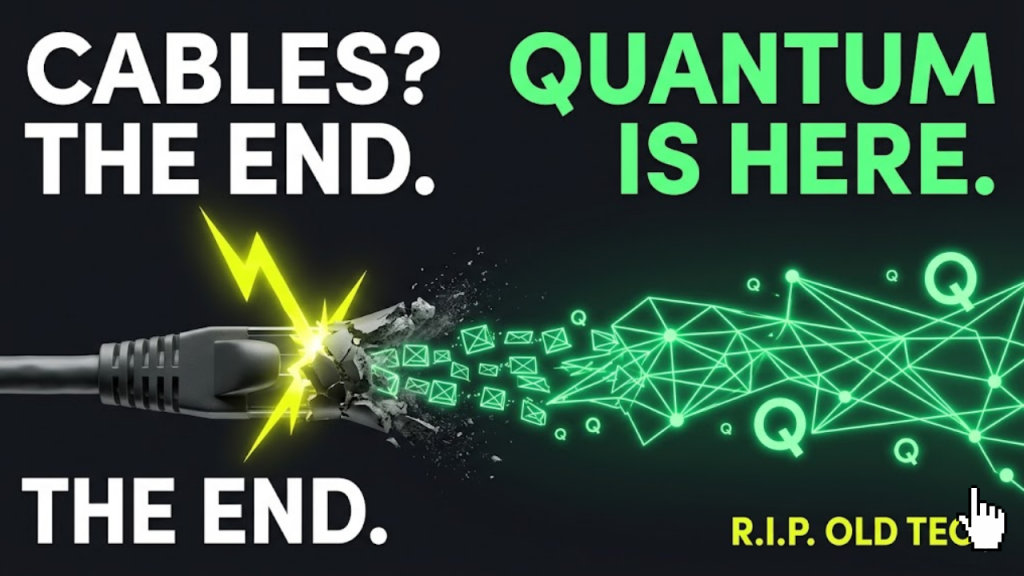
Is This the End of Traditional Cables?
No. In 2026, the “Quantum Internet” is not a replacement for traditional fiber optics; rather, it is a foundational upgrade that runs directly on top of them.
- Existing Infrastructure: Modern quantum hardware, such as the Cisco Universal Quantum Switch, is designed to operate at room temperature over standard telecom fiber that carries today’s internet traffic.
- The “Hybrid” Standard: By 2026, the industry has shifted toward integrated architectures where quantum processors handle high-complexity tasks (like drug discovery or cryptography) while classical systems handle data validation and problem decomposition.
- Complementary roles: Classical cables remain the most efficient way to transmit massive amounts of “symbolic” data (videos, websites), while quantum links are reserved for “physical” data states that require absolute security.
3 Reasons Quantum Networking is Transformative
The shift to quantum networking in 2026 is driven by three “Unbreakable” advantages:
1. Physically Unbreakable Security (QKD)
Traditional encryption relies on “computational difficulty” (math that is hard to solve). Quantum networking uses Quantum Key Distribution (QKD), which relies on the laws of physics. Any attempt to eavesdrop on a quantum transmission alters the state of the qubits, making the intrusion instantly detectable by both parties.
2. Distributed Quantum Computing
Single quantum computers are powerful but limited by qubit counts. Quantum networking allows multiple processors to be linked into a Quantum Computing Cluster, essentially creating a “super-processor” distributed across multiple locations.
3. High-Precision Quantum Sensing
Quantum networks enable spatially separated sensors to share quantum correlations. This dramatically improves measurement precision for applications like GPS-free navigation, earthquake detection, and high-fidelity medical imaging.
Frequently Asked Questions (FAQ)
1. Does information travel “faster than light”?
No. While entanglement is instantaneous, the “useful” information still requires a classical signal to decode the result. Therefore, quantum communication still obeys the universal speed limit of light.
2. Can I get a quantum internet connection at home in 2026?
Not yet. In 2026, deployments are focused on “Crown Jewel” links, connecting research institutions, national security agencies, and interbank transfer hubs.
3. What is a Quantum Repeater?
Unlike classical signals, qubits cannot be “copied” (due to the No-cloning theorem). Instead of a standard amplifier, a Quantum Repeater uses entanglement swapping to extend the reach of qubits over long distances (currently roughly 60 miles).
4. Why do I see an Apple Security Warning on my network tools?
If your diagnostic software attempts to monitor encrypted quantum-safe channels using legacy intercept methods, you may trigger an Apple Security Warning on your iPhone.
5. What is “Harvest Now, Decrypt Later”?
This is a threat where attackers capture today’s encrypted data to decrypt it once quantum computers become powerful enough. Quantum networking prevents this by using keys that are physically impossible to crack, regardless of future computing power.
6. Do we need specialized cooling for quantum networks?
While many quantum computers require cryogenic temperatures, 2026 breakthroughs like the Cisco Universal Quantum Switch operate at room temperature, making deployment significantly cheaper.
Final Verdict: The Birth of a New Backbone
In 2026, Quantum Networking hasn’t killed the traditional cable; it has given it a second life. By layering quantum security and synchronization over our existing fiber-optic world, we are building a “trust-less” global infrastructure where privacy is guaranteed by the universe itself.
Ready to secure your future? Explore our guide on Zero-Trust Architecture for Web Developers or learn about the Top Dev Skills Needed to Shine in 2026.
Authority Resources
- SLAC: Quantum Networking – The Dance of Qubits – Clear explanation of entanglement and photons.
- Cisco: Reaching the Milestone of the Universal Quantum Switch – Technical details on room-temperature quantum switching.
- Forbes: QKD Moves from Theory to Targeted Investment – Commercial adoption in banking and defense.
- Fujitsu: 2026 Predictions for Hybrid Quantum Infrastructure – The rise of integrated classical-quantum supercomputing.