
What is Bun?
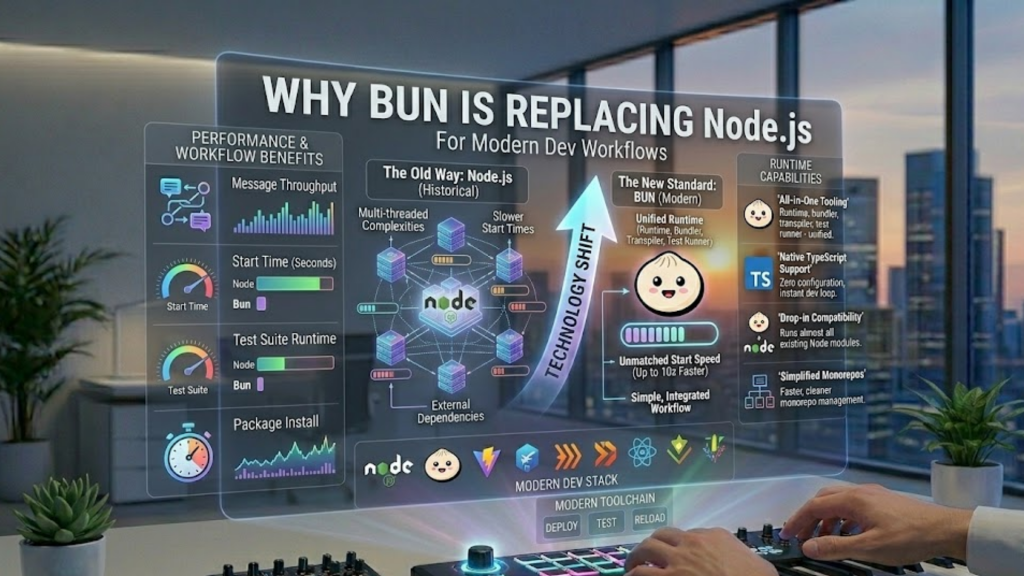
Bun is an all-in-one JavaScript runtime, package manager, and test runner designed for speed. In 2026, it has become the preferred choice for new projects, surpassing Node.js in developer adoption for greenfield applications. Unlike Node.js, which relies on a fragmented ecosystem of external tools like npm, jest, and tsc, Bun is a single binary that handles the entire development lifecycle natively.
The shift to Bun isn’t just about a new runtime; it is about the collapse of the “Toolchain Tax” that has slowed down web development for a decade.
3 Reasons Why Bun is Dominating 2026
The transition to Bun is driven by three “Velocity Pillars” that Node.js simply cannot match without massive architectural changes.
1. The “Zero-Wait” Package Manager
In 2026, bun install is the gold standard. While npm and yarn still struggle with complex dependency trees, Bun uses a binary lockfile and a global cache to install packages 20x to 30x faster than Node.js. For a developer, this means a “cold” project setup takes 2 seconds instead of 2 minutes.
2. Native TypeScript and JSX Support
One of the biggest frustrations with Node.js is the “Transpilation Gap.” To run TypeScript, you typically need ts-node or a build step with esbuild. Bun runs TypeScript (.ts) and JSX (.tsx) files directly out of the box. It uses the Zig programming language and the JavaScriptCore engine (from Safari) to parse and execute your code without an intermediate build step.
3. All-in-One Tooling (The Death of Boilerplate)
In 2026, modern dev workflows no longer require separate configurations for testing and bundling.
- Bun Test: Replaces Jest and Vitest with a built-in runner that is 10x faster.
- Bun Bundler: Replaces Webpack and Vite for many production builds, offering a unified API for generating production-ready assets.
Performance Comparison: Node.js vs. Bun
| Metric | Node.js (2026) | Bun (2026) |
| Runtime Engine | V8 (Google Chrome) | JavaScriptCore (Safari) |
| HTTP Requests/Sec | ~15,000 | ~65,000 (4x Faster) |
| Package Install | 10s – 60s | 0.5s – 3s |
| TypeScript Support | Via external tools | Native / Built-in |
| Test Runner | External (Jest/Vitest) | Built-in (Bun Test) |
Migrating from Node to Bun in 2026
Migrating is surprisingly easy because Bun is designed as a drop-in replacement for the Node.js API. Most existing Express, Fastify, or Hono applications work without a single line of code change.
- The Binary Switch: Instead of
node index.js, you simply runbun index.js. - The Script Switch: Replace
npm run devwithbun run dev. - Compatibility Layer: Bun supports 99% of the Node.js built-in modules (like
fs,path, andcrypto) and thenode_modulesstructure, ensuring your favorite 2026 libraries still work perfectly.
Frequently Asked Questions (FAQ)
1. Is Bun stable enough for production in 2026?
Yes. After the 2.0 release in late 2025, Bun resolved its early stability and memory leak issues. Major cloud providers like Vercel, AWS, and Railway now offer native Bun support as a first-class citizen.
2. Does Bun replace Vite?
For many projects, yes. Bun’s internal bundler is faster and simpler. However, if you rely on complex Vite plugins for a legacy React app, you may still want to use Vite on top of the Bun runtime.
3. Can I use Bun on Windows?
Yes. As of 2026, Bun has full, native Windows support with no performance penalties compared to Linux or macOS.
4. Why do I see an Apple Security Warning during Bun installation?
If you download the Bun binary via a non-secure curl command or if your Mac’s Gatekeeper hasn’t verified the specific local build, you may trigger an Apple Security Warning on your iPhone or Mac.
5. What is the biggest advantage for 2026 startups?
Reduced Cloud Costs. Because Bun is more memory-efficient and faster at handling HTTP requests, startups can often downgrade their server instances while maintaining the same user load, saving hundreds of dollars a month.
6. Does Bun support npm packages?
Yes. Bun is fully compatible with the npm registry. It even handles package.json and node_modules exactly like Node, but much faster.
7. What is JavaScriptCore?
It is the JavaScript engine developed by Apple for Safari. It is known for its fast startup times and low memory usage, which is why Bun chose it over Chrome’s V8 engine.
8. Should I learn Node.js or Bun first?
Learn the fundamentals of JavaScript first. Once you know the language, using Bun is identical to using Node, but you’ll enjoy a much smoother development experience.
Final Verdict: Speed is the New Standard
In 2026, Bun is no longer the “new kid” on the block; it is the industry standard for high-velocity teams. By unifying the toolchain and slashing execution times, Bun allows you to spend less time waiting for your computer and more time building the future.
Ready to upgrade your workflow? Explore our guide on Next.js 16 vs. Nuxt 4 to see how these frameworks run on Bun, or learn about the Top Dev Skills Needed to Shine in 2026.
Authority Resources
- Bun.sh: The Bun 2.0 Roadmap and Stability – The official source for the latest feature releases and performance data.
- Medium: Why Bun is Taking Over in 2026 – A deep dive into cloud cost savings and startup velocity.
- Stack Overflow: 2026 Developer Survey Results – Tracking the rise of Bun in the professional ecosystem.
- Node.js: The 2026 State of the Union – How Node.js is evolving to compete with newer runtimes.