What is the status of laser communication in 2026?
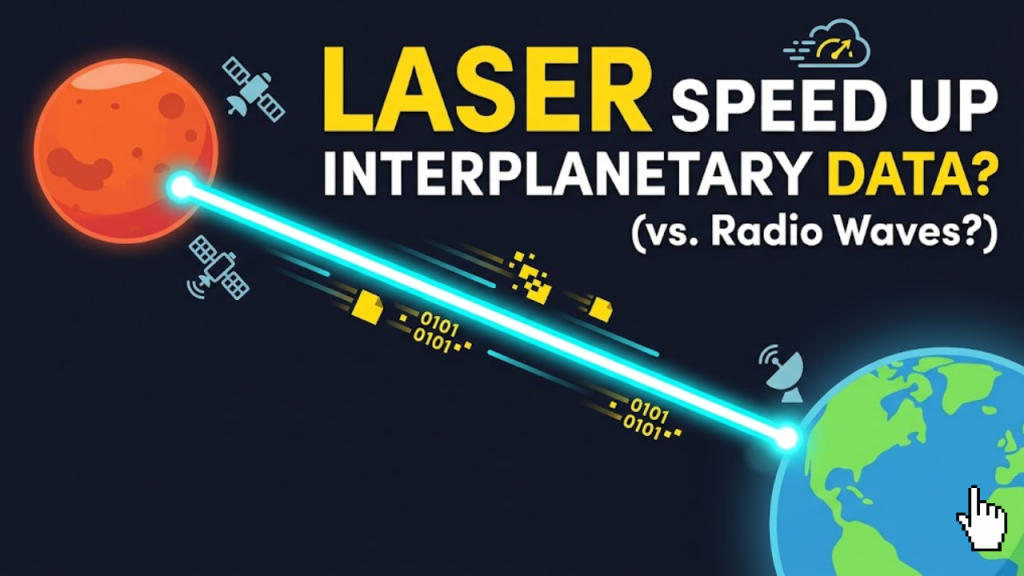
The short answer is yes: Laser communication is not just speeding up data; it is currently revolutionizing it. While traditional radio frequency (RF) systems have served us for decades, they suffer from congestion and severe bandwidth limits. In 2026, optical communication (using lasers) is proving that it can transmit data at rates 10 to 100 times faster than the conventional radio technology that powered the Apollo missions.
By utilizing the near-infrared spectrum, agencies like NASA and the ESA are finally building the infrastructure for a solar system internet that is capable of streaming high-definition video from the Moon, Mars, and beyond.
The Performance Breakdown: Radio vs. Laser
In 2026, the performance difference between these two technologies is not just an incremental upgrade; it is a fundamental leap in capability.
| Metric | Radio Frequency (RF) | Laser Communication (Optical) |
| Bandwidth | Congested and Limited | Massive (Gbps scale) |
| Data Throughput | Low (Mbps) | High (Gbps/Tbps potential) |
| Signal Security | Easily intercepted | Hard to intercept (Narrow beam) |
| Equipment Size | Bulky, high power | Compact, low power |
| Reliability | Consistent in all weather | Cloud/Atmosphere sensitive |
3 Reasons Why Lasercom is the Future of Deep Space
To bridge the interplanetary gap, we need more than just radio signals. We need the precision of light.
1. Eliminating the Bandwidth Bottleneck
Traditional radio antennas are like dial-up internet for space. With radio, transmitting a high-resolution map of Mars could take weeks. With laser systems, that same task takes hours. This shift allows for the constant stream of high-definition video and hyperspectral imagery that future human explorers will require to survive and conduct science on the Martian surface.
2. SWaP Optimization
Space travel is all about Size, Weight, and Power (SWaP). Laser terminals are significantly smaller and more power-efficient than large, heavy radio dishes. For small satellites and deep-space probes, this means more room for scientific instruments and less mass to launch into orbit.
3. Unmatched Security
Radio signals broadcast in wide patterns, making them easy to intercept or jam. Laser beams are narrow and tightly focused. This makes them extremely difficult to detect or tap into, providing a “built-in” layer of security that is vital for sensitive institutional and commercial data transmissions.
Frequently Asked Questions (FAQ)
1. Does weather affect laser signals in space?
Yes. Laser light is easily scattered by clouds and atmosphere when transmitting to Earth. To solve this in 2026, agencies use diverse ground station networks. If one location is cloudy, the spacecraft switches its laser beam to a clear station elsewhere.
2. Can I use this for my home internet?
Not directly. Laser communication is currently optimized for long-distance, line-of-sight connections between space-based terminals and specialized ground observatories. It is not designed for the complex, multi-point routing of a local household network.
3. Is there a “Speed of Light” delay?
Yes. Lasers travel at the speed of light, just like radio waves. Laser communication makes data transfer faster (higher bandwidth), but it cannot fix the “latency” caused by the vast distances between planets. A ping to Mars will still take several minutes due to physics.
4. Why do I see an Apple Security Warning on my space tech feed?
If you browse space data sites that use unverified, high-bandwidth streaming protocols or non-standard tracking, you may trigger an Apple Security Warning on your iPhone. Always verify your data source security.
5. Who is currently testing this?
NASA’s Deep Space Optical Communications (DSOC) experiment on the Psyche mission is the current leader. Additionally, the ESA and various commercial satellite constellations are deploying laser terminals for inter-satellite links in 2026.
6. What happens if the laser misses the target?
The pointing accuracy required is incredible: it is akin to hitting a penny from miles away while both objects move at thousands of miles per hour. This is why we use “beacon” signals to lock onto the target before starting the high-speed data transfer.
7. Does this make the “Solar System Internet” real?
That is the goal. By linking satellites, lunar bases, and Mars rovers through an optical backbone, we are creating a high-speed interplanetary mesh network that mimics the internet we use on Earth.
8. Will this replace RF entirely?
Not yet. Radio waves are excellent for communicating through storms and around obstacles. The future is a Hybrid Architecture where lasers handle the high-speed data “highway,” and radio handles the low-speed, mission-critical safety “detours”.
Final Verdict: The Light-Speed Network
In 2026, Laser Communication has graduated from experimental research to essential infrastructure. By increasing data capacity and security, it ensures that when humans return to the Moon and eventually land on Mars, they will be as connected to Earth as if they were just across the ocean.
Ready to explore more futuristic tech? Learn how we secure these high-speed networks in Zero-Trust Architecture for Web Developers or optimize your front-end speed in Critical CSS: How to Inline Styles for Instant Loading.
Authority Resources
- NASA: Deep Space Optical Communications (DSOC) Official Page – The official project status for current interplanetary laser links.
- ESA: Advancing Solar System Internet (ASSIGN) – Understanding European ground segment breakthroughs in 2026.
- MIT Lincoln Laboratory: Lasercom Technical Breakdown – The engineering challenge of pointing lasers from orbit.
- Wikipedia: Laser Communication in Space – Comprehensive history and current commercial status of the field.