What is the Internet of Everything (IoE)?
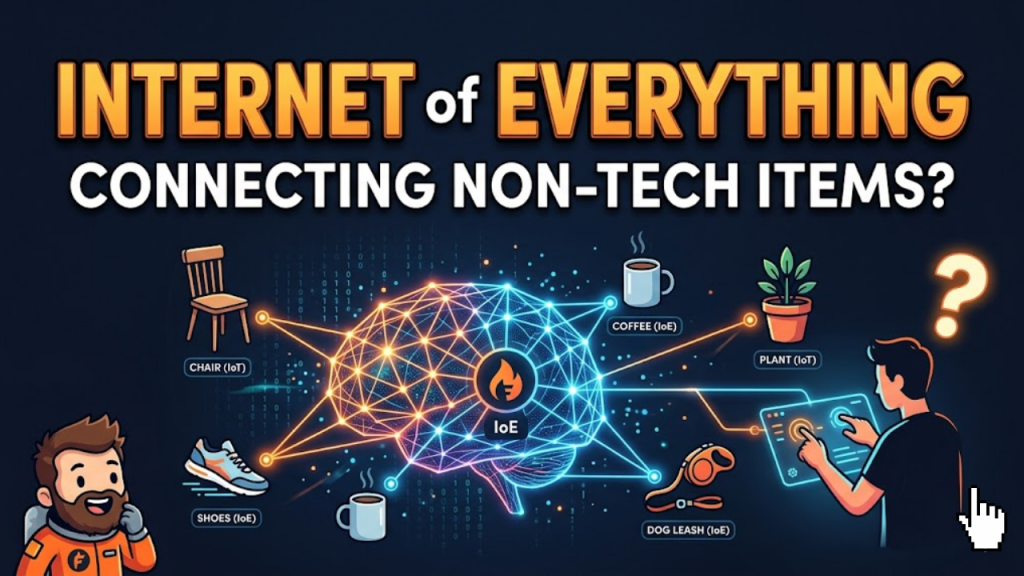
The Internet of Everything describes the networked connection of people, processes, data, and things. While the Internet of Things (IoT) focuses specifically on physical devices, IoE acts as a superset. In 2026, IoE provides the intelligence that links these physical devices with human behavior and business processes. This connection transforms “non-tech” items, such as bridges, crops, or even retail shelves, into intelligent data sources that can inform complex decision-making.
By turning the physical world into a digital feedback loop, IoE allows businesses to move from simple connectivity to actionable intelligence.
The 4 Pillars of IoE
To understand how IoE connects everything, we look at the four pillars that Cisco originally defined. These work together to make the “dumb” world “smart”.
| Pillar | What it Connects | Purpose |
| People | Users and employees | Enhancing collaboration and decision-making |
| Process | Business workflows | Delivering the right info to the right place |
| Data | Raw information | Converting bits into intelligent insights |
| Things | Sensors and physical objects | Sensing and controlling the environment |
Connecting Non-Tech Items: The “Sensor Strategy”
You might wonder how a non-tech item, like a shipping pallet or a city park bench, becomes part of this network. The process relies on three specific technologies.
1. Sensing (The Eyes and Ears)
The first step is attaching low-cost sensors to non-tech items.
- Example: A simple wooden pallet in a warehouse is fitted with an RFID tag or a vibration sensor. Suddenly, the pallet is no longer just wood; it is a data point that can report its location, temperature, and handling history.
2. Connectivity (The Nervous System)
Once the item can “sense,” it needs a way to talk to the network.
- Example: In 2026, we use low-power networks like LoRaWAN or Private 5G. These networks allow thousands of “dumb” items to send tiny data packets back to the cloud without needing a constant power source or expensive Wi-Fi setup.
3. Intelligence (The Brain)
The raw data from these items is useless without context.
- Example: An AI model analyzes the vibration data from that wooden pallet. It realizes the pallet is vibrating too much, which predicts that the items inside are being damaged. The system then alerts the warehouse manager to adjust the handling process. The non-tech item has now successfully initiated a business process improvement.
Frequently Asked Questions (FAQ)
1. Is IoE just a rebranding of IoT?
Not exactly. While they overlap, IoT is a subset of IoE. IoT focuses on the connection of physical devices (the “things”). IoE is the broader framework that includes how those devices interact with human actions, corporate processes, and massive data streams.
2. Can IoE secure my legacy non-tech hardware?
Yes, but you need a Zero-Trust approach. Since old equipment lacks modern security, you must isolate these items on a separate network segment and use identity-based access control to prevent them from becoming attack vectors.
3. Why do I see an Apple Security Warning when connecting smart items?
If your mobile app attempts to connect to a legacy sensor or an unverified network gateway that doesn’t use modern encryption, you may trigger an Apple Security Warning on your iPhone.
4. What are the top industries for IoE in 2026?
Healthcare (patient monitoring), Smart Cities (traffic and energy management), and Supply Chain (real-time inventory) are currently the highest-growth sectors for IoE technology.
5. Does IoE require a 5G connection?
Not always. While 5G is great for high-bandwidth tasks, many IoE connections (like soil sensors) use NB-IoT or LoRaWAN, which are much lower-power and slower but offer incredible battery life and range.
6. Is data privacy a concern in IoE?
Major concern. Because IoE connects people and processes, it collects massive amounts of personal and operational data. Adhering to GDPR 2.0 and ensuring end-to-end encryption is a non-negotiable requirement for any IoE deployment.
7. What is “Edge Intelligence”?
In 2026, we no longer send all sensor data to the cloud. Edge Intelligence means the device (the “thing”) processes data locally to make decisions in real-time, reducing bandwidth costs and response times.
8. How do I start a career in IoE?
Focus on Systems Architecture and Data Integration. Learning how to map physical workflows to digital systems is a rare and highly paid skill in the current market.
Final Verdict: Connecting the Unconnected
The Internet of Everything turns the physical world into a digital asset. By connecting non-tech items through sensors and smart data processing, we unlock new efficiencies and business models. For developers, this is the ultimate frontier: the chance to build systems that interact directly with the real world.
Ready to secure the systems that run our world? Explore our guide on Zero-Trust Architecture for Web Developers or learn how to optimize your web performance in Interaction to Next Paint (INP): The New Core Web Vital.
Authority Resources
- Cisco: What is the Internet of Everything? – The foundational source for the IoE conceptual framework.
- IEEE: The Future of IoE and Intelligent Connectivity – Academic research on the evolution of connectivity through 2026.
- IoT For All: Connectivity Trends 2026 – A practical look at the infrastructure (5G, LoRaWAN) powering IoE.
- GeeksforGeeks: Difference between IoE and IoT – Detailed breakdown of the pillars of IoE versus IoT.