What is JavaScript Pattern Matching?
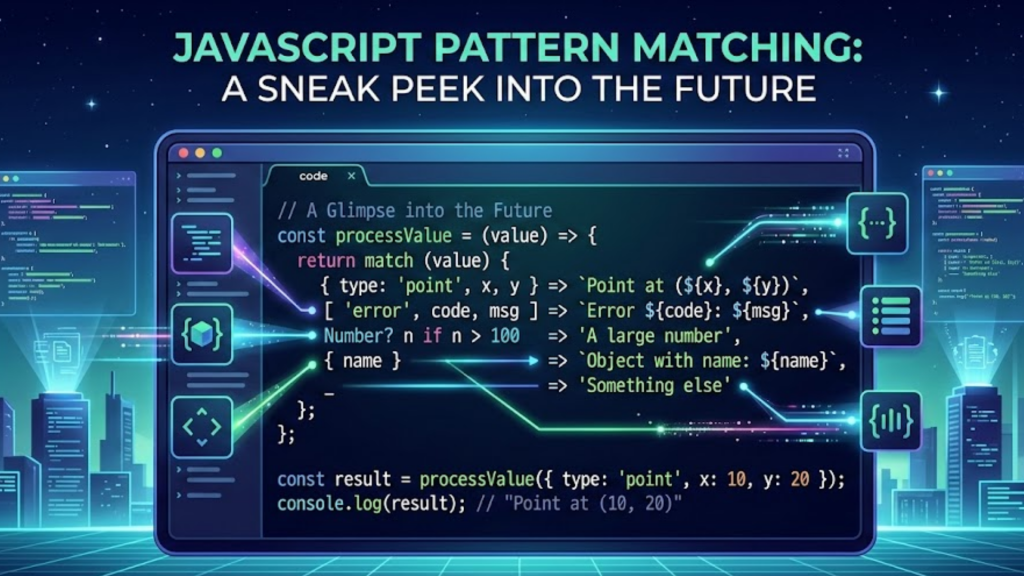
JavaScript Pattern Matching is a major upcoming language feature that introduces the match expression. In 2026, this feature has advanced to Stage 3 of the TC39 process, meaning the design is complete and it is awaiting final implementation by browser vendors. Unlike the traditional switch statement, which only checks for simple equality, match allows you to check the structure and contents of objects and arrays simultaneously.
This move brings JavaScript closer to functional languages like Rust and Scala, enabling you to write declarative code that is virtually impossible to break with accidental “fallthrough” bugs.
Why match is the Successor to switch
In 2026, developers are moving away from imperative logic toward Expression-Based coding. The match syntax solves the “Footgun” problems that have plagued switch for decades.
| Feature | Traditional switch | Future match (2026) |
| Logic Style | Imperative Statement | Declarative Expression |
| Returns Value | No (Must assign to variable) | Yes (Directly assignable) |
| Fallthrough | Yes (Source of many bugs) | No (Implicitly safe) |
| Deep Matching | No (Simple values only) | Yes (Objects, Arrays, Types) |
| Scoping | Ambiguous/Shared | Block-Scoped (Private variables) |
3 Real-World Use Cases for Pattern Matching
In 2026, the match syntax has become the “clean code” standard for three specific development scenarios.
1. API Response Handling
Instead of checking response.status and then destructuring the body, you can match against the entire response object in one go.
- The Strategy: Match for
{ status: 200, data }to handle success, or{ status: 404 }to trigger a “Not Found” UI, all within a single block of code.
2. Form State Management
In complex 2026 apps, forms can be in many states: idle, submitting, error, or success.
- The Implementation: Use
match(formState)to render the correct UI component based on whether the state is an object with an error message or a success payload.
3. Deep Data Extraction
Pattern matching allows for “Pinpoint Destructuring.” You can verify if an object has a nested property—like user.profile.settings.theme—and bind that value to a local variable only if the structure matches perfectly.
Frequently Asked Questions (FAQ)
1. When can I use Pattern Matching in browsers?
As of March 2026, it is at Stage 3. While not yet native in all browsers, you can use it today via Babel with the @babel/plugin-proposal-pattern-matching.
2. Is match faster than if-else?
For simple values, switch and if-else remain slightly faster because they are easier for engines to optimize into jump tables. However, for complex objects, match is more efficient because it performs structural checks in a single pass.
3. What is the “Exhaustiveness Check”?
In 2026, many IDEs and linters use the match syntax to warn you if you have forgotten to handle a potential case (e.g., you handled 200 and 404 but forgot 500). This “Safety Check” is a hallmark of the new syntax.
4. Why do I see an Apple Security Warning during build?
If your build tools attempt to download unverified TC39 experimental polyfills from non-secure mirrors, you may trigger an Apple Security Warning on your iPhone or Mac.
5. Does match support custom logic?
Yes! The proposal includes Custom Matchers (via Symbol.customMatcher). This allows you to define your own rules for what counts as a “match” for your specific business objects.
6. Will switch be removed from JavaScript?
No. switch will remain for backwards compatibility and for very simple value-based branching where its legacy syntax is already established.
7. Can I use Pattern Matching with React?
Absolutely. Since match is an expression, it is perfect for Conditional Rendering inside JSX. You can assign the result of a match directly to a variable and render it in your component.
8. What is the _ (Underscore) pattern?
The underscore is the “Wildcard” or default case. It matches anything that wasn’t caught by previous arms, acting as the modern replacement for the default: label in a switch.
Final Verdict: Functional Stability for the Modern Web
In 2026, JavaScript Pattern Matching is the final piece of the functional programming puzzle. By adopting this syntax, you eliminate entire categories of “undefined” and “null” errors, resulting in codebases that are not only cleaner but significantly more resilient.
Ready to try the future? Explore our guide on Building Backendless Apps with Server Functions to see how to use match for data flow, or learn about Top Dev Skills Needed to Shine in 2026.
Authority Resources
- TC39: Pattern Matching Proposal (Official Repo) – The primary source for the language specification and syntax.
- Medium: ES2025 Shocker – Native Pattern Matching – Breaking news on the Stage 3 advancement and use cases.
- The New Stack: ES2026 Solves JS Headaches – A look at the broader 2026 roadmap for the language.
- Barış Güler: What if “switch” did not exist? – A philosophical and technical comparison of control structures.