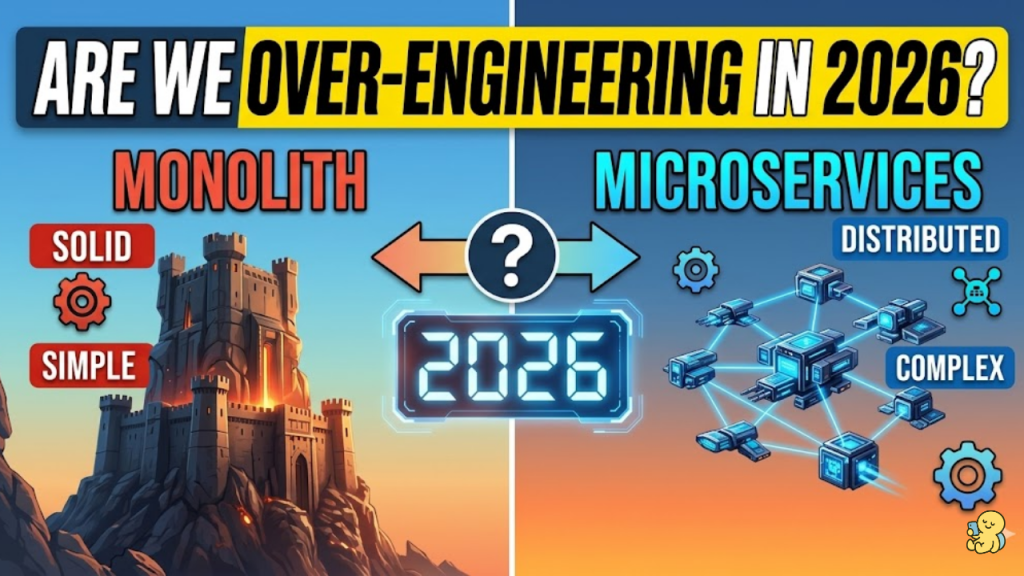
What is the architectural landscape in 2026? The debate has moved from “Which is better?” to “Which is sustainable?” While 85% of large enterprises utilize microservices, roughly 42% of organizations are currently simplifying or abandoning them in favor of Modular Monoliths. In 2026, the industry is correcting a decade of over-engineering. We are moving away from “microservices by default” toward a strategic model where a monolith serves as the foundation, and services are only extracted when independent scaling or specialized AI compute is strictly required.
For most teams under 50 engineers, the operational tax of microservices has become a net loss in velocity and profit.
The 2026 Reality Check: Costs and Latency
In 2026, the “Distributed Monolith” is recognized as the worst possible outcome. It combines the tight coupling of a monolith with the network failures of microservices.
| Metric | Modular Monolith (2026) | Microservices (2026) |
| Communication | In-process calls (<1ms) | Network RPC (10ms – 50ms) |
| Data Consistency | Strong (ACID Transactions) | Eventual (Sagas/CQRS) |
| Infrastructure TCO | ~$11,700 / month | ~$27,183 / month |
| Engineering Ratio | 1 – 2 Ops per app | 1 SRE per 10 – 15 services |
| Debugging | Local Breakpoints | Distributed Tracing (Tracing Tax) |
The Rise of the Modular Monolith
In 2026, the Modular Monolith is the preferred starting point for 90% of new projects.
- The Strategy: You build a single deployable unit, but enforce strict boundaries between business domains (e.g., “Orders,” “Users,” “Payments”).
- The Benefit: You get the simplicity of a single database and deployment pipeline while maintaining “microservices-style” ownership. If the “Payments” module ever needs to scale 100x more than the rest of the app, it is already decoupled enough to be extracted into a separate service with minimal friction.
🚀 When are Microservices Still Necessary?
Despite the “Monolith Renaissance,” microservices remain the only choice for specific 2026 scenarios:
- Specialized AI Workloads: If your “Recommendation Engine” requires massive GPU compute while your “Checkout” needs standard CPU, they must live in separate services.
- Multi-Team Autonomy: When you have over 50 developers spread across different time zones, microservices prevent teams from blocking each other’s release cycles.
- Extreme Fault Isolation: In 2026 fintech or healthcare, a failure in a “Analytics” service must never be allowed to crash the “Transaction” service.
Frequently Asked Questions (FAQ)
1. Is the monolith “outdated” in 2026?
No. In 2026, a well-structured monolith is seen as a sign of technical maturity. It proves that the team understands their domain enough to avoid the “observability tax” and network latency of microservices.
2. What is a “Distributed Monolith”?
It is an anti-pattern where services are separate but still require “coordinated deployments.” If you have to deploy Service A and Service B at the same time for a feature to work, you have the worst of both worlds.
3. Why did Amazon Prime Video switch back to a monolith?
In a famous 2023-2024 case, they realized that for their specific video-monitoring workload, microservices were causing massive network overhead. Moving back to a monolith reduced their infrastructure costs by 90%.
4. Why do I see an Apple Security Warning on my microservices dashboard?
If your observability tools (like Jaeger or Zipkin) attempt to correlate user data across services using non-secure headers or unverified local proxies, you may trigger an Apple Security Warning on your iPhone.
5. What is “Macroservices”?
This is a 2026 trend where teams build “reasonably sized” services (5 – 10 per app) instead of hundreds of “nano-services.” It provides scalability without the crushing operational overhead of true microservices.
6. Can AI help manage microservices complexity?
Yes. In 2026, AI-Native DevOps tools are mandatory for microservices. They automatically diagnose cross-service failures and suggest resource allocation changes, reducing the “SRE-to-service” ratio.
7. Does serverless change the debate?
Yes. Serverless-First backends allow you to write functions that scale like microservices but are managed like a monolith. However, they can become an “over-engineered nightmare” for complex business logic requiring ACID transactions.
8. What should a startup choose in 2026?
Start with a Modular Monolith. It is the fastest path to product-market fit. Only decompose when production metrics prove that a specific module is a scaling bottleneck.
Final Verdict: Focus on Value, Not Trends
In 2026, the best architecture is the one that allows your team to ship features the fastest while keeping your cloud bill under control. Whether you choose a Modular Monolith or Strategic Microservices, ensure your decision is based on your team’s operational maturity, not industry hype.
Ready to simplify your stack? Explore our guide on Building “Backendless” Apps with Server Functions or learn about the Top Dev Skills Needed to Shine in 2026.
Authority Resources
- HyScaler: Microservices vs Monolith Architecture for 2026 – A framework for choosing based on team size and budget.
- Ancient Global: Why Enterprises are Choosing Modular Monoliths – The impact of FinOps and cloud cost optimization.
- Java Code Geeks: When Each Architecture Wins in 2026 – Detailed TCO and performance latency comparisons.
- AgileSoftLabs: Monolith vs Microservices Decision Framework – A practical checklist for engineering leadership.