What is Distributed SQL in 2026?
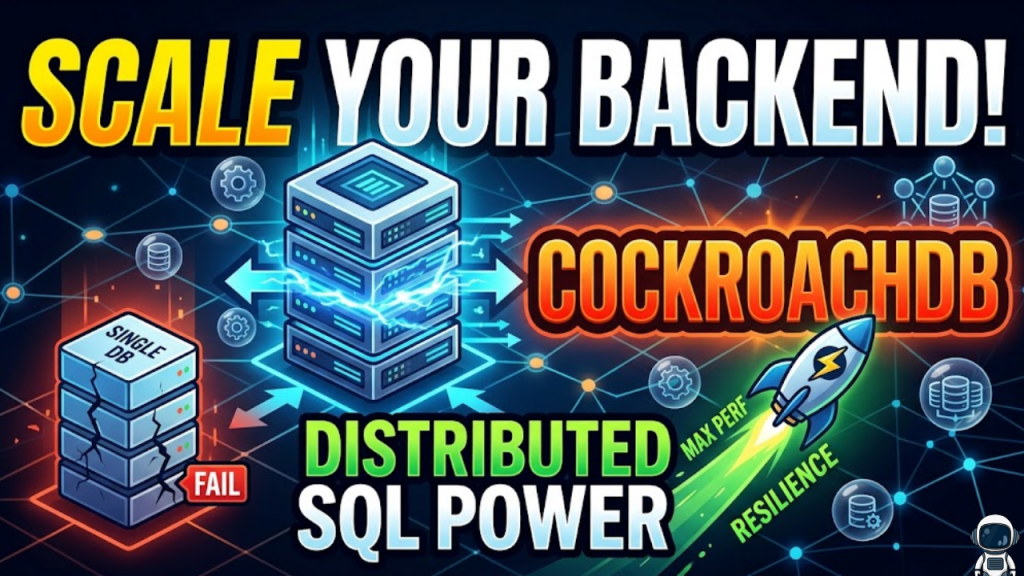
Distributed SQL is a cloud-native database architecture that combines the reliability of a traditional relational database (ACID compliance) with the infinite horizontal scalability of NoSQL. In 2026, CockroachDB has set a new industry benchmark by supporting 300-node clusters and 1 petabyte (PB) of data per cluster. Unlike older systems that require “manual sharding” (splitting data by hand), CockroachDB automatically distributes data across nodes and regions while keeping it perfectly consistent.
In the era of AI-driven applications, where agents read and write shared state simultaneously across the globe, Distributed SQL is no longer a luxury; it is a requirement for survival.

3 Pillars of Distributed Scale in 2026
To scale a backend that handles billions of transactions, you must move beyond the “Primary-Replica” mindset.
1. The Raft Consensus Algorithm
In 2026, data safety is handled by the Raft consensus protocol. Every piece of data is replicated across at least three nodes. A “Write” is only confirmed once a majority (quorum) of nodes agree. This ensures that even if an entire data center goes dark, your database remains online and your data remains accurate.
2. Multi-Region Data Domiciling
Global regulations like GDPR and new 2026 data residency laws require data to stay in specific countries.
- The Strategy: Use CockroachDB’s Regional Tables. You can “pin” a German user’s data to a Frankfurt node while a Brazilian user’s data stays in São Paulo. This reduces latency to near-zero and ensures you stay legally compliant.
3. Online Schema Changes
In 2026, “Maintenance Windows” are a thing of the past.
- The Strategy: CockroachDB allows you to add columns or change indexes while the database is under full load. This “Zero-Downtime Migration” capability is why fintech and gaming giants have moved away from traditional PostgreSQL.
Distributed SQL vs. Traditional RDBMS (2026)
The architectural trade-offs in 2026 are focused on Consistency vs. Latency. While traditional SQL is faster for local, single-region tasks, it fails as soon as you “break the boundaries” of a single data center.
| Feature | Traditional SQL (Postgres/RDS) | CockroachDB (Distributed SQL) |
| Scalability | Vertical (Bigger server) | Horizontal (More nodes) |
| Failover | Manual/Fragile scripts | Automatic (Self-healing) |
| Consistency | Local only | Global (Strict Serializability) |
| Data Locality | Hard to manage | Native (Row-level pinning) |
| AI Workload | Struggles with high concurrency | Validated for 1B+ transactions |
Frequently Asked Questions (FAQ)
1. Is CockroachDB compatible with my current code?
Yes. It is PostgreSQL compatible. You can use your existing Postgres drivers, ORMs, and tools. Most developers can migrate their local dev environment to a distributed cluster in a single afternoon.
2. What is the “Survival Goal” in 2026?
This is a setting where you tell the database to survive the loss of a Node, an Availability Zone, or even a Region. The database will automatically rearrange itself to keep the data available based on your priority.
3. Does Distributed SQL cost more?
While the infrastructure cost might be higher, the Total Cost of Ownership (TCO) is often lower. Because it eliminates the need for expensive “DBAs” to manually shard data or manage failover, your team can focus on building features.
4. Why do I see an Apple Security Warning on my DB Console?
If you are accessing the CockroachDB Console over a non-secure connection or using an unverified self-signed certificate in your local Kubernetes cluster, you may trigger an Apple Security Warning on your iPhone.
5. What is the “1PB Milestone”?
In February 2026, Cockroach Labs validated support for 1 Petabyte per cluster. This is essential for AI companies that are now storing massive amounts of “Vector” and “Agentic” data in a single, consistent store.
6. Can I run CockroachDB on my own hardware?
Yes. You can run it on-prem, in the cloud, or in a Hybrid configuration. It is cloud-agnostic, meaning you aren’t locked into a single provider like AWS or Azure.
7. How does it handle “Hot Spots”?
CockroachDB uses Automatic Load Balancing. If one node gets too busy (a “hot spot”), the system automatically moves pieces of data (Ranges) to other nodes to even out the pressure.
8. What is “Serverless Distributed SQL”?
It is a pricing model where you only pay for the storage and the SQL requests you use. In 2026, this is the preferred way for startups to get “big tech” scaling capabilities without the high upfront cost.
Final Verdict: Scale When Others Fail
In 2026, your database is either a bottleneck or a backbone. By adopting Distributed SQL and CockroachDB, you ensure that your backend can survive disasters, respect global laws, and scale to petabyte levels without ever needing to re-architect your application.
Ready to modernize your data layer? Explore our guide on Zero-Trust Architecture for Web Developers or learn about the Impact of WebAssembly (Wasm) on Browser Performance.
Authority Resources
- CockroachDB: What is Distributed SQL? – The definitive evolution of the database.
- Simplyblock: Scalable SQL with CockroachDB – Technical breakdown of Raft, replication, and performance.
- PingCap: Why Distributed SQL Elevates Modern App Dev – Exploring the parallel processing and high availability benefits.
- ResearchGate: Globally Distributed vs. Traditional RDBMS – A deep architectural analysis of trade-offs.