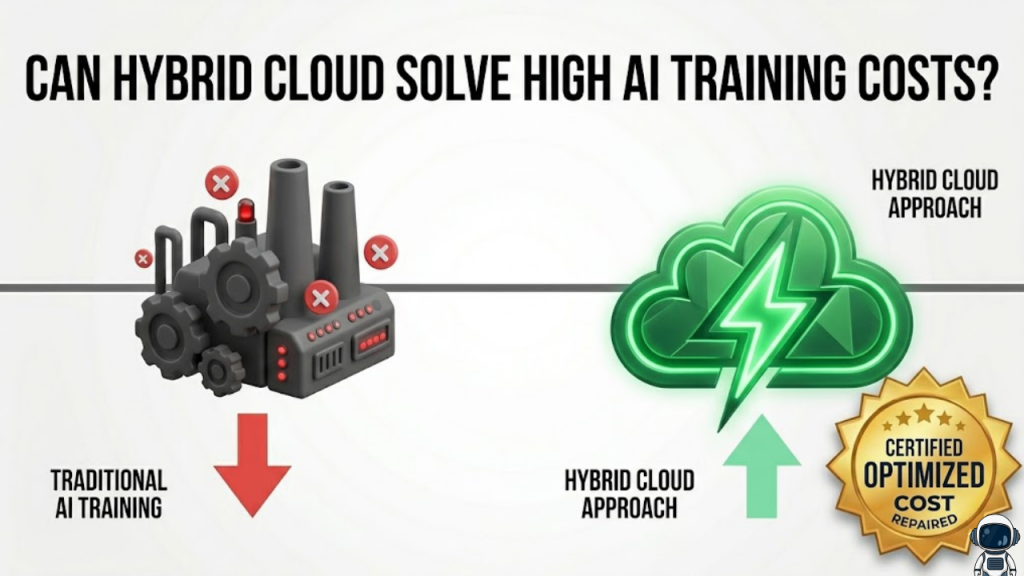
The short answer is yes. In 2026, hybrid cloud models have emerged as the definitive solution for the “Rent-Seeking” trap of public clouds. By keeping steady-state AI workloads on private infrastructure while “bursting” to the public cloud for peak training demands, organizations can reduce their Total Cost of Ownership (TCO) by up to 50% to 18x per million tokens.
The shift in 2026 is away from “Cloud-First” and toward “Sovereign-First” architectures, where data gravity and token economics dictate where a model should live.
The 2026 AI Economic Shift: Own vs. Rent
In 2026, the industry has moved from measuring “FLOPS” to measuring “Tokens Per Second per Dollar” (TPS/$). This metric has revealed a massive efficiency gap between owning hardware and renting it.
| Feature | Public Cloud Only (AWS/Azure) | Hybrid Cloud Model (2026) |
| Cost Predictability | Low (Consumption-based spikes) | High (Fixed CapEx + Variable Cloud) |
| Breakeven Velocity | Never (Ongoing rent) | ~4 Months for high-utilization |
| Data Egress Fees | High (Moving datasets is costly) | Zero (Data stays close to compute) |
| Hardware Access | Latest (B200/B300) available | Hybrid (B200 On-prem + Cloud Burst) |
| Governance | Complex (Compliance risks) | Strong (Sensitive data stays on-prem) |
3 Strategies to Solve AI Costs with Hybrid Models
To succeed in 2026, your hybrid strategy must be “Agentic” and automated.
1. The “Steady-State” Anchor
For “workhorse” models (7B to 70B parameters) that require continuous fine-tuning or high-throughput inference, owning the infrastructure is now significantly cheaper.
- The Strategy: Use on-premises nodes (like NVIDIA L40S or Blackwell systems) for 80% of your daily predictable load. This eliminates the “Idle Time” tax charged by hourly cloud providers.
2. Intelligent Bursting
When you need to train a massive “Trillion-Parameter” model for a short window, the public cloud is still king.
- The Strategy: Use a unified control plane (like Kubernetes-native stacks) to “burst” to public cloud GPUs only when your on-prem capacity is at 100%. This provides the elasticity you need without the 24/7 “rental” cost.
3. Eliminating “Data Gravity” Costs
Moving petabytes of data to the cloud for training can cost more in egress fees than the actual GPU time.
- The Strategy: Build a Sovereign Cloud or local private cluster where your data already lives. In 2026, models perform best when they operate close to their data sources, reducing both latency and the “Egress Tax”.
Frequently Asked Questions (FAQ)
1. Is it cheaper to build an AI cluster on-prem in 2026?
For sustained workloads with over 20% utilization, yes. On-premises hardware can reach a breakeven point against cloud providers in as little as four months.
2. What is “Token Economics”?
It is the 2026 framework for measuring AI ROI. Instead of server uptime, companies now track the cost of generating one million tokens. Owning infrastructure can offer up to an 18x cost advantage in this metric.
3. Can small companies afford hybrid AI?
Yes. With the rise of GPU-as-a-Service (GPUaaS) and localized “Sovereign Clouds,” SMEs are growing their hybrid adoption at 17% annually.
4. Why do I see an Apple Security Warning on my AI dashboard?
If your hybrid management tool attempts to access hardware BIOS or secure enclaves on an Apple device without proper certificates, you may trigger an Apple Security Warning on your iPhone.
5. What hardware is best for on-prem AI in 2026?
The NVIDIA L40S is the current TCO champion for medium models, while the Blackwell (B200/B300) architecture is required for the “Trillion-Parameter” era.
6. Does hybrid cloud help with AI compliance?
Absolutely. In 2026, regulated industries (Healthcare/Finance) use hybrid models to keep sensitive PII (Personally Identifiable Information) on private servers while using the cloud for anonymized compute.
7. What is “Spot Training”?
This involves using “Preemptible” or “Spot” instances in the public cloud, which are up to 70% cheaper, for training runs that can be safely interrupted and resumed from a checkpoint.
8. What is the biggest challenge of hybrid AI?
Complexity. Managing “two horses” (on-prem and cloud) requires a unified lifecycle approach and a mature FinOps team to prevent visibility gaps and overspending.
Final Verdict: Alignment Over Adoption
In 2026, the question isn’t “Cloud or On-Prem,” but rather “What goes where?” By using a hybrid cloud model, you gain the freedom to place workloads where they make the most sense financially, operationally, and legally.
Ready to optimize your AI spend? Explore our guide on Zero-Trust Architecture for Web Developers to secure your hybrid connections, or learn about the Top Tech Careers to Start in 2026.
Authority Resources
- Lenovo Press: On-Premise vs Cloud – Generative AI TCO 2026 – Definitive financial analysis of AI hardware vs. cloud rent.
- Verinext: Where Hybrid AI Architectures Will Win in 2026 – Strategic insights into data gravity and cost predictability.
- AppVerticals: AI Cloud Cost Statistics and Trends 2026 – Comprehensive market share and price-performance metrics.
- CACI: Cloud Cost Optimisation Strategies for 2026 – Practical FinOps roadmap for structural and architectural savings.